






A full polishing range.
From cutting and one-step correction to final finishing.
Specialist chemistry. Expert application.
 QUARTZ99 / CERAMIC BASE COAT
The foundation of your coating system.
A layerable quartz base coat designed for mechanical protection. Pair it with a suitable top coat to create the final finish.
For application by NANOLAB certified installers only.
Four formulas. Extended working time. Find the coating for your finish.
Explore the BEAST family of ceramic coatings.
Find the coating for each exterior surface.
 PPF & VINYLGLOSSProtection for glossy films and wraps.Discover
 MATTE & SATINMATTEProtection that respects the finish.Discover
 GLASSWINDOWSExplore dedicated glass protection.Discover
 WHEEL PROTECTIONWHEELSA dedicated coating for your wheels.Discover
 TRIM PROTECTIONPLASTICProtection for plastic surfaces.Discover
Dedicated care for the surfaces inside.
 LEATHER SURFACESLEATHERDiscover NANOLAB leather protection.Discover PLASTIC SURFACESPLASTICProtection for interior plastic surfaces.Discover TEXTILE SURFACESFABRICExplore the latest fabric formulation.Discover
Spray protection, maintenance and upcoming wash products.
 MAINTENANCEBEAST 365Explore the BEAST maintenance range.Discover
Next in washing, cleaning & care.
Ceramic protection for boats and yachts.
An easy-to-apply ceramic coating with an established track record on boats and yachts around the world.
Results vary with surface preparation, exposure and maintenance.
Read 50 MARINE guides →Explore MARINEProtection for the surfaces you live with.
A look at what we’re developing.
From cutting and one-step correction to final finishing.
A wider range for professional vehicle care.
Taking shape alongside BEAST & MATRIX.
Practical guidance for your next coating project.
Explore all guides →
Informal names such as new sample or latest version become ambiguous as a project grows. Use unique sample references that remain stable across application notes, photographs and supplier discussions.
Updated · NANOLAB Knowledge
The reference should identify the sample without revealing confidential formulation details unnecessarily. Keep the supplier's code and the buyer's internal code mapped where both are used. A clear naming system prevents observations from different versions being merged into a product history that no single sample actually represents.
Illustrative example: two bottles are both described as sample B in separate email threads, but they contain different revisions. An installer prefers one while purchasing approves the other. Unique references and a verified mapping would prevent the misunderstanding before it reaches a production decision.
Do not reconstruct identity from smell, colour or expected behaviour. If a reference is missing, resolve it with the supplier before testing. This guide does not authorize relabelling that removes required product information; it concerns additional project traceability within the approved handling process.
Discuss bulk supply and private-label requirements with NANOLAB. Use the current product documentation for formulation-specific instructions.
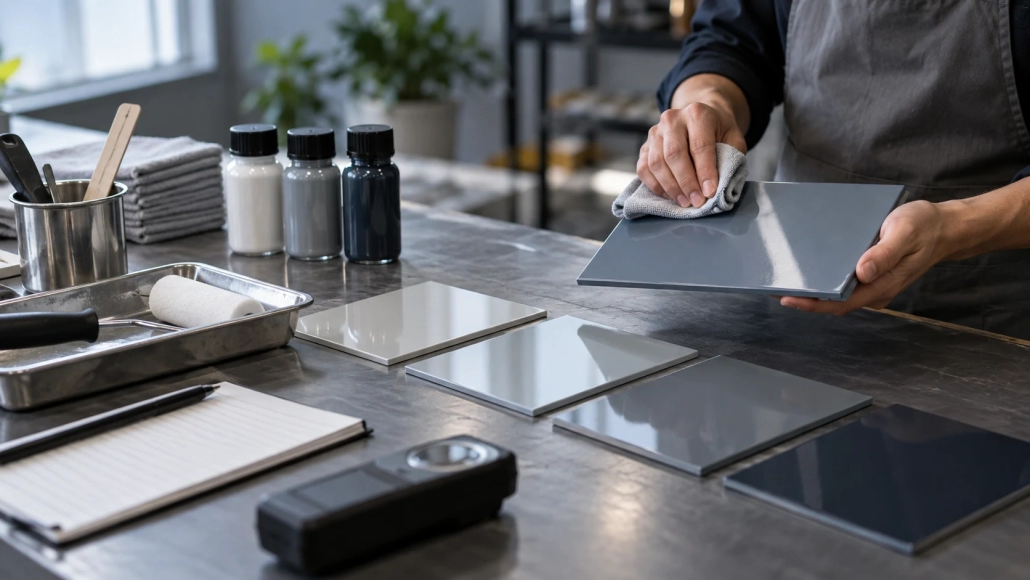
Compare private label coating samples using consistent preparation, application notes, finish checks and aftercare observations.
Reduce label bias in coating trials with coded samples, consistent preparation and separate records for application and finish.

Each development sample should have a defined purpose. A version intended to explore one property should not be treated as a final production approval simply because its early demonstration looks promising.