






A full polishing range.
From cutting and one-step correction to final finishing.
Specialist chemistry. Expert application.
 QUARTZ99 / CERAMIC BASE COAT
The foundation of your coating system.
A layerable quartz base coat designed for mechanical protection. Pair it with a suitable top coat to create the final finish.
For application by NANOLAB certified installers only.
Four formulas. Extended working time. Find the coating for your finish.
Explore the BEAST family of ceramic coatings.
Find the coating for each exterior surface.
 PPF & VINYLGLOSSProtection for glossy films and wraps.Discover
 MATTE & SATINMATTEProtection that respects the finish.Discover
 GLASSWINDOWSExplore dedicated glass protection.Discover
 WHEEL PROTECTIONWHEELSA dedicated coating for your wheels.Discover
 TRIM PROTECTIONPLASTICProtection for plastic surfaces.Discover
Dedicated care for the surfaces inside.
 LEATHER SURFACESLEATHERDiscover NANOLAB leather protection.Discover PLASTIC SURFACESPLASTICProtection for interior plastic surfaces.Discover TEXTILE SURFACESFABRICExplore the latest fabric formulation.Discover
Spray protection, maintenance and upcoming wash products.
 MAINTENANCEBEAST 365Explore the BEAST maintenance range.Discover
Next in washing, cleaning & care.
Ceramic protection for boats and yachts.
An easy-to-apply ceramic coating with an established track record on boats and yachts around the world.
Results vary with surface preparation, exposure and maintenance.
Read 50 MARINE guides →Explore MARINEProtection for the surfaces you live with.
A look at what we’re developing.
From cutting and one-step correction to final finishing.
A wider range for professional vehicle care.
Taking shape alongside BEAST & MATRIX.
Practical guidance for your next coating project.
Explore all guides →
Compare the mean of job-level coating rates with total consumption per total area, using a worked example with unequal job sizes.
Updated · NANOLAB Knowledge
An average of job-level consumption rates does not always equal total consumption divided by total coated area. The difference matters when jobs vary in size. Choose the calculation that matches the planning question and label it clearly.
In an illustrative dataset, a 1 m² test job uses 3 mL and a 9 m² job uses 9 mL. Their individual rates are 3 and 1 mL/m². The simple mean of those rates is 2 mL/m².
Across both jobs, total use is 12 mL over 10 m², giving 1.2 mL/m². This area-weighted rate is appropriate for describing total material use per total area in that dataset. The simple mean instead gives the small and large jobs equal influence.
Small jobs may have proportionally larger applicator-loading or handling losses. That can make their rates genuinely different. Do not erase the difference merely to produce one convenient number for every quote.
Separate fixed-per-job consumption from area-related use when the records support it. Also record spills, training and rework. A blended rate that includes all of these can be useful for stock reconciliation but unsuitable as a product application instruction.
For a known mix of future jobs, estimate consumption by job group or by a justified model. For an overall historical stock report, total use divided by total area may be appropriate. For a typical-job comparison, the distribution of job rates can be informative.
Always keep the manufacturer's recommended application procedure separate from internal costing averages. A lower historical rate does not authorize under-application, and a higher rate does not prove a thicker useful film. The calculation describes consumption within a defined workflow, not the installed coating's performance.
For product-specific application instructions, consult NANOLAB technical documentation or ask about your surface and intended use.
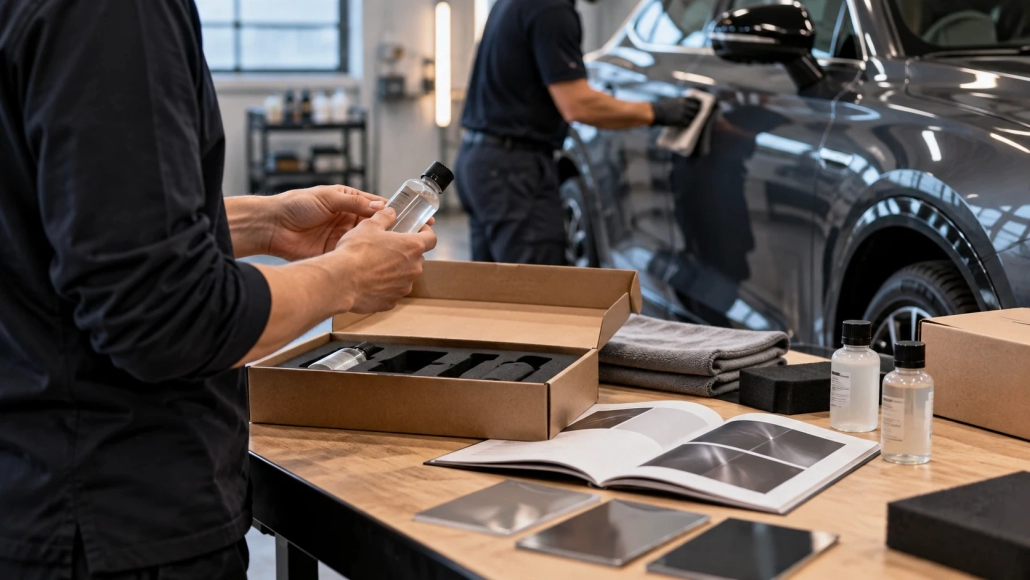
Design a coating field trial with recorded vehicles, use patterns, care routines and inspection points that produce interpretable feedback.
Several readings from one coated patch are not the same as several independently prepared test patches. Keep those two forms of repetition separate.

Report missing coating-trial follow-ups as unknown outcomes and keep enrolled, inspected and passing sample counts visible.