






A full polishing range.
From cutting and one-step correction to final finishing.
Specialist chemistry. Expert application.
 QUARTZ99 / CERAMIC BASE COAT
The foundation of your coating system.
A layerable quartz base coat designed for mechanical protection. Pair it with a suitable top coat to create the final finish.
For application by NANOLAB certified installers only.
Four formulas. Extended working time. Find the coating for your finish.
Explore the BEAST family of ceramic coatings.
Find the coating for each exterior surface.
 PPF & VINYLGLOSSProtection for glossy films and wraps.Discover
 MATTE & SATINMATTEProtection that respects the finish.Discover
 GLASSWINDOWSExplore dedicated glass protection.Discover
 WHEEL PROTECTIONWHEELSA dedicated coating for your wheels.Discover
 TRIM PROTECTIONPLASTICProtection for plastic surfaces.Discover
Dedicated care for the surfaces inside.
 LEATHER SURFACESLEATHERDiscover NANOLAB leather protection.Discover PLASTIC SURFACESPLASTICProtection for interior plastic surfaces.Discover TEXTILE SURFACESFABRICExplore the latest fabric formulation.Discover
Spray protection, maintenance and upcoming wash products.
 MAINTENANCEBEAST 365Explore the BEAST maintenance range.Discover
Next in washing, cleaning & care.
Ceramic protection for boats and yachts.
An easy-to-apply ceramic coating with an established track record on boats and yachts around the world.
Results vary with surface preparation, exposure and maintenance.
Read 50 MARINE guides →Explore MARINEProtection for the surfaces you live with.
A look at what we’re developing.
From cutting and one-step correction to final finishing.
A wider range for professional vehicle care.
Taking shape alongside BEAST & MATRIX.
Practical guidance for your next coating project.
Explore all guides →
Calculate gloss retention, preserve the initial and final readings, and avoid hiding baseline differences behind a percentage.
Updated · NANOLAB Knowledge
Gloss retention is often calculated as the later reading divided by the initial reading, multiplied by 100. The percentage can help describe change, but it should be accompanied by the original readings and measurement geometry.
An illustrative sample changing from 80 to 76 gloss units has 95 percent retention. Another changing from 100 to 90 has 90 percent retention. The first retains a larger share of its baseline, while the second still has the higher final reading.
Those observations answer different questions. Neither percentage alone establishes which finish is preferred, especially if the substrates or intended gloss levels differ.
Use the same appropriate instrument geometry, location procedure and reference checks. A different measurement angle or a curved test position can change the comparison. Record the method with the numbers rather than treating all gloss readings as interchangeable.
Very low initial values can make ratios unstable or visually misleading. A small numerical change from a low baseline can become a large percentage change. Check the method's suitability and uncertainty before interpreting the ratio.
Gloss can be affected by contamination, cleaning, polishing and surface damage. A retention figure does not identify the cause of change. Define whether the sample was measured as exposed or after a standardized cleaning step, and use that condition consistently.
For a meaningful coating study, include representative controls and record the exposure sequence. Report initial and final readings, the calculated retention, sample count and variability. Avoid translating a short controlled gloss test into a service-life promise. The useful claim is the measured appearance change under the stated procedure, with enough detail for another reader to understand what the percentage includes.
For product-specific application instructions, consult NANOLAB technical documentation or ask about your surface and intended use.
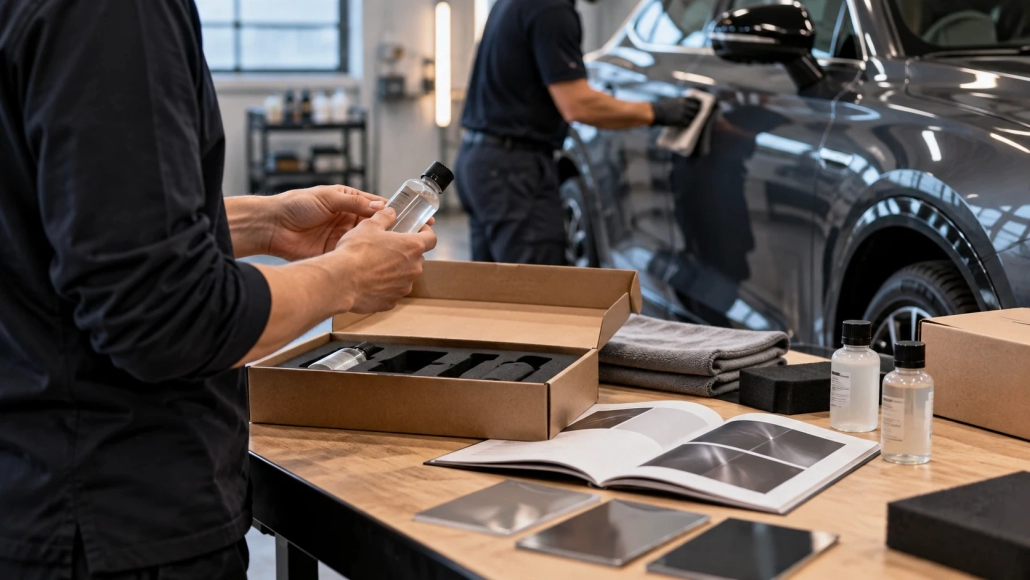
Design a coating field trial with recorded vehicles, use patterns, care routines and inspection points that produce interpretable feedback.
Several readings from one coated patch are not the same as several independently prepared test patches. Keep those two forms of repetition separate.

Compare the mean of job-level coating rates with total consumption per total area, using a worked example with unequal job sizes.