






A full polishing range.
From cutting and one-step correction to final finishing.
Specialist chemistry. Expert application.
 QUARTZ99 / CERAMIC BASE COAT
The foundation of your coating system.
A layerable quartz base coat designed for mechanical protection. Pair it with a suitable top coat to create the final finish.
For application by NANOLAB certified installers only.
Four formulas. Extended working time. Find the coating for your finish.
Explore the BEAST family of ceramic coatings.
Find the coating for each exterior surface.
 PPF & VINYLGLOSSProtection for glossy films and wraps.Discover
 MATTE & SATINMATTEProtection that respects the finish.Discover
 GLASSWINDOWSExplore dedicated glass protection.Discover
 WHEEL PROTECTIONWHEELSA dedicated coating for your wheels.Discover
 TRIM PROTECTIONPLASTICProtection for plastic surfaces.Discover
Dedicated care for the surfaces inside.
 LEATHER SURFACESLEATHERDiscover NANOLAB leather protection.Discover PLASTIC SURFACESPLASTICProtection for interior plastic surfaces.Discover TEXTILE SURFACESFABRICExplore the latest fabric formulation.Discover
Spray protection, maintenance and upcoming wash products.
 MAINTENANCEBEAST 365Explore the BEAST maintenance range.Discover
Next in washing, cleaning & care.
Ceramic protection for boats and yachts.
An easy-to-apply ceramic coating with an established track record on boats and yachts around the world.
Results vary with surface preparation, exposure and maintenance.
Read 50 MARINE guides →Explore MARINEProtection for the surfaces you live with.
A look at what we’re developing.
From cutting and one-step correction to final finishing.
A wider range for professional vehicle care.
Taking shape alongside BEAST & MATRIX.
Practical guidance for your next coating project.
Explore all guides →
Locate the actual leak path in a coating package before changing the bottle, closure or filling process.
Updated · NANOLAB Knowledge
Liquid on the outside of a coating bottle does not prove that the bottle wall leaked. The source may be a closure interface, dispensing component, filling residue or damage during distribution. Preserve evidence before cleaning the package.
Photograph the bottle, closure, carton and wet areas. Record product batch, package-component identities, shipment and orientation if known. Handle the material under its safety instructions; do not open or test a damaged package casually.
| Location | Question |
|---|---|
| Closure exterior | Did liquid pass the seal or remain from filling? |
| Bottle body | Is there visible mechanical damage? |
| Dispensing tip | Does the component retain or release product? |
| Carton | Does its stain pattern identify orientation or source? |
Use retained packages from the relevant batch and suitable controls. A packaging specialist should define safe tests for the actual formulation and container. Keep fill volume, closure application and storage conditions comparable when isolating one suspected variable.
If a closure change is proposed, repeat the relevant distribution and handling assessment rather than accepting a dry bottle immediately after filling. Record which failure mode the change addresses. For example, improved carton cushioning may reduce impact damage but cannot establish that a chemically incompatible liner has been corrected. Close the investigation with evidence tied to the identified escape path.
Discuss your private-label coating project. For application and care, use the current instructions for the exact product.
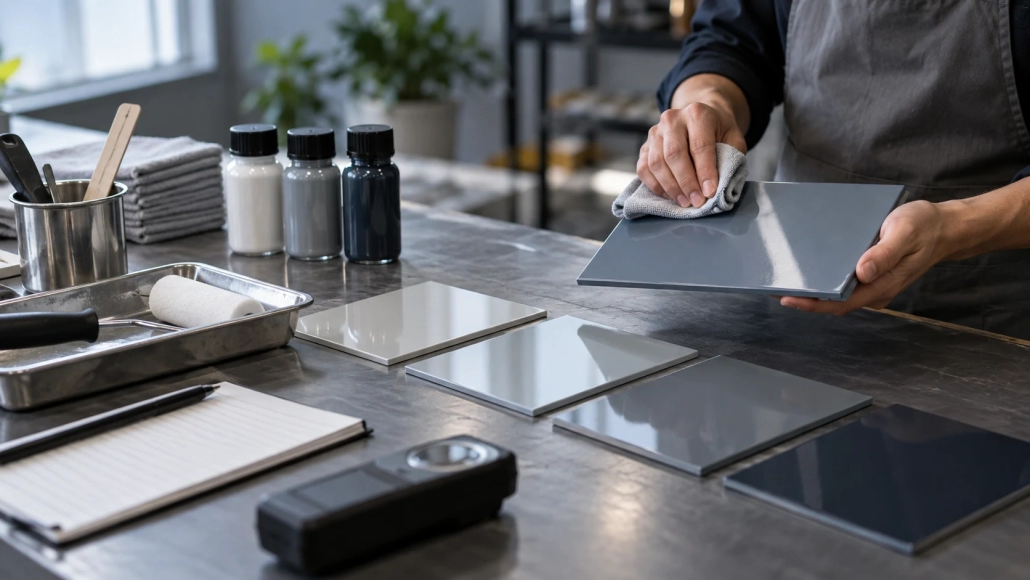
Compare private label coating samples using consistent preparation, application notes, finish checks and aftercare observations.

A label that adheres to plain glass may behave differently on a painted, textured or treated bottle. The actual production surface is the meaningful test substrate.
Measure dropper output under realistic handling before translating a drop count into an application dose or coverage instruction.

 Dropper Delivery Variation: Measure Output before Writing an Application-Dose...