






A full polishing range.
From cutting and one-step correction to final finishing.
Specialist chemistry. Expert application.
 QUARTZ99 / CERAMIC BASE COAT
The foundation of your coating system.
A layerable quartz base coat designed for mechanical protection. Pair it with a suitable top coat to create the final finish.
For application by NANOLAB certified installers only.
Four formulas. Extended working time. Find the coating for your finish.
Explore the BEAST family of ceramic coatings.
Find the coating for each exterior surface.
 PPF & VINYLGLOSSProtection for glossy films and wraps.Discover
 MATTE & SATINMATTEProtection that respects the finish.Discover
 GLASSWINDOWSExplore dedicated glass protection.Discover
 WHEEL PROTECTIONWHEELSA dedicated coating for your wheels.Discover
 TRIM PROTECTIONPLASTICProtection for plastic surfaces.Discover
Dedicated care for the surfaces inside.
 LEATHER SURFACESLEATHERDiscover NANOLAB leather protection.Discover PLASTIC SURFACESPLASTICProtection for interior plastic surfaces.Discover TEXTILE SURFACESFABRICExplore the latest fabric formulation.Discover
Spray protection, maintenance and upcoming wash products.
 MAINTENANCEBEAST 365Explore the BEAST maintenance range.Discover
Next in washing, cleaning & care.
Ceramic protection for boats and yachts.
An easy-to-apply ceramic coating with an established track record on boats and yachts around the world.
Results vary with surface preparation, exposure and maintenance.
Read 50 MARINE guides →Explore MARINEProtection for the surfaces you live with.
A look at what we’re developing.
From cutting and one-step correction to final finishing.
A wider range for professional vehicle care.
Taking shape alongside BEAST & MATRIX.
Practical guidance for your next coating project.
Explore all guides →
Measure dropper output under realistic handling before translating a drop count into an application dose or coverage instruction.
Updated · NANOLAB Knowledge
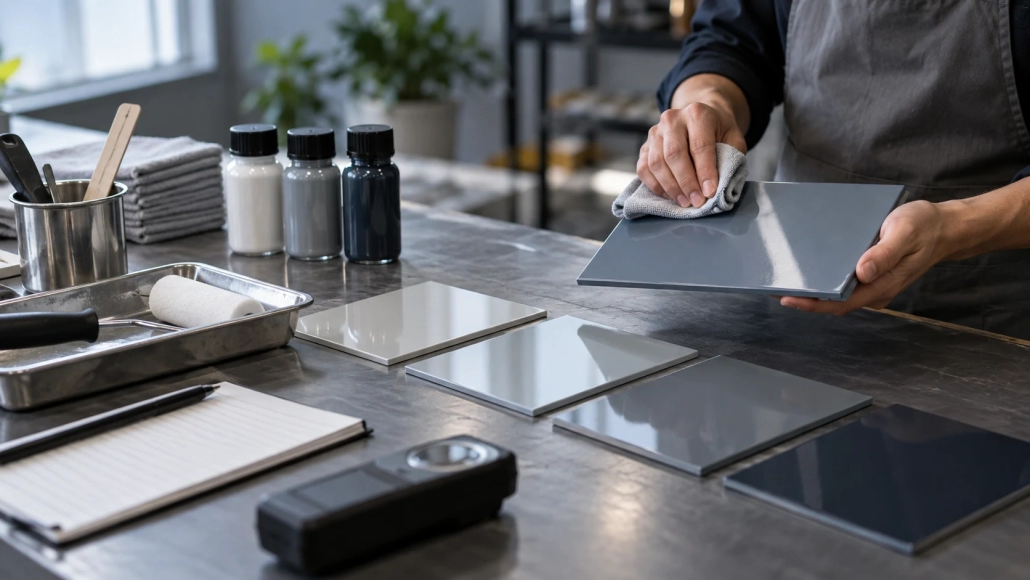
A drop count is convenient, but the quantity delivered can vary with the dispenser, product and handling. Before writing a dose instruction, establish what the intended package actually delivers under the specified method.
Record bottle fill level, orientation, conditioning temperature and whether the user squeezes or allows gravity flow. Use the final closure and formulation. A test with water in a substitute dropper does not establish the coating’s dose.
Collect a defined number of drops into a suitable tared vessel using a balance with adequate capability. Repeat across packages and operators. Follow the product’s safety and handling requirements and account for evaporation where it can affect the result.
If a ten-drop sequence averages a particular mass, that still does not prove the amount required per square metre. Establish coverage and accepted application separately on the intended surface. Use volume only when an appropriate density conversion is supported. If variation is too large for a reliable drop-based instruction, revise the dispenser or instruction format. The goal is a dose the installer can reproduce, not a precise-looking number unsupported by the package.
Discuss your private-label coating project. For application and care, use the current instructions for the exact product.
Compare private label coating samples using consistent preparation, application notes, finish checks and aftercare observations.

Dispensing can change with bottle angle, fill level and user technique. Testing only a full bottle held in one position misses part of the working experience.
Compare matched coating packages before and after a defined transport simulation when investigating closure torque and leakage.
 Closure Torque after Shipping Vibration: Compare Matched Coating Packages