






A full polishing range.
From cutting and one-step correction to final finishing.
Specialist chemistry. Expert application.
 QUARTZ99 / CERAMIC BASE COAT
The foundation of your coating system.
A layerable quartz base coat designed for mechanical protection. Pair it with a suitable top coat to create the final finish.
For application by NANOLAB certified installers only.
Four formulas. Extended working time. Find the coating for your finish.
Explore the BEAST family of ceramic coatings.
Find the coating for each exterior surface.
 PPF & VINYLGLOSSProtection for glossy films and wraps.Discover
 MATTE & SATINMATTEProtection that respects the finish.Discover
 GLASSWINDOWSExplore dedicated glass protection.Discover
 WHEEL PROTECTIONWHEELSA dedicated coating for your wheels.Discover
 TRIM PROTECTIONPLASTICProtection for plastic surfaces.Discover
Dedicated care for the surfaces inside.
 LEATHER SURFACESLEATHERDiscover NANOLAB leather protection.Discover PLASTIC SURFACESPLASTICProtection for interior plastic surfaces.Discover TEXTILE SURFACESFABRICExplore the latest fabric formulation.Discover
Spray protection, maintenance and upcoming wash products.
 MAINTENANCEBEAST 365Explore the BEAST maintenance range.Discover
Next in washing, cleaning & care.
Ceramic protection for boats and yachts.
An easy-to-apply ceramic coating with an established track record on boats and yachts around the world.
Results vary with surface preparation, exposure and maintenance.
Read 50 MARINE guides →Explore MARINEProtection for the surfaces you live with.
A look at what we’re developing.
From cutting and one-step correction to final finishing.
A wider range for professional vehicle care.
Taking shape alongside BEAST & MATRIX.
Practical guidance for your next coating project.
Explore all guides →
A particle-size chart is more useful when the assumptions used to calculate it are retained. For a laser-diffraction study, ask the laboratory to identify the optical model and relevant material inputs.
Updated · NANOLAB Knowledge
Mie-based laser-diffraction analysis uses optical information about the particles and dispersing medium. Treat those inputs as part of the measurement record, rather than assuming every instrument report used identical settings.
Illustrative example: two reports use the same sample identifier but different optical inputs. The reviewer first resolves that difference before interpreting the apparent size shift as a manufacturing change.
Do not select optical constants merely to obtain a preferred distribution. Method suitability and the defensibility of inputs belong with the competent laboratory, not a marketing comparison.
Technical references: Malvern Panalytical: laser diffraction. These sources describe their stated methods or products; they do not certify NANOLAB products or establish compatibility with an unlisted surface.
Ask NANOLAB about the exact product and intended use. Use the current product documentation for formulation-specific instructions.
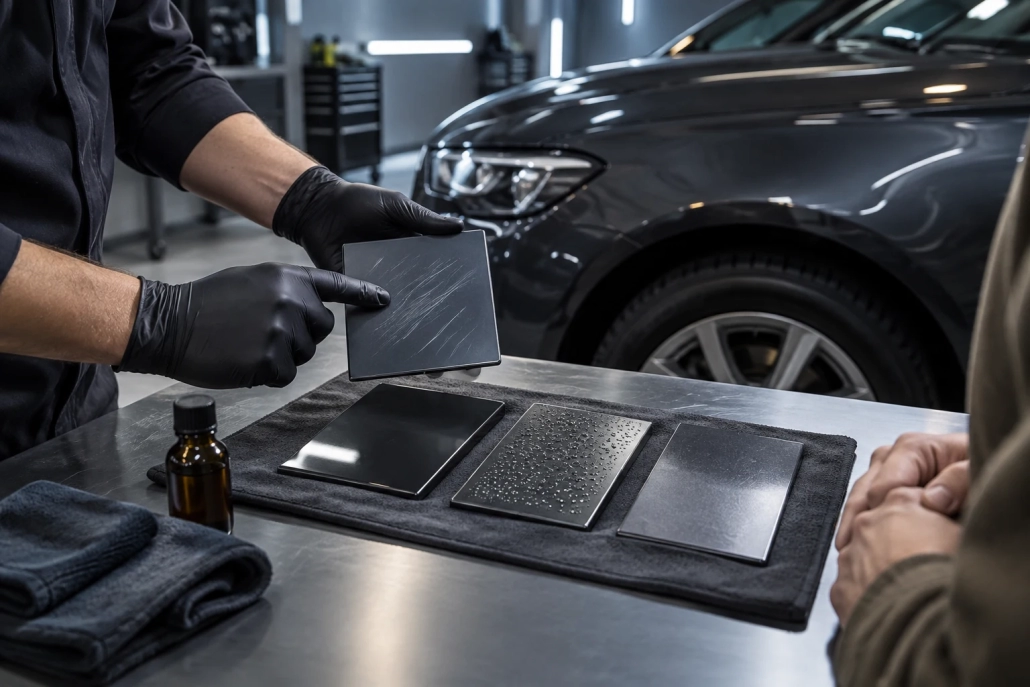
Investigate an unusual coating test result with a documented process instead of automatically deleting it or treating it as definitive.

The support behind a sample can affect how a test is performed or observed. Unrecorded backing changes introduce another variable into comparisons.
Before comparing particle-size reports for coating development, identify the measurement technique. A laser-diffraction distribution and a dynamic-light-scattering result should not be treated as interchangeable descriptions simply because both use nanometres.