






A full polishing range.
From cutting and one-step correction to final finishing.
Specialist chemistry. Expert application.
 QUARTZ99 / CERAMIC BASE COAT
The foundation of your coating system.
A layerable quartz base coat designed for mechanical protection. Pair it with a suitable top coat to create the final finish.
For application by NANOLAB certified installers only.
Four formulas. Extended working time. Find the coating for your finish.
Explore the BEAST family of ceramic coatings.
Find the coating for each exterior surface.
 PPF & VINYLGLOSSProtection for glossy films and wraps.Discover
 MATTE & SATINMATTEProtection that respects the finish.Discover
 GLASSWINDOWSExplore dedicated glass protection.Discover
 WHEEL PROTECTIONWHEELSA dedicated coating for your wheels.Discover
 TRIM PROTECTIONPLASTICProtection for plastic surfaces.Discover
Dedicated care for the surfaces inside.
 LEATHER SURFACESLEATHERDiscover NANOLAB leather protection.Discover PLASTIC SURFACESPLASTICProtection for interior plastic surfaces.Discover TEXTILE SURFACESFABRICExplore the latest fabric formulation.Discover
Spray protection, maintenance and upcoming wash products.
 MAINTENANCEBEAST 365Explore the BEAST maintenance range.Discover
Next in washing, cleaning & care.
Ceramic protection for boats and yachts.
An easy-to-apply ceramic coating with an established track record on boats and yachts around the world.
Results vary with surface preparation, exposure and maintenance.
Read 50 MARINE guides →Explore MARINEProtection for the surfaces you live with.
A look at what we’re developing.
From cutting and one-step correction to final finishing.
A wider range for professional vehicle care.
Taking shape alongside BEAST & MATRIX.
Practical guidance for your next coating project.
Explore all guides →
A value written as 1.30 can be mistaken for one hour thirty minutes when a spreadsheet interprets it as decimal hours. Define the time format before using job records for coating labour estimates.
Updated · NANOLAB Knowledge
Decimal hours express fractions of an hour, while clock-style notation expresses hours and minutes. The difference can materially affect costs and capacity calculations. Keep raw start and finish times or a clearly labelled duration field, and convert through a checked formula rather than relying on visual similarity.
Arithmetic example: one hour thirty minutes equals 1.5 decimal hours. A value of 1.30 decimal hours equals one hour eighteen minutes. Treating those as identical understates a ninety-minute task by twelve minutes and can compound across many jobs.
These figures illustrate unit conversion, not a NANOLAB installation time. Do not mix active labour with cure or waiting time in the same field. The job estimate should preserve the different time categories needed to answer the actual staffing, pricing or scheduling question.
Ask NANOLAB about the exact product and intended use. Use the current product documentation for formulation-specific instructions.
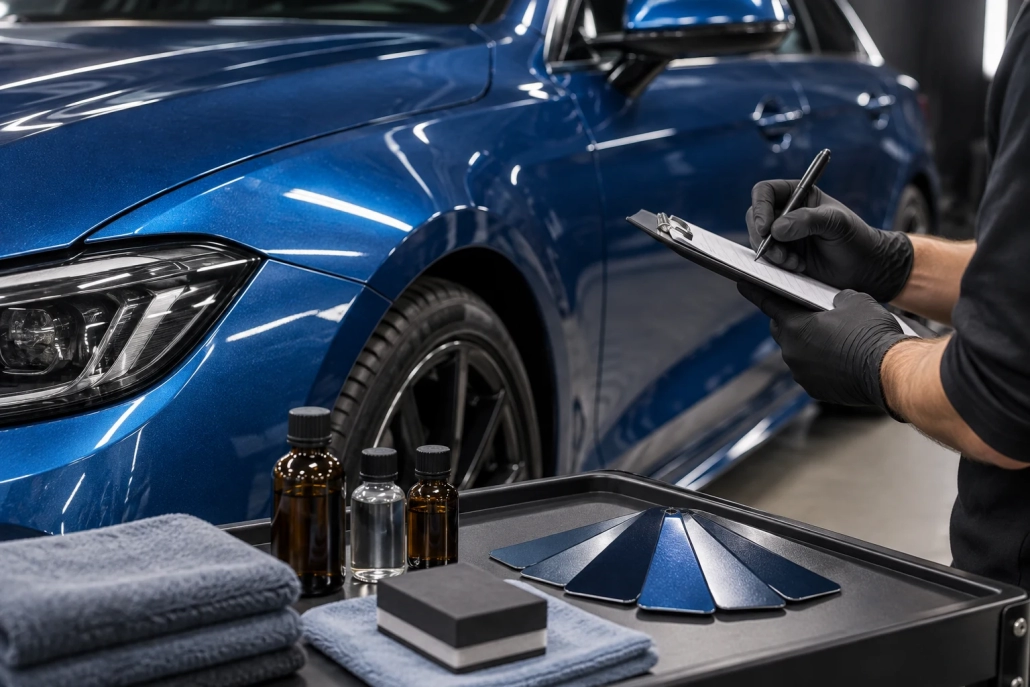
Build a clearer job estimate by separating active work, bay occupancy and the coating's required curing period.

Use coating maintenance patterns as investigation leads without turning observational correlations into unsupported causal claims.
Person-hours measure combined labour, while elapsed hours measure time on the clock. A two-person coating task lasting three hours uses six person-hours if both people work throughout.