






A full polishing range.
From cutting and one-step correction to final finishing.
Specialist chemistry. Expert application.
 QUARTZ99 / CERAMIC BASE COAT
The foundation of your coating system.
A layerable quartz base coat designed for mechanical protection. Pair it with a suitable top coat to create the final finish.
For application by NANOLAB certified installers only.
Four formulas. Extended working time. Find the coating for your finish.
Explore the BEAST family of ceramic coatings.
Find the coating for each exterior surface.
 PPF & VINYLGLOSSProtection for glossy films and wraps.Discover
 MATTE & SATINMATTEProtection that respects the finish.Discover
 GLASSWINDOWSExplore dedicated glass protection.Discover
 WHEEL PROTECTIONWHEELSA dedicated coating for your wheels.Discover
 TRIM PROTECTIONPLASTICProtection for plastic surfaces.Discover
Dedicated care for the surfaces inside.
 LEATHER SURFACESLEATHERDiscover NANOLAB leather protection.Discover PLASTIC SURFACESPLASTICProtection for interior plastic surfaces.Discover TEXTILE SURFACESFABRICExplore the latest fabric formulation.Discover
Spray protection, maintenance and upcoming wash products.
 MAINTENANCEBEAST 365Explore the BEAST maintenance range.Discover
Next in washing, cleaning & care.
Ceramic protection for boats and yachts.
An easy-to-apply ceramic coating with an established track record on boats and yachts around the world.
Results vary with surface preparation, exposure and maintenance.
Read 50 MARINE guides →Explore MARINEProtection for the surfaces you live with.
A look at what we’re developing.
From cutting and one-step correction to final finishing.
A wider range for professional vehicle care.
Taking shape alongside BEAST & MATRIX.
Practical guidance for your next coating project.
Explore all guides →
Use work sampling to estimate where detailing time goes without continuously timing every operator movement or confusing activity with useful output.
Updated · NANOLAB Knowledge

Continuous time studies can be intrusive and expensive. Work sampling uses observations at planned or randomly selected times to estimate the proportion of time spent in defined activities. It is useful for locating delays, provided the design is clear.
Use categories such as direct preparation, polishing, cleanup, inspection, required waiting and avoidable waiting. Keep definitions consistent and distinguish operator activity from the vehicle’s state. Explain the study’s purpose to the team.
Avoid checking only when a supervisor happens to walk past. Cover relevant shifts and job types. Random or appropriately structured sampling reduces the risk of observing only convenient periods, but formal precision requires a suitable statistical design.
If 40 of 200 valid observations show waiting for shared equipment, the observed proportion is 20%. It is an estimate for the sampled conditions, not an exact statement that every employee loses one-fifth of every shift.
| Record | Purpose |
|---|---|
| Time and job type | Checks representativeness |
| Activity category | Builds the estimate |
| Reason for waiting | Identifies an actionable issue |
Investigate the largest apparent delays and verify their cause through direct process review. More visible activity is not automatically more accepted output.
Use the findings to improve layout, scheduling or equipment access, then repeat a comparable study. Work sampling should reveal where the process obstructs good work, not become a simplistic ranking of individuals from a handful of observations.
Ask NANOLAB about your surface and intended use. For application and care, use the current instructions for the exact product.
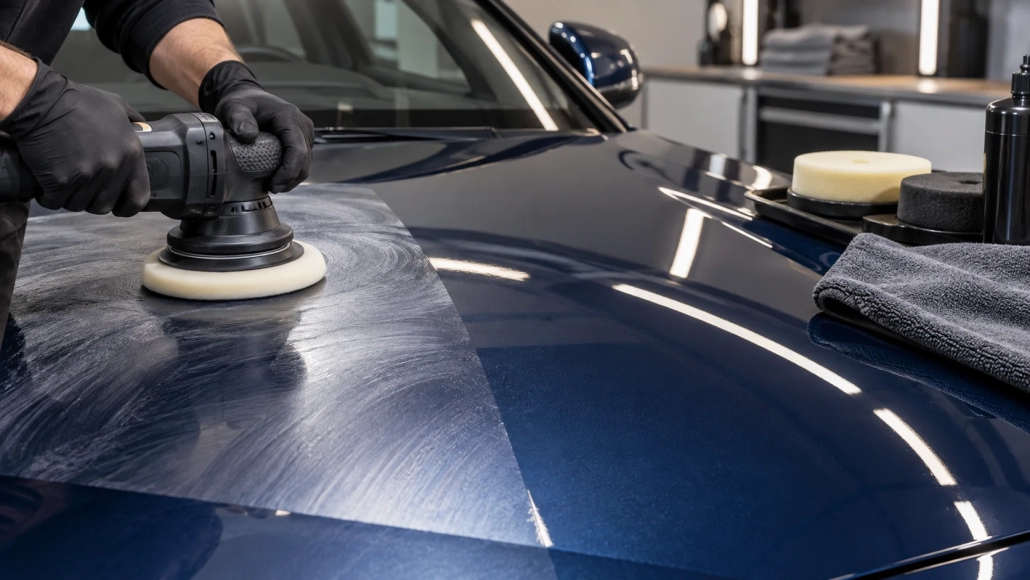
Choose a polishing process by testing defect removal, finishing quality and clear-coat preservation rather than counting steps alone.

When inspected packs are selected without replacement from a finite lot, successive selections are not identical independent draws. The sampling calculation should reflect the actual lot and selection process.
Scale a polishing test spot into a whole-car estimate by adding geometry, setup, cleanup and inspection instead of multiplying area alone.

 Scaling a Polishing Test Spot to a Whole-Car Estimate