






A full polishing range.
From cutting and one-step correction to final finishing.
Specialist chemistry. Expert application.
 QUARTZ99 / CERAMIC BASE COAT
The foundation of your coating system.
A layerable quartz base coat designed for mechanical protection. Pair it with a suitable top coat to create the final finish.
For application by NANOLAB certified installers only.
Four formulas. Extended working time. Find the coating for your finish.
Explore the BEAST family of ceramic coatings.
Find the coating for each exterior surface.
 PPF & VINYLGLOSSProtection for glossy films and wraps.Discover
 MATTE & SATINMATTEProtection that respects the finish.Discover
 GLASSWINDOWSExplore dedicated glass protection.Discover
 WHEEL PROTECTIONWHEELSA dedicated coating for your wheels.Discover
 TRIM PROTECTIONPLASTICProtection for plastic surfaces.Discover
Dedicated care for the surfaces inside.
 LEATHER SURFACESLEATHERDiscover NANOLAB leather protection.Discover PLASTIC SURFACESPLASTICProtection for interior plastic surfaces.Discover TEXTILE SURFACESFABRICExplore the latest fabric formulation.Discover
Spray protection, maintenance and upcoming wash products.
 MAINTENANCEBEAST 365Explore the BEAST maintenance range.Discover
Next in washing, cleaning & care.
Ceramic protection for boats and yachts.
An easy-to-apply ceramic coating with an established track record on boats and yachts around the world.
Results vary with surface preparation, exposure and maintenance.
Read 50 MARINE guides →Explore MARINEProtection for the surfaces you live with.
A look at what we’re developing.
From cutting and one-step correction to final finishing.
A wider range for professional vehicle care.
Taking shape alongside BEAST & MATRIX.
Practical guidance for your next coating project.
Explore all guides →
Scale a polishing test spot into a whole-car estimate by adding geometry, setup, cleanup and inspection instead of multiplying area alone.
Updated · NANOLAB Knowledge
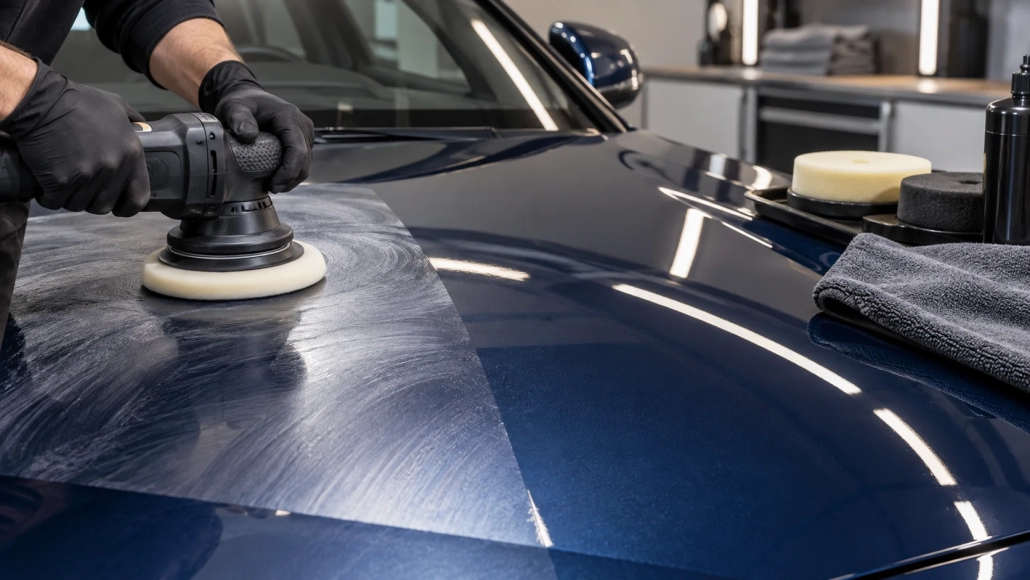
A test spot establishes a promising correction process, but its stopwatch time is not automatically the production rate for an entire vehicle. Access, curves and transitions add work that a small open square may not contain.
Area-dependent work includes the repeated polishing sequence. Fixed or partly fixed work includes setup, masking, tool changes, cleaning and final inspection. Estimate these separately so they are not accidentally omitted or counted twice.
Suppose a representative 0.5 m² area takes 12 minutes through the accepted sequence. A simple area rate is 24 minutes/m². Applying it to 6 m² gives 144 minutes before geometry, preparation, cleanup and inspection allowances. These figures are illustrative, not a recommended production target.
| Exception | Estimate adjustment |
|---|---|
| Curves and narrow areas | Separate tooling or slower access |
| Different repair finish | Additional assessment |
| Heavy local defects | Defined extra work or exclusion |
The first test area may use an ideal fresh setup. Include normal pad care, replenishment and realistic breaks in the full plan. Do not set a schedule that requires the operator to omit necessary process steps.
After completion, record which assumptions were accurate. Build rates from comparable accepted jobs rather than continually extrapolating one memorable test spot.
The test spot remains essential technical evidence. Its role in quoting is to anchor a complete estimate, not replace the rest of the vehicle assessment.
Ask NANOLAB about your surface and intended use. For application and care, use the current instructions for the exact product.
Choose a polishing process by testing defect removal, finishing quality and clear-coat preservation rather than counting steps alone.
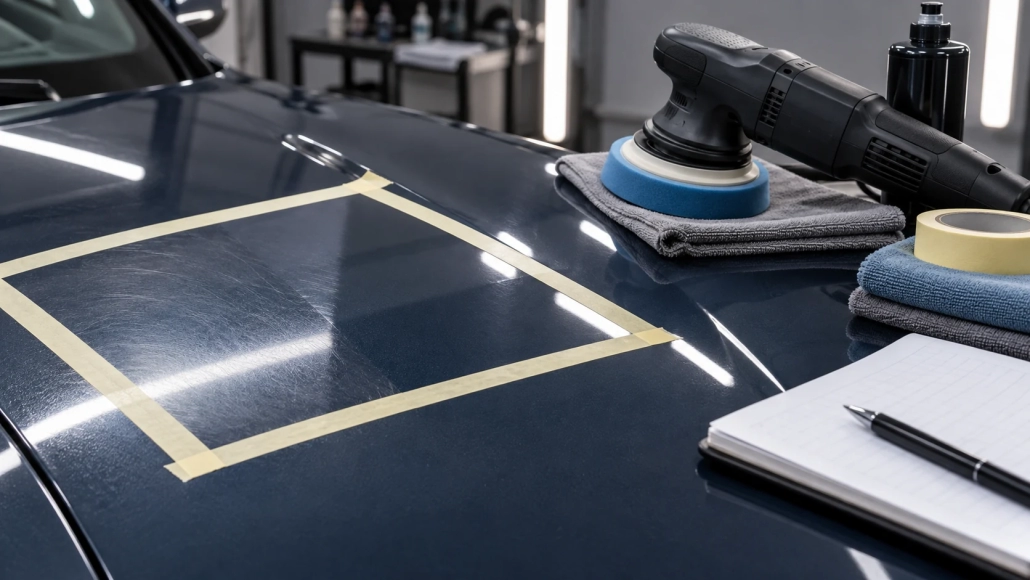
Document pad, polish, machine, surface and inspection results so a successful polishing test can guide the rest of the vehicle.
Use coded polishing references and repeat scoring to train inspectors to recognise the agreed finish without relying on product labels or operator reputation.

 Blind Finish Grading for Training New Polishing Inspectors