






A full polishing range.
From cutting and one-step correction to final finishing.
Specialist chemistry. Expert application.
 QUARTZ99 / CERAMIC BASE COAT
The foundation of your coating system.
A layerable quartz base coat designed for mechanical protection. Pair it with a suitable top coat to create the final finish.
For application by NANOLAB certified installers only.
Four formulas. Extended working time. Find the coating for your finish.
Explore the BEAST family of ceramic coatings.
Find the coating for each exterior surface.
 PPF & VINYLGLOSSProtection for glossy films and wraps.Discover
 MATTE & SATINMATTEProtection that respects the finish.Discover
 GLASSWINDOWSExplore dedicated glass protection.Discover
 WHEEL PROTECTIONWHEELSA dedicated coating for your wheels.Discover
 TRIM PROTECTIONPLASTICProtection for plastic surfaces.Discover
Dedicated care for the surfaces inside.
 LEATHER SURFACESLEATHERDiscover NANOLAB leather protection.Discover PLASTIC SURFACESPLASTICProtection for interior plastic surfaces.Discover TEXTILE SURFACESFABRICExplore the latest fabric formulation.Discover
Spray protection, maintenance and upcoming wash products.
 MAINTENANCEBEAST 365Explore the BEAST maintenance range.Discover
Next in washing, cleaning & care.
Ceramic protection for boats and yachts.
An easy-to-apply ceramic coating with an established track record on boats and yachts around the world.
Results vary with surface preparation, exposure and maintenance.
Read 50 MARINE guides →Explore MARINEProtection for the surfaces you live with.
A look at what we’re developing.
From cutting and one-step correction to final finishing.
A wider range for professional vehicle care.
Taking shape alongside BEAST & MATRIX.
Practical guidance for your next coating project.
Explore all guides →
Choose hardness or TDS measurements for the actual washing problem and distinguish water softening from low-ion final-rinse treatment.
Updated · NANOLAB Knowledge
Hardness and total dissolved solids answer different questions. Hardness mainly concerns dissolved calcium and magnesium. TDS concerns the total dissolved material. A handheld conductivity-based TDS meter does not separately measure calcium, magnesium or the tendency of every residue to mark a surface.
If the concern is scale and soap behaviour, a suitable hardness test is relevant. If the concern is the performance of a deionizing rinse system, conductivity or the system's specified water-quality measurement may be more useful. If the deposit itself must be identified, neither reading alone identifies its composition.
Two water supplies can have similar TDS but different hardness because the mixture of dissolved substances differs. A softener can reduce hardness while leaving substantial dissolved material. “Soft” and “suitable for unattended spot-free drying” are therefore not interchangeable descriptions.
Label readings as incoming supply, after softener, after reverse osmosis, after deionization or at the hose outlet. A test of the incoming tap does not verify the water reaching the car after it passes through a storage tank and hose.
An illustrative record might show lower hardness after a softener with little change in the conductivity-based TDS reading. That is not necessarily an equipment fault; the two tests are tracking different properties. Evaluate the equipment against its specified function.
Use the appropriate test to investigate the water, then inspect the actual washing and drying process. Surface temperature, detergent residue and trapped water can still cause problems even when a water-treatment reading is satisfactory.
A ceramic coating does not remove minerals from rinse water. Continue the product's recommended washing and drying routine. If recurring deposits persist, retain water readings, sampling locations and photographs so that the cause can be investigated without assuming the coating itself has failed.
Technical references: USGS: Hardness of Water; USGS: Chloride, Salinity, and Dissolved Solids.
For product-specific application instructions, consult NANOLAB technical documentation or ask about your surface and intended use.
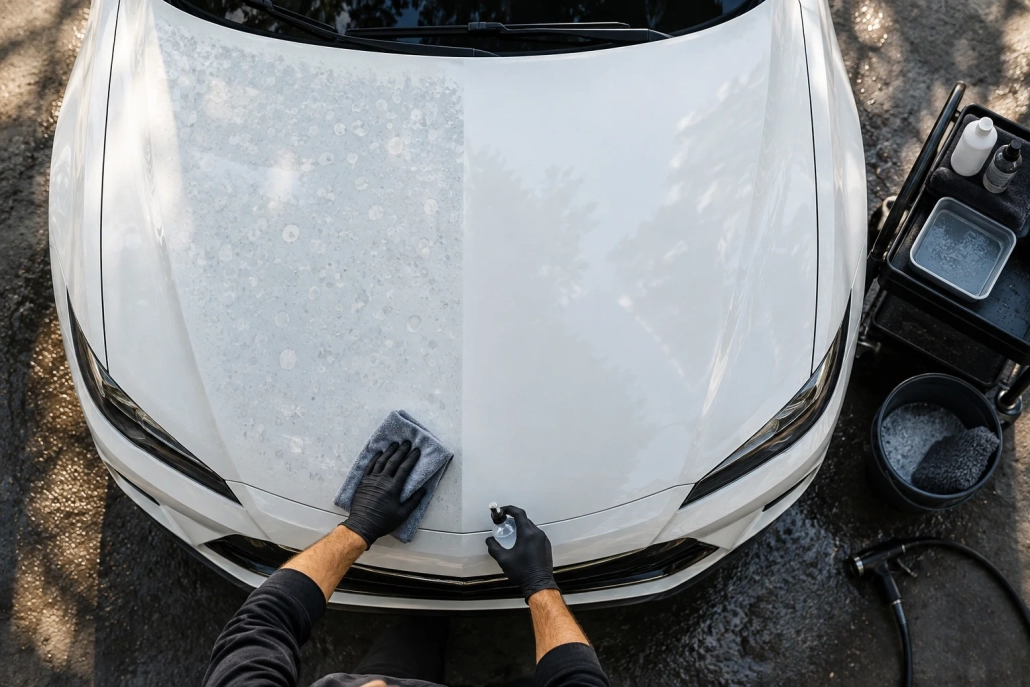
Understand why softened water and deionised rinse water are different when planning washing and drying for a ceramic-coated car.
A TDS display can help monitor a water-treatment system, but it does not describe every contaminant or guarantee that drying will leave no marks.
Convert water hardness between mg/L as CaCO3 and grains per US gallon while avoiding confusion with calcium-only or TDS readings.