






A full polishing range.
From cutting and one-step correction to final finishing.
Specialist chemistry. Expert application.
 QUARTZ99 / CERAMIC BASE COAT
The foundation of your coating system.
A layerable quartz base coat designed for mechanical protection. Pair it with a suitable top coat to create the final finish.
For application by NANOLAB certified installers only.
Four formulas. Extended working time. Find the coating for your finish.
Explore the BEAST family of ceramic coatings.
Find the coating for each exterior surface.
 PPF & VINYLGLOSSProtection for glossy films and wraps.Discover
 MATTE & SATINMATTEProtection that respects the finish.Discover
 GLASSWINDOWSExplore dedicated glass protection.Discover
 WHEEL PROTECTIONWHEELSA dedicated coating for your wheels.Discover
 TRIM PROTECTIONPLASTICProtection for plastic surfaces.Discover
Dedicated care for the surfaces inside.
 LEATHER SURFACESLEATHERDiscover NANOLAB leather protection.Discover PLASTIC SURFACESPLASTICProtection for interior plastic surfaces.Discover TEXTILE SURFACESFABRICExplore the latest fabric formulation.Discover
Spray protection, maintenance and upcoming wash products.
 MAINTENANCEBEAST 365Explore the BEAST maintenance range.Discover
Next in washing, cleaning & care.
Ceramic protection for boats and yachts.
An easy-to-apply ceramic coating with an established track record on boats and yachts around the world.
Results vary with surface preparation, exposure and maintenance.
Read 50 MARINE guides →Explore MARINEProtection for the surfaces you live with.
A look at what we’re developing.
From cutting and one-step correction to final finishing.
A wider range for professional vehicle care.
Taking shape alongside BEAST & MATRIX.
Practical guidance for your next coating project.
Explore all guides →
Distinguish liquid surface tension from solid surface energy and understand why application wetting differs from cured-coating water repellency.
Updated · NANOLAB Knowledge
Surface tension describes a liquid interface; surface free energy describes a solid surface. Their interaction helps explain whether a liquid spreads or forms droplets. A coating's application wetting and the cured coating's water repellency are different questions involving different surfaces and liquids.
Before application, the liquid coating needs to wet the prepared substrate appropriately. After curing, water interacts with the new outer surface. A liquid coating that spreads well is not thereby proven to produce a non-hydrophobic finish. The carrier and the final exposed film are not identical materials.
For a useful test record, name the liquid, substrate condition and application stage. “Good wetting” without those details could refer to cleaning, coating application, printing or a finished surface in service.
Contact angle is a relationship between a particular liquid and surface under the measurement conditions. Surface-energy calculations require a defined model and appropriate probe liquids. A phone photograph of a water bead cannot establish a complete surface-energy specification.
Roughness, contamination and surface variation can also influence the observed angle. A test on a polished flat coupon should not be transferred uncritically to textured plastic or a curved panel.
If a coating pulls away from small patches, record the pattern and preparation history. Local contamination or an incompatible surface treatment may be relevant, but the appearance alone does not identify the cause. Stop expanding the application until the supplier's troubleshooting procedure resolves it.
When comparing samples, keep the substrate preparation and test liquid consistent. Assess the finished result using the intended maintenance and exposure conditions as well. Wetting explains one interface behaviour; adhesion, appearance and durability still need their own evidence.
Technical references: KRUSS: Surface free energy.
For product-specific application instructions, consult NANOLAB technical documentation or ask about your surface and intended use.
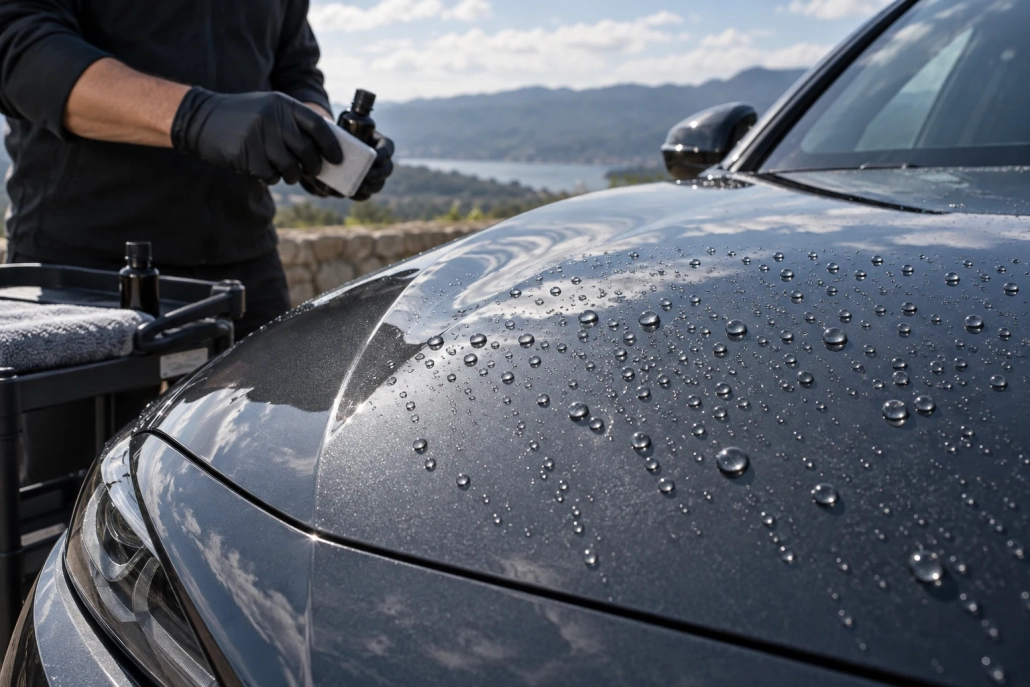
Distinguish the shape of a water drop from how easily it moves when comparing ceramic coating water behaviour.
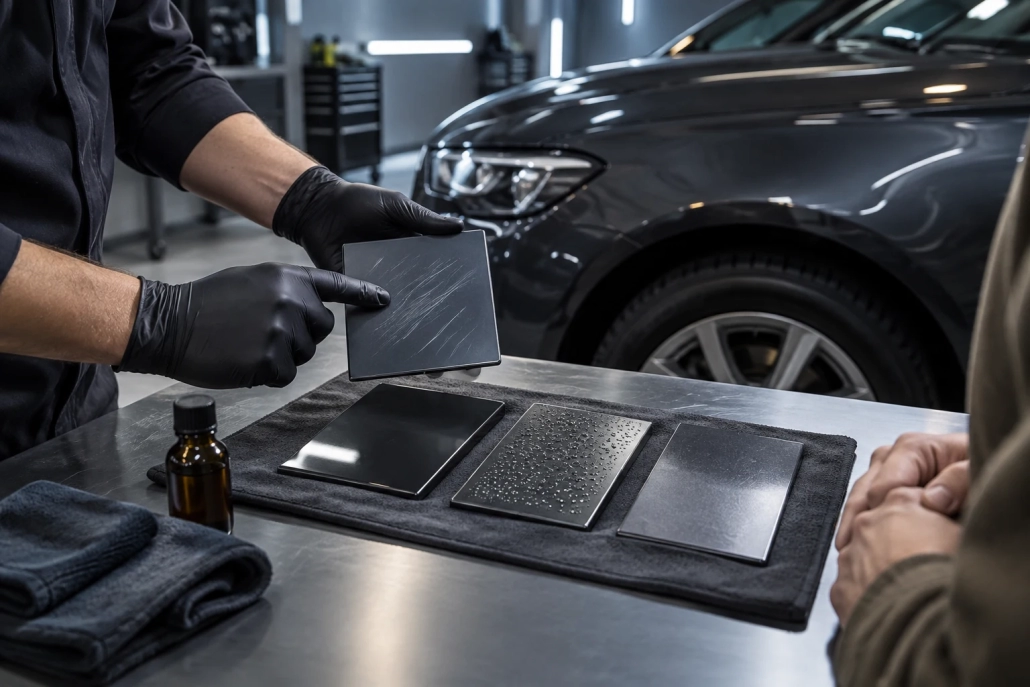
Check whether a laboratory report actually supports a nano coating claim by reviewing sample identity, method, scope, results and the connection to the sold product.

Read polar and dispersive surface-energy results with the correct model and probe liquids, rather than relying on a single water-angle result.