






A full polishing range.
From cutting and one-step correction to final finishing.
Specialist chemistry. Expert application.
 QUARTZ99 / CERAMIC BASE COAT
The foundation of your coating system.
A layerable quartz base coat designed for mechanical protection. Pair it with a suitable top coat to create the final finish.
For application by NANOLAB certified installers only.
Four formulas. Extended working time. Find the coating for your finish.
Explore the BEAST family of ceramic coatings.
Find the coating for each exterior surface.
 PPF & VINYLGLOSSProtection for glossy films and wraps.Discover
 MATTE & SATINMATTEProtection that respects the finish.Discover
 GLASSWINDOWSExplore dedicated glass protection.Discover
 WHEEL PROTECTIONWHEELSA dedicated coating for your wheels.Discover
 TRIM PROTECTIONPLASTICProtection for plastic surfaces.Discover
Dedicated care for the surfaces inside.
 LEATHER SURFACESLEATHERDiscover NANOLAB leather protection.Discover PLASTIC SURFACESPLASTICProtection for interior plastic surfaces.Discover TEXTILE SURFACESFABRICExplore the latest fabric formulation.Discover
Spray protection, maintenance and upcoming wash products.
 MAINTENANCEBEAST 365Explore the BEAST maintenance range.Discover
Next in washing, cleaning & care.
Ceramic protection for boats and yachts.
An easy-to-apply ceramic coating with an established track record on boats and yachts around the world.
Results vary with surface preparation, exposure and maintenance.
Read 50 MARINE guides →Explore MARINEProtection for the surfaces you live with.
A look at what we’re developing.
From cutting and one-step correction to final finishing.
A wider range for professional vehicle care.
Taking shape alongside BEAST & MATRIX.
Practical guidance for your next coating project.
Explore all guides →
Explore Wenzel and Cassie-Baxter wetting states and why surface texture complicates comparisons between coated glass, paint and plastic.
Updated · NANOLAB Knowledge
Surface texture can change how a droplet sits. In a Wenzel-type state, liquid enters the surface structures; in a Cassie-Baxter-type state, air remains within parts of the structure beneath the droplet. These models help explain wetting behaviour, but a photograph alone rarely proves which state exists.
Two test panels with different roughness can show different apparent contact angles even when their surface chemistry is similar. This is one reason a result from smooth glass should not be treated as a guaranteed result on textured trim.
The model assumptions matter. Real surfaces can be irregular, chemically varied or contaminated. A simple equation may not accurately correct every textured surface to an equivalent smooth-surface angle.
A dramatic droplet can depend on a particular surface structure and test condition. It does not establish that the structure will survive abrasion, detergent exposure or repeated cleaning. A water-repellent surface can also behave differently under pressure or immersion than under a gently placed drop.
For an illustrative comparison, document both a smooth and a textured substrate, apply the prescribed preparation and test each separately. Keep the substrate labels in the report. Combining their results into one “coating angle” hides an important variable.
If the real project is textured exterior plastic, include that finish in compatibility and appearance testing. Inspect for trapped residue and changes to the intended sheen. Do not polish or sand the customer part merely to create a surface that matches a laboratory coupon.
Use wetting models to understand why a result may change, then verify the actual surface and exposure. For NANOLAB selection, the product's substrate guidance remains the starting point; a scientific model is not permission to extend a coating to every textured material.
Technical references: KRUSS: Wetting and roughness.
For product-specific application instructions, consult NANOLAB technical documentation or ask about your surface and intended use.
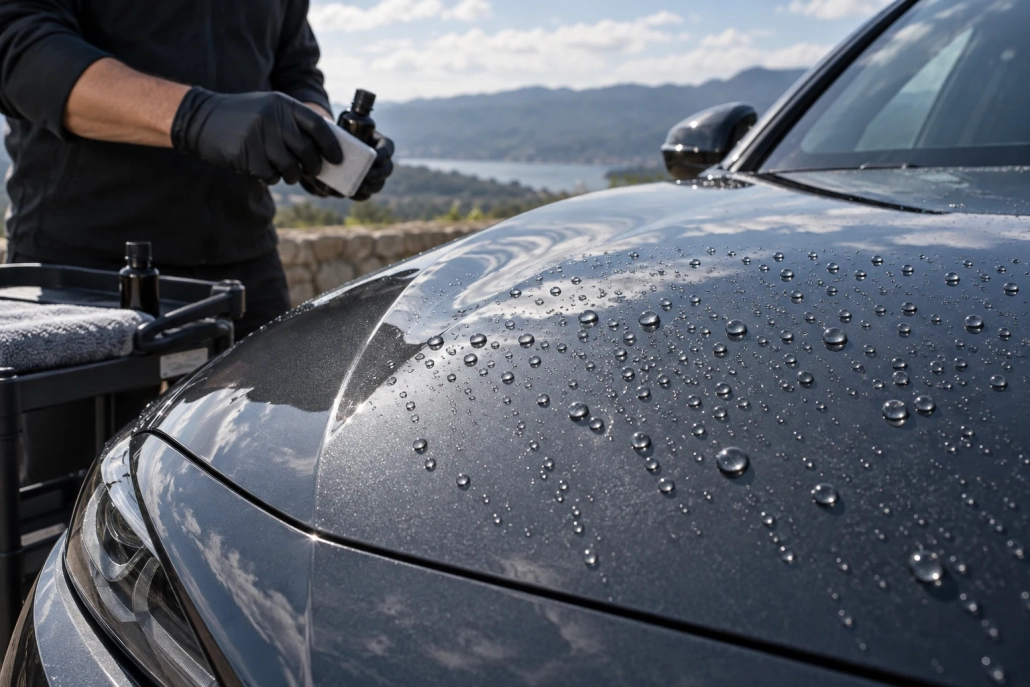
Distinguish the shape of a water drop from how easily it moves when comparing ceramic coating water behaviour.
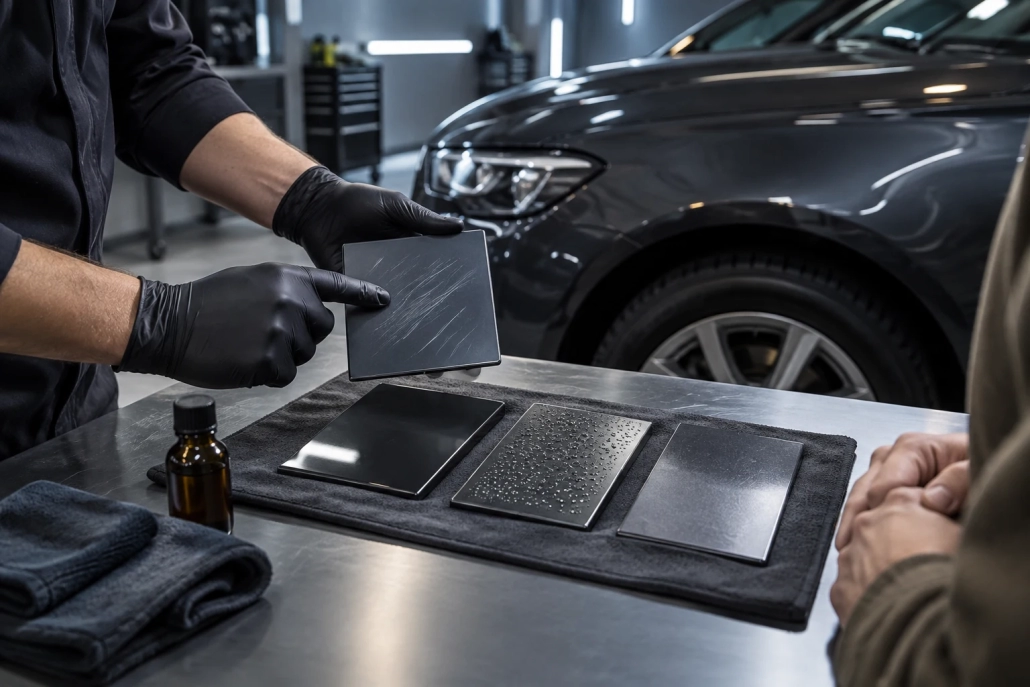
Check whether a laboratory report actually supports a nano coating claim by reviewing sample identity, method, scope, results and the connection to the sold product.
Separate refractive index, transparency, haze and gloss when evaluating a clear coating on appearance-sensitive surfaces.