






A full polishing range.
From cutting and one-step correction to final finishing.
Specialist chemistry. Expert application.
 QUARTZ99 / CERAMIC BASE COAT
The foundation of your coating system.
A layerable quartz base coat designed for mechanical protection. Pair it with a suitable top coat to create the final finish.
For application by NANOLAB certified installers only.
Four formulas. Extended working time. Find the coating for your finish.
Explore the BEAST family of ceramic coatings.
Find the coating for each exterior surface.
 PPF & VINYLGLOSSProtection for glossy films and wraps.Discover
 MATTE & SATINMATTEProtection that respects the finish.Discover
 GLASSWINDOWSExplore dedicated glass protection.Discover
 WHEEL PROTECTIONWHEELSA dedicated coating for your wheels.Discover
 TRIM PROTECTIONPLASTICProtection for plastic surfaces.Discover
Dedicated care for the surfaces inside.
 LEATHER SURFACESLEATHERDiscover NANOLAB leather protection.Discover PLASTIC SURFACESPLASTICProtection for interior plastic surfaces.Discover TEXTILE SURFACESFABRICExplore the latest fabric formulation.Discover
Spray protection, maintenance and upcoming wash products.
 MAINTENANCEBEAST 365Explore the BEAST maintenance range.Discover
Next in washing, cleaning & care.
Ceramic protection for boats and yachts.
An easy-to-apply ceramic coating with an established track record on boats and yachts around the world.
Results vary with surface preparation, exposure and maintenance.
Read 50 MARINE guides →Explore MARINEProtection for the surfaces you live with.
A look at what we’re developing.
From cutting and one-step correction to final finishing.
A wider range for professional vehicle care.
Taking shape alongside BEAST & MATRIX.
Practical guidance for your next coating project.
Explore all guides →
Separate refractive index, transparency, haze and gloss when evaluating a clear coating on appearance-sensitive surfaces.
Updated · NANOLAB Knowledge
A transparent coating can still alter how a surface looks. Light interacts with interfaces, film thickness, texture and defects as well as with the material's refractive index. Transparency alone does not guarantee an unchanged gloss, colour or reflection.
Transparency concerns light transmission. Haze concerns scattered light. Gloss concerns reflection under a defined geometry. Refractive index describes how light propagates through a material. These properties are connected, but one number does not replace the others.
On an opaque painted panel, the viewing result also depends on the existing paint system. On a clear screen, transmission and distortion may matter more. On matte trim, a small sheen change may be unacceptable even if the applied coating is colourless.
Use an approved sample with the same texture, colour and existing treatment as the intended part. Examine it after the specified cure under diffuse light and a suitable directional light. Include the viewing angles that matter in normal use.
For example, a sample may appear unchanged when viewed straight on but reveal a visible boundary at a shallow angle. Record that observation rather than reducing the decision to “clear” or “not clear.” Keep a genuinely untreated comparison area.
A refractive-index value should identify the measurement conditions, including wavelength where relevant. It does not establish that a liquid will cure into a uniform film on every substrate. Uneven application, contamination and excess residue can create visible effects unrelated to a supplier's nominal optical value.
For an appearance-sensitive project, agree on the acceptable finish before applying the product broadly. Select a coating explicitly suitable for the substrate and finish, and judge the installed result after the prescribed preparation and cure. Do not use “transparent” as a substitute for a compatibility test on matte, optical or decorative surfaces.
For product-specific application instructions, consult NANOLAB technical documentation or ask about your surface and intended use.
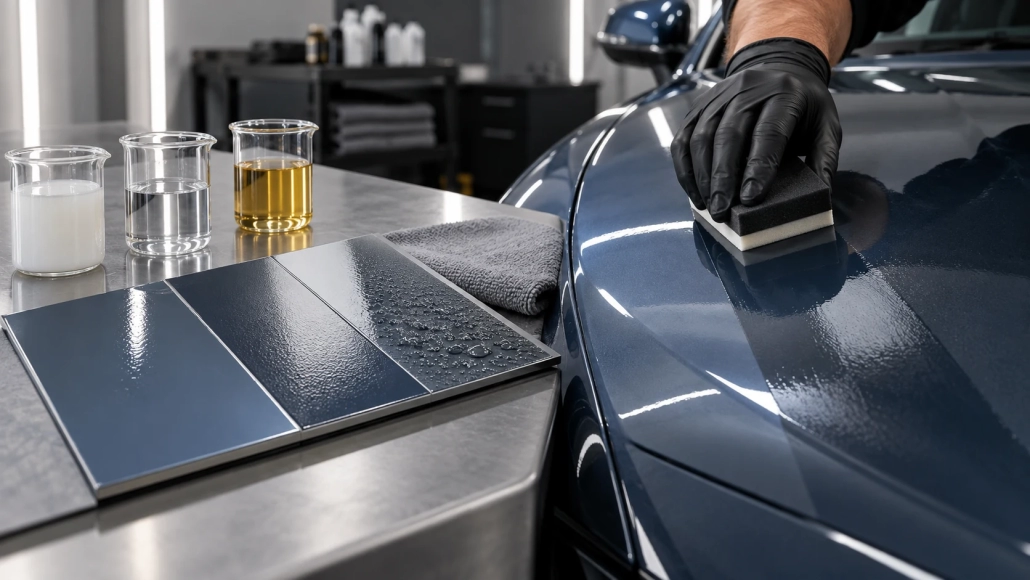
Read coating solids figures alongside application method, finish compatibility and documented performance rather than using one number alone.
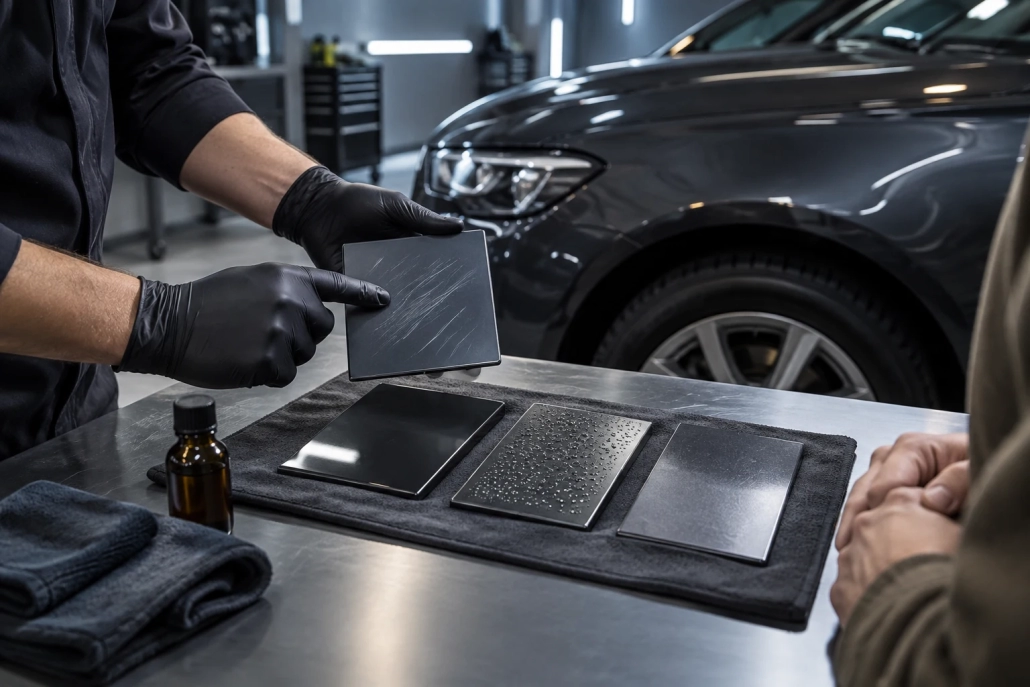
Check whether a laboratory report actually supports a nano coating claim by reviewing sample identity, method, scope, results and the connection to the sold product.
Distinguish flash point, boiling point and approved application temperature when reading coating safety and technical documentation.