






A full polishing range.
From cutting and one-step correction to final finishing.
Specialist chemistry. Expert application.
 QUARTZ99 / CERAMIC BASE COAT
The foundation of your coating system.
A layerable quartz base coat designed for mechanical protection. Pair it with a suitable top coat to create the final finish.
For application by NANOLAB certified installers only.
Four formulas. Extended working time. Find the coating for your finish.
Explore the BEAST family of ceramic coatings.
Find the coating for each exterior surface.
 PPF & VINYLGLOSSProtection for glossy films and wraps.Discover
 MATTE & SATINMATTEProtection that respects the finish.Discover
 GLASSWINDOWSExplore dedicated glass protection.Discover
 WHEEL PROTECTIONWHEELSA dedicated coating for your wheels.Discover
 TRIM PROTECTIONPLASTICProtection for plastic surfaces.Discover
Dedicated care for the surfaces inside.
 LEATHER SURFACESLEATHERDiscover NANOLAB leather protection.Discover PLASTIC SURFACESPLASTICProtection for interior plastic surfaces.Discover TEXTILE SURFACESFABRICExplore the latest fabric formulation.Discover
Spray protection, maintenance and upcoming wash products.
 MAINTENANCEBEAST 365Explore the BEAST maintenance range.Discover
Next in washing, cleaning & care.
Ceramic protection for boats and yachts.
An easy-to-apply ceramic coating with an established track record on boats and yachts around the world.
Results vary with surface preparation, exposure and maintenance.
Read 50 MARINE guides →Explore MARINEProtection for the surfaces you live with.
A look at what we’re developing.
From cutting and one-step correction to final finishing.
A wider range for professional vehicle care.
Taking shape alongside BEAST & MATRIX.
Practical guidance for your next coating project.
Explore all guides →
Read polar and dispersive surface-energy results with the correct model and probe liquids, rather than relying on a single water-angle result.
Updated · NANOLAB Knowledge
Two surfaces can show similar water contact angles while interacting differently with another liquid. Surface-energy models that separate polar and dispersive contributions help explain why a single water result cannot predict every cleaning, coating or bonding interaction.
The OWRK approach divides surface free energy into polar and dispersive components and uses contact-angle measurements with suitable liquids. These are model-derived quantities, not two layers that can be seen on a coated panel.
A laboratory report should identify the model, probe liquids, liquid-property data and measurement procedure. Results produced with different models or unsuitable probe-liquid sets are not automatically interchangeable, even when the units match.
For an installer, the useful question is often whether the prescribed preparation creates a suitable surface for the specified coating. For a product developer, it may be whether a treatment changes interactions relevant to a defined contaminant. Neither question is answered by choosing the highest or lowest total surface-energy number in isolation.
An illustrative report might give two samples the same total value while assigning different proportions to the two components. That does not establish which will perform better in an automotive wash. It indicates that the interaction profile deserves testing with the actual system.
Water beads are useful observations when obtained consistently, but they do not reveal oil repellency or adhesive compatibility by themselves. Avoid using a water-only demonstration to claim universal stain release.
If surface-energy data are relevant to procurement, request the complete method and uncertainty information from the laboratory. Link the result to a representative application test. For routine NANOLAB installation, follow the documented preparation process rather than attempting to redesign it from a single laboratory value or a convenient online contact-angle calculator.
Technical references: KRUSS: OWRK surface-energy method.
For product-specific application instructions, consult NANOLAB technical documentation or ask about your surface and intended use.
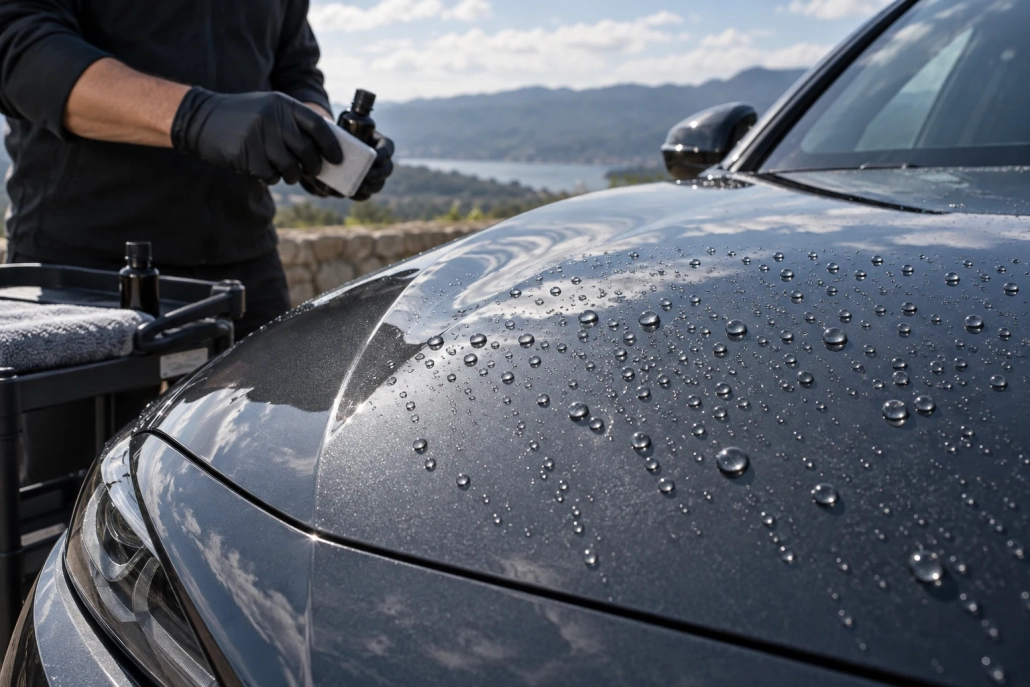
Distinguish the shape of a water drop from how easily it moves when comparing ceramic coating water behaviour.
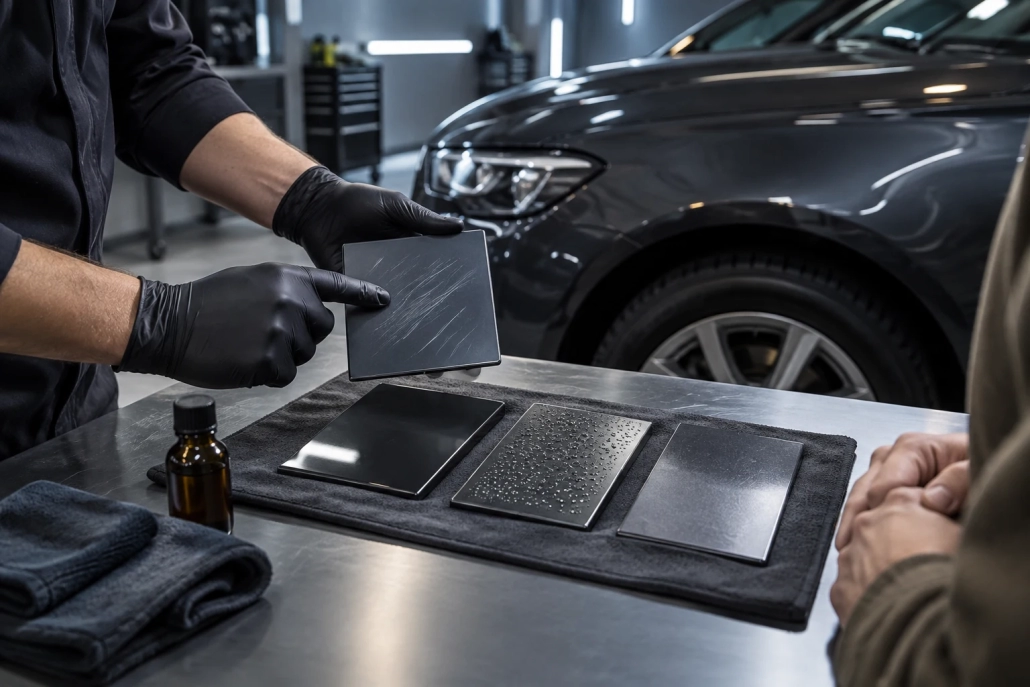
Check whether a laboratory report actually supports a nano coating claim by reviewing sample identity, method, scope, results and the connection to the sold product.
Understand advancing and receding contact angles, calculate hysteresis, and learn why a tall water bead may still resist movement.