






A full polishing range.
From cutting and one-step correction to final finishing.
Specialist chemistry. Expert application.
 QUARTZ99 / CERAMIC BASE COAT
The foundation of your coating system.
A layerable quartz base coat designed for mechanical protection. Pair it with a suitable top coat to create the final finish.
For application by NANOLAB certified installers only.
Four formulas. Extended working time. Find the coating for your finish.
Explore the BEAST family of ceramic coatings.
Find the coating for each exterior surface.
 PPF & VINYLGLOSSProtection for glossy films and wraps.Discover
 MATTE & SATINMATTEProtection that respects the finish.Discover
 GLASSWINDOWSExplore dedicated glass protection.Discover
 WHEEL PROTECTIONWHEELSA dedicated coating for your wheels.Discover
 TRIM PROTECTIONPLASTICProtection for plastic surfaces.Discover
Dedicated care for the surfaces inside.
 LEATHER SURFACESLEATHERDiscover NANOLAB leather protection.Discover PLASTIC SURFACESPLASTICProtection for interior plastic surfaces.Discover TEXTILE SURFACESFABRICExplore the latest fabric formulation.Discover
Spray protection, maintenance and upcoming wash products.
 MAINTENANCEBEAST 365Explore the BEAST maintenance range.Discover
Next in washing, cleaning & care.
Ceramic protection for boats and yachts.
An easy-to-apply ceramic coating with an established track record on boats and yachts around the world.
Results vary with surface preparation, exposure and maintenance.
Read 50 MARINE guides →Explore MARINEProtection for the surfaces you live with.
A look at what we’re developing.
From cutting and one-step correction to final finishing.
A wider range for professional vehicle care.
Taking shape alongside BEAST & MATRIX.
Practical guidance for your next coating project.
Explore all guides →
Convert water hardness between mg/L as CaCO3 and grains per US gallon while avoiding confusion with calcium-only or TDS readings.
Updated · NANOLAB Knowledge
Water-hardness reports often use mg/L as calcium carbonate, while equipment specifications may use grains per US gallon. Converting the units helps compare records, but only when both numbers describe hardness on the same chemical basis.
One grain per US gallon is approximately 17.1 mg/L as CaCO3. Divide a hardness result in mg/L as CaCO3 by 17.1 to obtain grains per US gallon. An illustrative 171 mg/L result is therefore about 10 grains per gallon.
The reverse calculation multiplies by 17.1. Keep “US gallon” in the label; an Imperial gallon is a different volume. Rounding to an appropriate level is more useful than reporting a long decimal from a coarse test-strip reading.
A report of calcium concentration alone is not automatically total hardness. A conductivity reading in microsiemens per centimetre is also not a hardness value. Likewise, a generic “ppm” display on a TDS meter cannot simply be divided by 17.1 and called grains of hardness.
Before calculating, copy the complete parameter name, units and method from the source. If the report only says “minerals,” ask what was measured. The missing definition matters more than the arithmetic.
For a softener or treatment-system comparison, use the manufacturer's sizing procedure and the site's actual water use. Hardness concentration and water volume both contribute to the treatment load. A daily usage estimate based on busy-season washing may differ substantially from a quiet-week average.
Retain the original result alongside the converted value in the workshop record. That allows future staff to check the calculation and prevents a rounded conversion from becoming a false new laboratory measurement. The aim is a consistent operating record, not a universal threshold that guarantees a coating will never develop water marks.
Technical references: USGS: Hardness of Water.
For product-specific application instructions, consult NANOLAB technical documentation or ask about your surface and intended use.
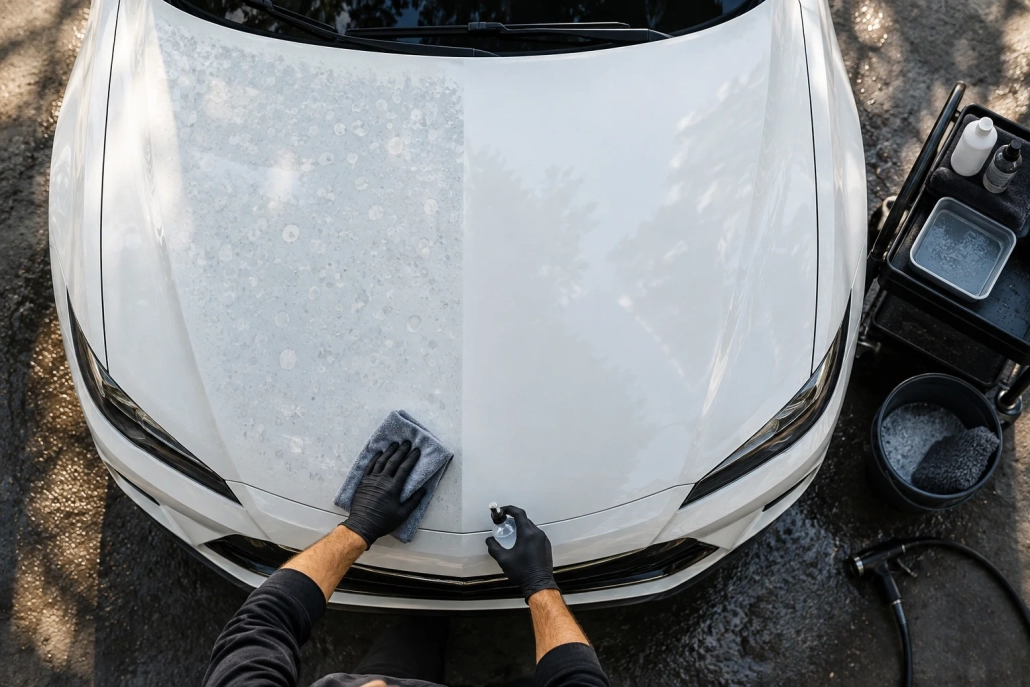
Understand why softened water and deionised rinse water are different when planning washing and drying for a ceramic-coated car.
A TDS display can help monitor a water-treatment system, but it does not describe every contaminant or guarantee that drying will leave no marks.
Convert conductivity between microsiemens and millisiemens, preserve meter settings, and prevent thousandfold errors in rinse-water records.