






A full polishing range.
From cutting and one-step correction to final finishing.
Specialist chemistry. Expert application.
 QUARTZ99 / CERAMIC BASE COAT
The foundation of your coating system.
A layerable quartz base coat designed for mechanical protection. Pair it with a suitable top coat to create the final finish.
For application by NANOLAB certified installers only.
Four formulas. Extended working time. Find the coating for your finish.
Explore the BEAST family of ceramic coatings.
Find the coating for each exterior surface.
 PPF & VINYLGLOSSProtection for glossy films and wraps.Discover
 MATTE & SATINMATTEProtection that respects the finish.Discover
 GLASSWINDOWSExplore dedicated glass protection.Discover
 WHEEL PROTECTIONWHEELSA dedicated coating for your wheels.Discover
 TRIM PROTECTIONPLASTICProtection for plastic surfaces.Discover
Dedicated care for the surfaces inside.
 LEATHER SURFACESLEATHERDiscover NANOLAB leather protection.Discover PLASTIC SURFACESPLASTICProtection for interior plastic surfaces.Discover TEXTILE SURFACESFABRICExplore the latest fabric formulation.Discover
Spray protection, maintenance and upcoming wash products.
 MAINTENANCEBEAST 365Explore the BEAST maintenance range.Discover
Next in washing, cleaning & care.
Ceramic protection for boats and yachts.
An easy-to-apply ceramic coating with an established track record on boats and yachts around the world.
Results vary with surface preparation, exposure and maintenance.
Read 50 MARINE guides →Explore MARINEProtection for the surfaces you live with.
A look at what we’re developing.
From cutting and one-step correction to final finishing.
A wider range for professional vehicle care.
Taking shape alongside BEAST & MATRIX.
Practical guidance for your next coating project.
Explore all guides →
Choose suitable pH calibration buffers, define the cleaner sample correctly, and keep calibration separate from compatibility assessment.
Updated · NANOLAB Knowledge
A pH meter should be calibrated using suitable reference buffers and the instrument's prescribed procedure. The buffers need to cover the expected measurement range; a successful check near neutral does not automatically establish reliable performance far away from it.
For an illustrative aqueous cleaner expected near pH 9, a suitable procedure may use neutral and alkaline buffers rather than only acidic ones. Follow the meter manufacturer's required points and buffer set. Do not assume every meter recognizes the same nominal values.
The sample also needs a clear definition: ready-to-use cleaner, a specified dilution or the concentrate. Those are different liquids. Record the dilution basis and water source when the test concerns an in-use mixture.
Use fresh suitable portions and prevent contamination. Never return used buffer to the stock bottle. Keep the electrode clean and maintained according to its manual; storage and cleaning requirements are specific to the sensor.
A repeatable calibration log should identify the buffers, their condition or expiry information, temperature and the instrument's acceptance result. If calibration fails, resolve that problem before using the meter to release a batch or compare products.
A measured pH does not by itself establish coating compatibility. Cleaner concentration, contact time, other ingredients, surface temperature and rinsing all affect the actual exposure. Use the product's approved procedure and a suitable compatibility test.
If a supplier gives pH for the concentrate while a workshop measures the working dilution, an apparent disagreement may be a sample-definition issue. Confirm the method before concluding that the product has changed. The purpose of calibration is trustworthy measurement of a defined sample, not a shortcut to declaring every cleaner within a chosen pH range safe for every coated surface.
Technical references: Hanna Instruments: Choosing pH calibration buffers.
For product-specific application instructions, consult NANOLAB technical documentation or ask about your surface and intended use.
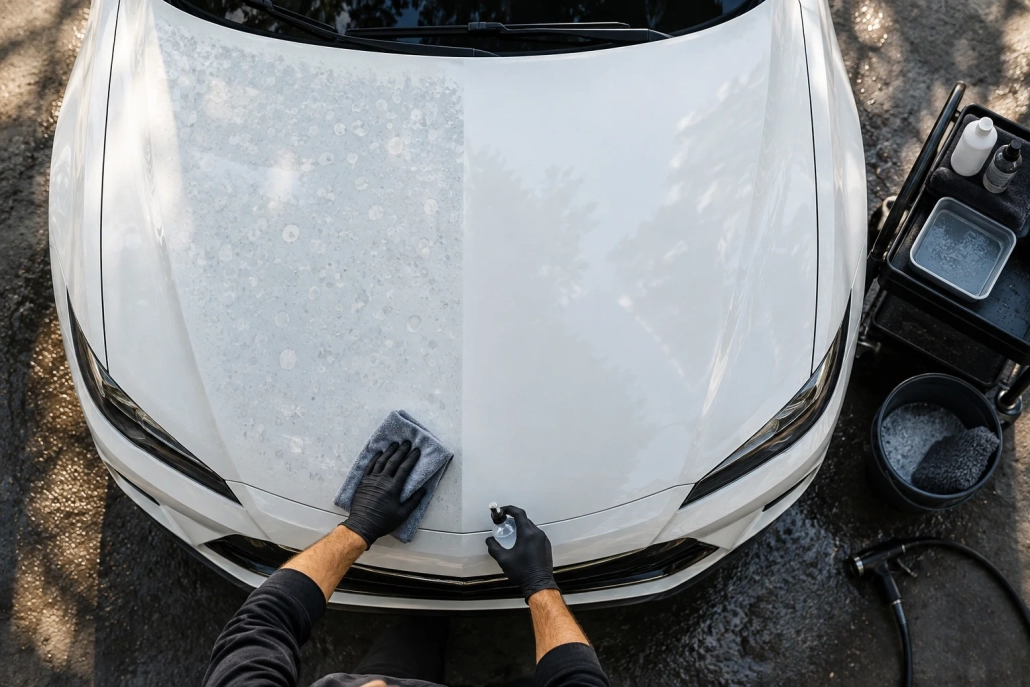
Understand why softened water and deionised rinse water are different when planning washing and drying for a ceramic-coated car.
A TDS display can help monitor a water-treatment system, but it does not describe every contaminant or guarantee that drying will leave no marks.
Choose between pH strips and a meter according to the required decision, sample limitations and measurement resolution.