






A full polishing range.
From cutting and one-step correction to final finishing.
Specialist chemistry. Expert application.
 QUARTZ99 / CERAMIC BASE COAT
The foundation of your coating system.
A layerable quartz base coat designed for mechanical protection. Pair it with a suitable top coat to create the final finish.
For application by NANOLAB certified installers only.
Four formulas. Extended working time. Find the coating for your finish.
Explore the BEAST family of ceramic coatings.
Find the coating for each exterior surface.
 PPF & VINYLGLOSSProtection for glossy films and wraps.Discover
 MATTE & SATINMATTEProtection that respects the finish.Discover
 GLASSWINDOWSExplore dedicated glass protection.Discover
 WHEEL PROTECTIONWHEELSA dedicated coating for your wheels.Discover
 TRIM PROTECTIONPLASTICProtection for plastic surfaces.Discover
Dedicated care for the surfaces inside.
 LEATHER SURFACESLEATHERDiscover NANOLAB leather protection.Discover PLASTIC SURFACESPLASTICProtection for interior plastic surfaces.Discover TEXTILE SURFACESFABRICExplore the latest fabric formulation.Discover
Spray protection, maintenance and upcoming wash products.
 MAINTENANCEBEAST 365Explore the BEAST maintenance range.Discover
Next in washing, cleaning & care.
Ceramic protection for boats and yachts.
An easy-to-apply ceramic coating with an established track record on boats and yachts around the world.
Results vary with surface preparation, exposure and maintenance.
Read 50 MARINE guides →Explore MARINEProtection for the surfaces you live with.
A look at what we’re developing.
From cutting and one-step correction to final finishing.
A wider range for professional vehicle care.
Taking shape alongside BEAST & MATRIX.
Practical guidance for your next coating project.
Explore all guides →
Record tilt rate and waiting time in water-shedding tests so delayed movement is not confused with permanent drop retention.
Updated · NANOLAB Knowledge

A water drop may remain still when a panel first reaches an angle and move a moment later. If one operator pauses and another keeps tilting, they can report different shedding behaviour from the same surface. Time belongs in the method alongside angle.
A continuous tilt should specify its rate. A stepped tilt should specify the angle increment and dwell at each step. Use a suitable controlled fixture and record the actual motion rather than relying on an operator’s impression of a slow hand movement.
Keep drop volume, liquid, deposition method, surface orientation and the delay before tilting fixed. Do not compare a newly deposited drop with one that has already sat on the panel for several minutes.
Agree whether the endpoint is first visible displacement, sustained travel or departure from a marked area. Those events need not occur at the same angle. Video with a visible angle or time record can help resolve borderline observations.
A drop stays still at a particular step for two seconds but begins sustained travel after six seconds. Under a two-second dwell method it would advance to the next step; under a ten-second dwell method it would be recorded as moving at the current step. Neither result should be reported without its timing rule.
Repeat on fresh locations and retain all valid observations. Report a range or distribution when behaviour varies, rather than the most favourable video. A tilt demonstration describes the chosen drop and method; it does not establish every aspect of real rain, washing or coating durability.
A reproducible shedding claim requires a reproducible opportunity for the drop to move.
Ask NANOLAB about your surface and intended use. For application and care, use the current instructions for the exact product.
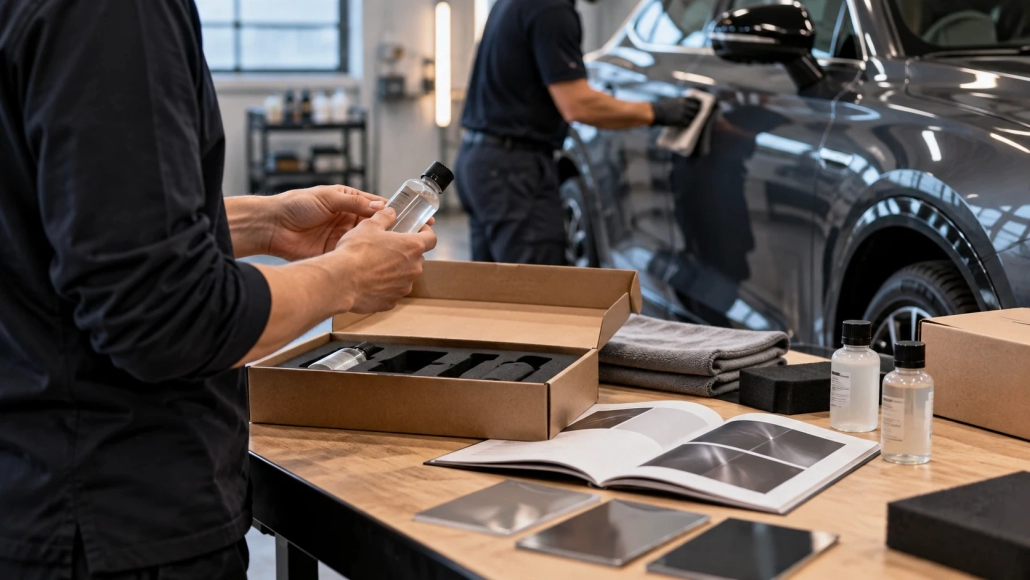
Design a coating field trial with recorded vehicles, use patterns, care routines and inspection points that produce interpretable feedback.
Hydrophobic coating photographs are easier to compare when the water application is consistent.
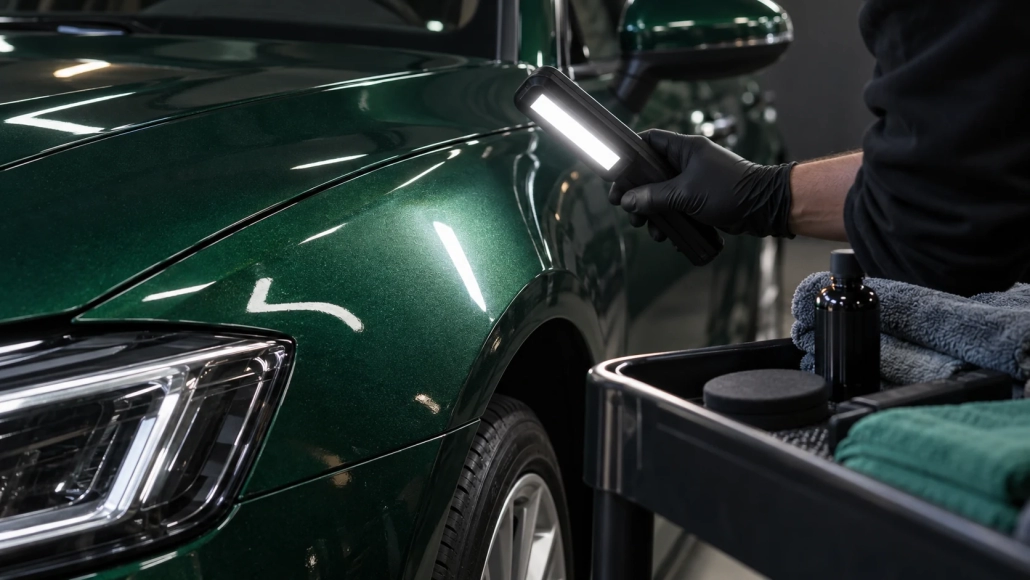
Control vibration and unintended shocks when comparing water shedding, particularly when droplets appear to release only after a panel is touched.

 Vibration in Water-Shedding Demonstrations: Why the Bench Matters