






A full polishing range.
From cutting and one-step correction to final finishing.
Specialist chemistry. Expert application.
 QUARTZ99 / CERAMIC BASE COAT
The foundation of your coating system.
A layerable quartz base coat designed for mechanical protection. Pair it with a suitable top coat to create the final finish.
For application by NANOLAB certified installers only.
Four formulas. Extended working time. Find the coating for your finish.
Explore the BEAST family of ceramic coatings.
Find the coating for each exterior surface.
 PPF & VINYLGLOSSProtection for glossy films and wraps.Discover
 MATTE & SATINMATTEProtection that respects the finish.Discover
 GLASSWINDOWSExplore dedicated glass protection.Discover
 WHEEL PROTECTIONWHEELSA dedicated coating for your wheels.Discover
 TRIM PROTECTIONPLASTICProtection for plastic surfaces.Discover
Dedicated care for the surfaces inside.
 LEATHER SURFACESLEATHERDiscover NANOLAB leather protection.Discover PLASTIC SURFACESPLASTICProtection for interior plastic surfaces.Discover TEXTILE SURFACESFABRICExplore the latest fabric formulation.Discover
Spray protection, maintenance and upcoming wash products.
 MAINTENANCEBEAST 365Explore the BEAST maintenance range.Discover
Next in washing, cleaning & care.
Ceramic protection for boats and yachts.
An easy-to-apply ceramic coating with an established track record on boats and yachts around the world.
Results vary with surface preparation, exposure and maintenance.
Read 50 MARINE guides →Explore MARINEProtection for the surfaces you live with.
A look at what we’re developing.
From cutting and one-step correction to final finishing.
A wider range for professional vehicle care.
Taking shape alongside BEAST & MATRIX.
Practical guidance for your next coating project.
Explore all guides →
Define a pass, section and working cycle clearly so polishing instructions and workshop records are understandable and repeatable.
Updated · NANOLAB Knowledge
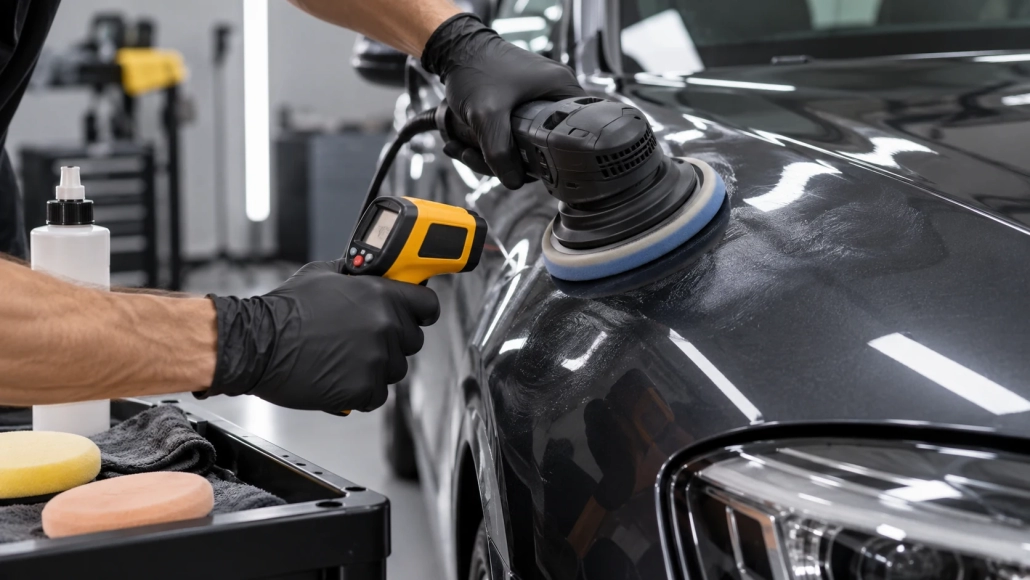
Polishing instructions become confusing when two people use the word pass differently. One may mean a single movement across the paint; another may mean covering the entire section in two directions. Define the terms before comparing results.
A section is the bounded area being treated during one controlled operation. A path is one movement of the tool through part of that area. A coverage pass is one systematic traversal of the section. A working cycle is the complete operation with the current product application before stopping for cleanup or reloading.
These definitions are a practical convention, not an industry-wide standard. If a manufacturer uses different terminology, follow its definitions for that procedure.
Two technicians can both report four passes while delivering very different coverage and machine time. A comparison based only on that number is therefore incomplete.
Section size also changes the meaning of a cycle. The same number of movements over a small recess and a broad panel does not represent an equivalent treatment.
Include the area, machine, pad, liquid, working pattern and stop condition. Describe whether the section was covered in one direction or a crosswise pattern and when residue was removed for inspection.
Do not turn the note into an instruction to polish until a fixed count regardless of surface response. Follow the product’s guidance and reassess if the film, pad or paint behaves unexpectedly.
After a cycle, evaluate useful defect reduction, remaining marks and finish quality. Decide whether another cycle, a different pairing or refinement is appropriate.
Clear terminology helps handovers and supplier discussions. Instead of saying the compound did nothing after six passes, you can explain the actual working area, coverage, machine time and cleaned result. That makes troubleshooting more precise and reduces unnecessary repetition driven by an ambiguous number.
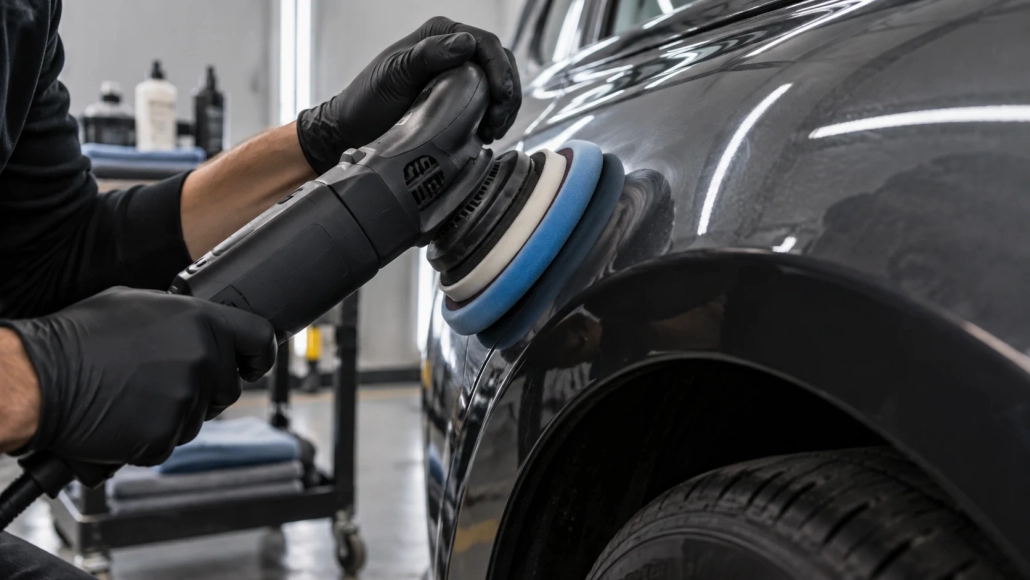
Choose a dual-action polish by machine movement, defect level and pad system, then validate correction and finish before working around the vehicle.
Build beginner DA skills on an appropriate practice surface with a limited objective, supported equipment and an inspected test section.
Plan polishing sections, pad rotation and inspection pauses to keep heat and tool control within the limits of the surface and equipment.

 Your First DA Polishing Panel: A Controlled Learning Plan