






A full polishing range.
From cutting and one-step correction to final finishing.
Specialist chemistry. Expert application.
 QUARTZ99 / CERAMIC BASE COAT
The foundation of your coating system.
A layerable quartz base coat designed for mechanical protection. Pair it with a suitable top coat to create the final finish.
For application by NANOLAB certified installers only.
Four formulas. Extended working time. Find the coating for your finish.
Explore the BEAST family of ceramic coatings.
Find the coating for each exterior surface.
 PPF & VINYLGLOSSProtection for glossy films and wraps.Discover
 MATTE & SATINMATTEProtection that respects the finish.Discover
 GLASSWINDOWSExplore dedicated glass protection.Discover
 WHEEL PROTECTIONWHEELSA dedicated coating for your wheels.Discover
 TRIM PROTECTIONPLASTICProtection for plastic surfaces.Discover
Dedicated care for the surfaces inside.
 LEATHER SURFACESLEATHERDiscover NANOLAB leather protection.Discover PLASTIC SURFACESPLASTICProtection for interior plastic surfaces.Discover TEXTILE SURFACESFABRICExplore the latest fabric formulation.Discover
Spray protection, maintenance and upcoming wash products.
 MAINTENANCEBEAST 365Explore the BEAST maintenance range.Discover
Next in washing, cleaning & care.
Ceramic protection for boats and yachts.
An easy-to-apply ceramic coating with an established track record on boats and yachts around the world.
Results vary with surface preparation, exposure and maintenance.
Read 50 MARINE guides →Explore MARINEProtection for the surfaces you live with.
A look at what we’re developing.
From cutting and one-step correction to final finishing.
A wider range for professional vehicle care.
Taking shape alongside BEAST & MATRIX.
Practical guidance for your next coating project.
Explore all guides →
Fluorescent UV and xenon-arc weathering are different approaches to exposure testing. The appropriate choice depends on the material, intended environment and failure question, not simply which machine produces a result sooner.
Updated · NANOLAB Knowledge
Q-Lab discusses differences between these test families, including their light sources and exposure capabilities. A useful test request explains what change matters: for example, a defined appearance change or loss of a specified property. The laboratory can then propose an appropriate method and describe the limits of the resulting evidence.
Illustrative example: a buyer requests a generic UV test without identifying the intended coating claim. The resulting report may document an exposure but leave the purchasing question unresolved. Defining the failure question first helps avoid paying for a test that cannot support the planned decision.
Do not claim that one test family universally predicts outdoor life better for every coating. Nor should a test duration be translated into years without supporting evidence. This guide frames a laboratory discussion; it does not prescribe a qualification method for an unidentified product.
Technical references: Q-Lab: QUV and Q-SUN comparison. These sources describe their stated methods or products; they do not certify NANOLAB products or establish compatibility with an unlisted surface.
Ask NANOLAB about the exact product and intended use. Use the current product documentation for formulation-specific instructions.

Compare mean and median cleaning times, retain legitimate difficult jobs, and choose a summary that matches the operational question.
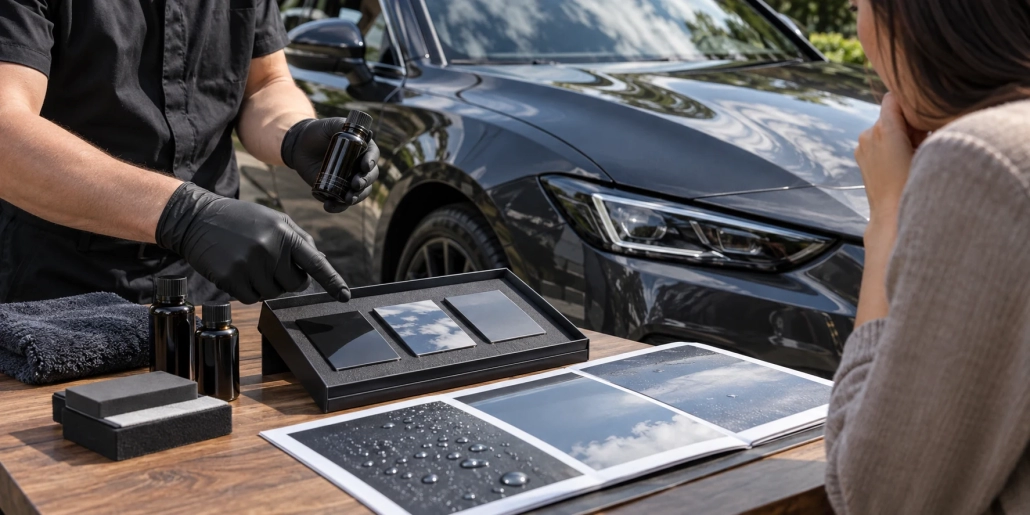
Evaluate inspection, preparation, product knowledge and aftercare instead of choosing an installer only by price or a durability headline.
Equal applied force does not mean equal contact pressure when the contact areas differ. A coating test comparison should retain the tool geometry and contact arrangement alongside the load.