






A full polishing range.
From cutting and one-step correction to final finishing.
Specialist chemistry. Expert application.
 QUARTZ99 / CERAMIC BASE COAT
The foundation of your coating system.
A layerable quartz base coat designed for mechanical protection. Pair it with a suitable top coat to create the final finish.
For application by NANOLAB certified installers only.
Four formulas. Extended working time. Find the coating for your finish.
Explore the BEAST family of ceramic coatings.
Find the coating for each exterior surface.
 PPF & VINYLGLOSSProtection for glossy films and wraps.Discover
 MATTE & SATINMATTEProtection that respects the finish.Discover
 GLASSWINDOWSExplore dedicated glass protection.Discover
 WHEEL PROTECTIONWHEELSA dedicated coating for your wheels.Discover
 TRIM PROTECTIONPLASTICProtection for plastic surfaces.Discover
Dedicated care for the surfaces inside.
 LEATHER SURFACESLEATHERDiscover NANOLAB leather protection.Discover PLASTIC SURFACESPLASTICProtection for interior plastic surfaces.Discover TEXTILE SURFACESFABRICExplore the latest fabric formulation.Discover
Spray protection, maintenance and upcoming wash products.
 MAINTENANCEBEAST 365Explore the BEAST maintenance range.Discover
Next in washing, cleaning & care.
Ceramic protection for boats and yachts.
An easy-to-apply ceramic coating with an established track record on boats and yachts around the world.
Results vary with surface preparation, exposure and maintenance.
Read 50 MARINE guides →Explore MARINEProtection for the surfaces you live with.
A look at what we’re developing.
From cutting and one-step correction to final finishing.
A wider range for professional vehicle care.
Taking shape alongside BEAST & MATRIX.
Practical guidance for your next coating project.
Explore all guides →
Build a distributor coating demonstration that can be repeated reliably, with a defined audience decision, transparent preparation and a practical follow-up.
Updated · NANOLAB Knowledge
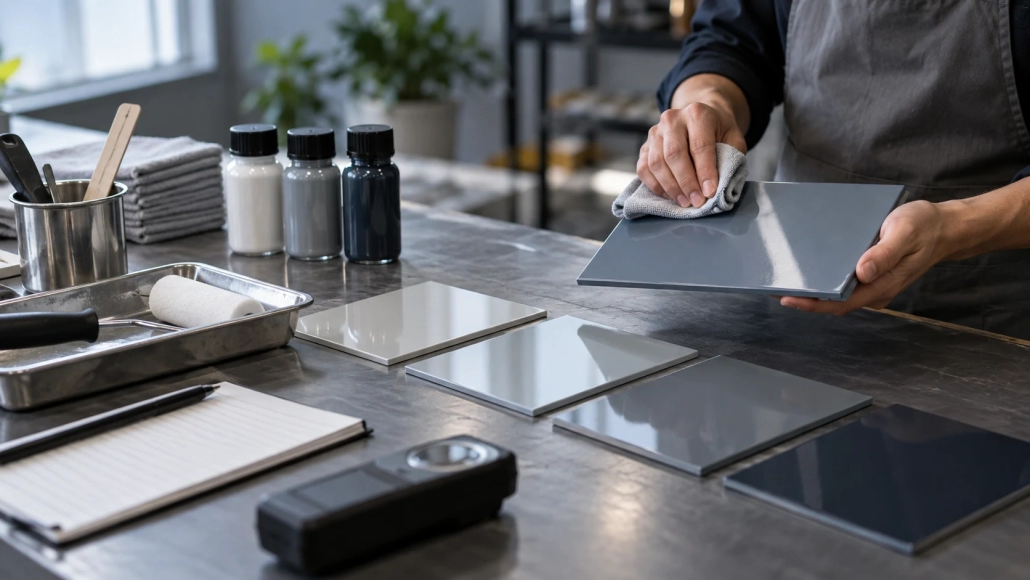
A distributor demonstration should help the audience make a specific decision: whether the product fits its customers, application process and support capability. An impressive water display alone leaves many of those questions unanswered. Plan the session as a reproducible explanation of use, result and limitations.
Define whether the session concerns application training, product-range selection or a technical comparison. Trying to answer every question in one demonstration often creates a rushed sequence with no clear evidence. Select a representative surface and the exact product intended for that surface.
Identify the substrate, preparation, product, application date and cure conditions. If a pre-cured sample is needed, prepare it in advance and label it clearly. Do not imply that a freshly applied coating can immediately undergo a test that requires additional curing.
| Session element | Purpose |
|---|---|
| Untreated or relevant reference | Provide context where comparison is appropriate |
| Application sample | Show the supported working process |
| Prepared performance sample | Demonstrate behaviour after its documented preparation and cure |
| Care example | Explain the maintenance routine |
| Written takeaway | Preserve exact product and process information |
Explain the surface and preparation before applying the product. Show the relevant application and finishing decisions without compressing the required process into a misleading live timetable. When moving to a prepared sample, say so explicitly and state its history.
Describe what the demonstration shows under those conditions. A water-shedding observation does not establish a universal service life, scratch resistance or chemical compatibility. Keep any broader claim tied to the evidence that actually supports it.
Use a written checklist for sample identity, lighting, tools and presentation order. Record deviations such as a changed surface, new applicator or different environmental condition. Keep replacement samples controlled so the presenter does not unknowingly compare differently prepared pieces.
For example, one session might use a polished panel and another an uncorrected panel. If both are described simply as “before and after coating,” the audience may attribute preparation differences to the product. The checklist should make that history visible.
After the demonstration, ask the distributor to explain which product suits a stated customer surface and what information is needed before application. A supervised, supported practice task can reveal misunderstandings more effectively than a nod of agreement. Do not present attendance alone as installer certification.
Provide the current instructions, a suitable evaluation plan and the route for technical questions. Agree what the distributor will record and review next. Keep commercial terms separate from the technical evidence so an attractive offer does not obscure an unresolved compatibility question.
The successful demonstration leaves the audience able to describe the product accurately and run the next evaluation consistently, even when the original presenter is no longer in the room.
Discuss a private-label coating project. Follow the current instructions for the exact product when planning application and care.

Document conditions and observations so a demonstration clip does not become an unsupported durability claim.
Turn recurring support questions into practical teaching modules rather than a product slideshow.

 Coating Workshop Scheduling: Account for Inspection and Rework Capacity