






A full polishing range.
From cutting and one-step correction to final finishing.
Specialist chemistry. Expert application.
 QUARTZ99 / CERAMIC BASE COAT
The foundation of your coating system.
A layerable quartz base coat designed for mechanical protection. Pair it with a suitable top coat to create the final finish.
For application by NANOLAB certified installers only.
Four formulas. Extended working time. Find the coating for your finish.
Explore the BEAST family of ceramic coatings.
Find the coating for each exterior surface.
 PPF & VINYLGLOSSProtection for glossy films and wraps.Discover
 MATTE & SATINMATTEProtection that respects the finish.Discover
 GLASSWINDOWSExplore dedicated glass protection.Discover
 WHEEL PROTECTIONWHEELSA dedicated coating for your wheels.Discover
 TRIM PROTECTIONPLASTICProtection for plastic surfaces.Discover
Dedicated care for the surfaces inside.
 LEATHER SURFACESLEATHERDiscover NANOLAB leather protection.Discover PLASTIC SURFACESPLASTICProtection for interior plastic surfaces.Discover TEXTILE SURFACESFABRICExplore the latest fabric formulation.Discover
Spray protection, maintenance and upcoming wash products.
 MAINTENANCEBEAST 365Explore the BEAST maintenance range.Discover
Next in washing, cleaning & care.
Ceramic protection for boats and yachts.
An easy-to-apply ceramic coating with an established track record on boats and yachts around the world.
Results vary with surface preparation, exposure and maintenance.
Read 50 MARINE guides →Explore MARINEProtection for the surfaces you live with.
A look at what we’re developing.
From cutting and one-step correction to final finishing.
A wider range for professional vehicle care.
Taking shape alongside BEAST & MATRIX.
Practical guidance for your next coating project.
Explore all guides →
Organise coating support photographs, records and test files with clear identifiers so each attachment answers a specific technical question.
Updated · NANOLAB Knowledge

A support case can contain useful evidence yet remain difficult to review because photographs and records are scattered across several messages. A compact evidence index connects each file to the surface, date and question it addresses.
Use a simple case code and numbered surface zones. Keep customer-sensitive details out of filenames where they are unnecessary. The same zone identifier should appear in the photograph caption, application record and observation log.
| Field | Purpose |
|---|---|
| File identifier | Provides an unambiguous reference |
| Date and surface zone | Places the observation in the timeline |
| State | As found, after cleaning or after another approved step |
| Question | Explains why the attachment is included |
Retain original photographs and instrument files. If an annotated copy is supplied, label it as a derivative and link it to the original. Do not overwrite the only image with arrows, contrast changes or a cropped view that removes context.
When support asks for a particular view or record, add it to the index and state which request it answers. Mark unavailable evidence explicitly rather than substituting a superficially similar file. For example, a photograph after cleaning cannot replace the missing as-found image without changing the question it can answer. A concise index reduces repeated requests and makes the final technical decision traceable to the evidence actually reviewed.
Ask NANOLAB about your surface and intended use. For application and care, use the current instructions for the exact product.
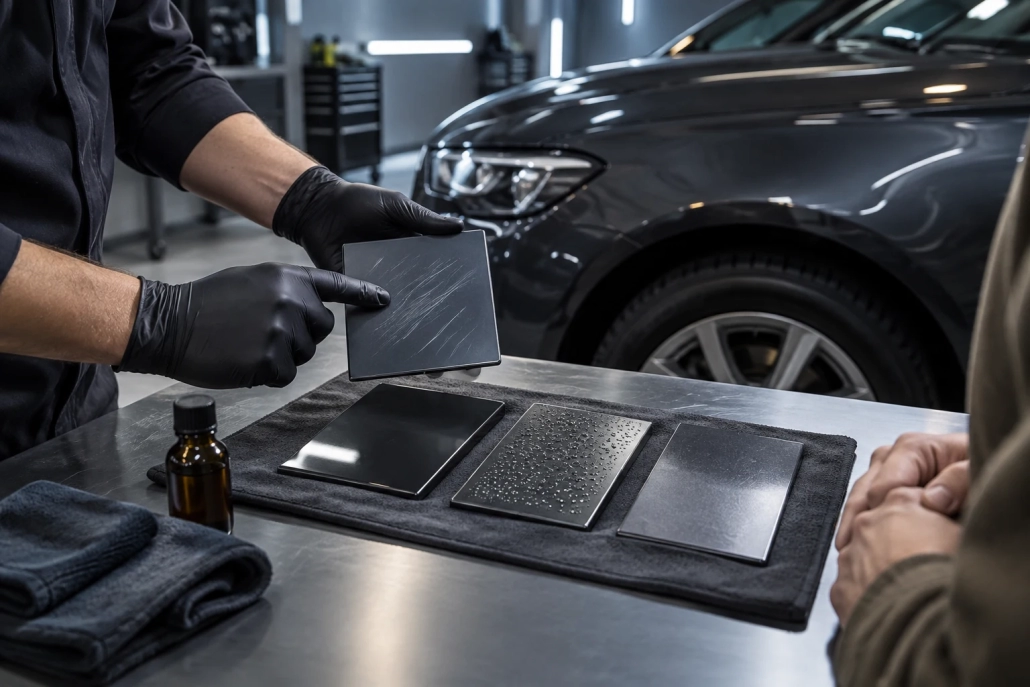
Keep coating performance statements connected to their product version, test method and limitations before using them in sales material.
Send NANOLAB a focused technical enquiry with product, surface, process and observations so the next recommendation can be specific.
Document cleaning and correction in before-and-after coating demonstrations so the coating is not credited for work performed during preparation.

 Before-and-After Coating Demonstrations: Keep the Preparation Work Visible