






A full polishing range.
From cutting and one-step correction to final finishing.
Specialist chemistry. Expert application.
 QUARTZ99 / CERAMIC BASE COAT
The foundation of your coating system.
A layerable quartz base coat designed for mechanical protection. Pair it with a suitable top coat to create the final finish.
For application by NANOLAB certified installers only.
Four formulas. Extended working time. Find the coating for your finish.
Explore the BEAST family of ceramic coatings.
Find the coating for each exterior surface.
 PPF & VINYLGLOSSProtection for glossy films and wraps.Discover
 MATTE & SATINMATTEProtection that respects the finish.Discover
 GLASSWINDOWSExplore dedicated glass protection.Discover
 WHEEL PROTECTIONWHEELSA dedicated coating for your wheels.Discover
 TRIM PROTECTIONPLASTICProtection for plastic surfaces.Discover
Dedicated care for the surfaces inside.
 LEATHER SURFACESLEATHERDiscover NANOLAB leather protection.Discover PLASTIC SURFACESPLASTICProtection for interior plastic surfaces.Discover TEXTILE SURFACESFABRICExplore the latest fabric formulation.Discover
Spray protection, maintenance and upcoming wash products.
 MAINTENANCEBEAST 365Explore the BEAST maintenance range.Discover
Next in washing, cleaning & care.
Ceramic protection for boats and yachts.
An easy-to-apply ceramic coating with an established track record on boats and yachts around the world.
Results vary with surface preparation, exposure and maintenance.
Read 50 MARINE guides →Explore MARINEProtection for the surfaces you live with.
A look at what we’re developing.
From cutting and one-step correction to final finishing.
A wider range for professional vehicle care.
Taking shape alongside BEAST & MATRIX.
Practical guidance for your next coating project.
Explore all guides →
Use independent batches and balanced within-batch sampling to distinguish production variation from specimen and measurement variation.
Updated · NANOLAB Knowledge

Measuring one coating batch many times can estimate some measurement variation, but it cannot establish how production batches differ. A sampling plan must include independent batches when between-batch variation is the question.
Identify batches, specimens within batches and repeated measurements within specimens. Keep those levels in the data rather than entering every reading as an independent production result.
An illustrative plan might sample four independent batches, three specimens from each and two readings per specimen. This creates 24 readings but only four batch units. The numbers are an example, not a universal recommendation; choose the design according to precision needs and available resources.
A suitable nested or mixed model can estimate variance components under its assumptions. Report uncertainty, especially with few batches. Do not interpret a small estimated batch component as proof that all future batches are identical. If every batch was also tested by a different operator on a different day, those effects are entangled. Improve the design before attributing the observed variation solely to manufacturing.
The sources below support the stated concepts or describe their own methods. The worked scenarios are editorial examples, not NANOLAB test results.
Ask NANOLAB about your surface and intended use. For application and care, use the current instructions for the exact product.
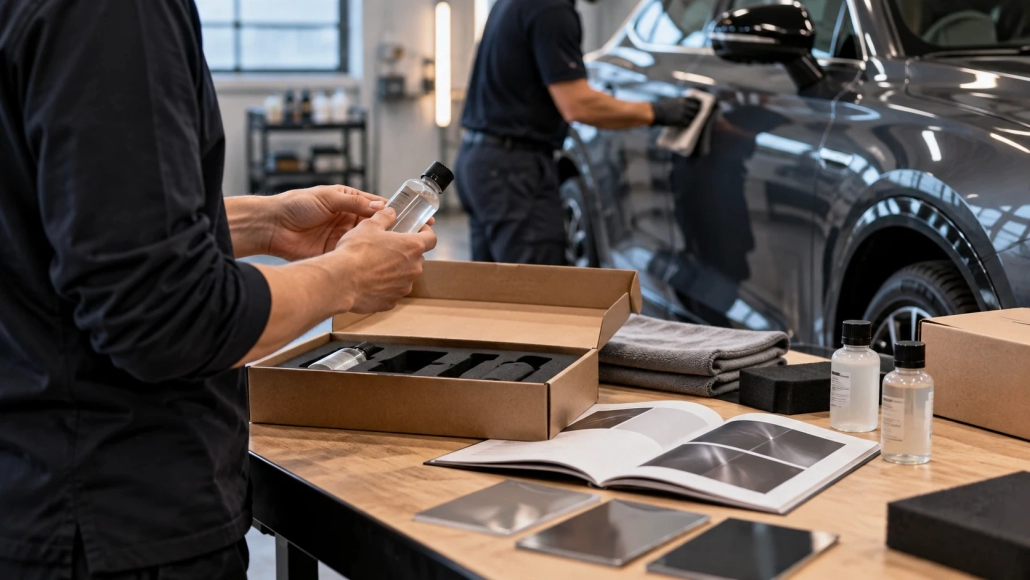
Design a coating field trial with recorded vehicles, use patterns, care routines and inspection points that produce interpretable feedback.

Testing many panels from one production batch does not establish variation across batches. State the number of batches as well as the number of specimens when describing the scope of a coating evaluation.
Evaluate inspector consistency with class-specific results and an appropriate agreement analysis, not only an overall percentage.
 Inspector Agreement in Coating QC: Look beyond the Percentage Agreeing