






A full polishing range.
From cutting and one-step correction to final finishing.
Specialist chemistry. Expert application.
 QUARTZ99 / CERAMIC BASE COAT
The foundation of your coating system.
A layerable quartz base coat designed for mechanical protection. Pair it with a suitable top coat to create the final finish.
For application by NANOLAB certified installers only.
Four formulas. Extended working time. Find the coating for your finish.
Explore the BEAST family of ceramic coatings.
Find the coating for each exterior surface.
 PPF & VINYLGLOSSProtection for glossy films and wraps.Discover
 MATTE & SATINMATTEProtection that respects the finish.Discover
 GLASSWINDOWSExplore dedicated glass protection.Discover
 WHEEL PROTECTIONWHEELSA dedicated coating for your wheels.Discover
 TRIM PROTECTIONPLASTICProtection for plastic surfaces.Discover
Dedicated care for the surfaces inside.
 LEATHER SURFACESLEATHERDiscover NANOLAB leather protection.Discover PLASTIC SURFACESPLASTICProtection for interior plastic surfaces.Discover TEXTILE SURFACESFABRICExplore the latest fabric formulation.Discover
Spray protection, maintenance and upcoming wash products.
 MAINTENANCEBEAST 365Explore the BEAST maintenance range.Discover
Next in washing, cleaning & care.
Ceramic protection for boats and yachts.
An easy-to-apply ceramic coating with an established track record on boats and yachts around the world.
Results vary with surface preparation, exposure and maintenance.
Read 50 MARINE guides →Explore MARINEProtection for the surfaces you live with.
A look at what we’re developing.
From cutting and one-step correction to final finishing.
A wider range for professional vehicle care.
Taking shape alongside BEAST & MATRIX.
Practical guidance for your next coating project.
Explore all guides →
Investigate salt retention at marine fasteners and joints before expecting a coating on the surrounding panel to solve repeated staining.
Updated · NANOLAB Knowledge
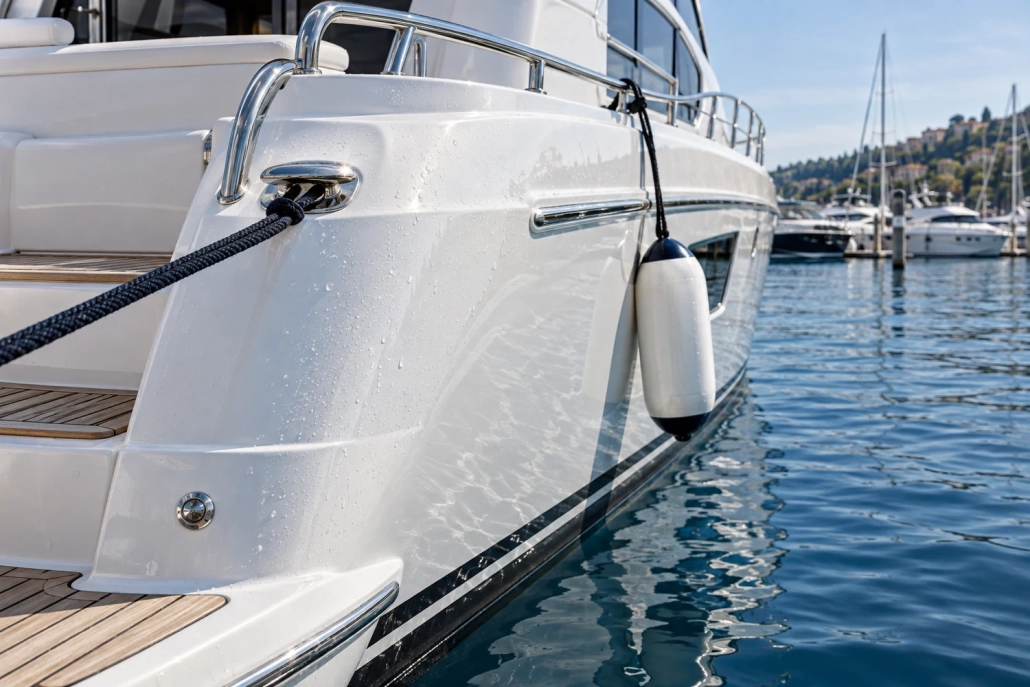
A broad marine panel may rinse clean while salt and moisture remain around a fastener, washer or narrow joint. Repeated staining at that location should be investigated as a local assembly problem before changing the coating on the whole panel.
Photograph the fitting before cleaning and trace the stain direction. Check whether it begins at a joint, drains from an adjacent component or appears on the open surface. Record the metal and finish where documentation is available; appearance alone may not identify the alloy.
| Observation | Investigation |
|---|---|
| Residue under a washer edge | Can the approved rinse reach and leave the area? |
| Stain below the fitting | Is the source at the joint or farther upstream? |
| Persistent dampness | Does the assembly retain water? |
Do not loosen safety-critical fittings or introduce sealant as an improvised cleaning measure. Refer suspected installation, material or corrosion problems to the responsible marine professional. A surface coating is not evidence that a hidden interface has been cleaned, sealed or made corrosion-resistant.
After the agreed correction and approved cleaning, establish a new photograph baseline. Reinspect after ordinary service and rinsing, recording when the local stain returns. Compare the joint with the adjacent broad panel. If the panel remains clean but the joint repeatedly releases residue, the maintenance plan needs to address that source rather than simply increase coating frequency over the surrounding area.
Ask NANOLAB about your surface and intended use. For application and care, use the current instructions for the exact product.
A pre-coating inspection prevents attractive results in one area from hiding unresolved problems elsewhere.
Ceramic coating does not remove the need to wash a boat exposed to salt.
Trace scupper and drain runoff before treating repeated gelcoat staining as a failure of the exposed surface coating.
 Scupper Runoff and Repeated Staining on Coated Gelcoat