






A full polishing range.
From cutting and one-step correction to final finishing.
Specialist chemistry. Expert application.
 QUARTZ99 / CERAMIC BASE COAT
The foundation of your coating system.
A layerable quartz base coat designed for mechanical protection. Pair it with a suitable top coat to create the final finish.
For application by NANOLAB certified installers only.
Four formulas. Extended working time. Find the coating for your finish.
Explore the BEAST family of ceramic coatings.
Find the coating for each exterior surface.
 PPF & VINYLGLOSSProtection for glossy films and wraps.Discover
 MATTE & SATINMATTEProtection that respects the finish.Discover
 GLASSWINDOWSExplore dedicated glass protection.Discover
 WHEEL PROTECTIONWHEELSA dedicated coating for your wheels.Discover
 TRIM PROTECTIONPLASTICProtection for plastic surfaces.Discover
Dedicated care for the surfaces inside.
 LEATHER SURFACESLEATHERDiscover NANOLAB leather protection.Discover PLASTIC SURFACESPLASTICProtection for interior plastic surfaces.Discover TEXTILE SURFACESFABRICExplore the latest fabric formulation.Discover
Spray protection, maintenance and upcoming wash products.
 MAINTENANCEBEAST 365Explore the BEAST maintenance range.Discover
Next in washing, cleaning & care.
Ceramic protection for boats and yachts.
An easy-to-apply ceramic coating with an established track record on boats and yachts around the world.
Results vary with surface preparation, exposure and maintenance.
Read 50 MARINE guides →Explore MARINEProtection for the surfaces you live with.
A look at what we’re developing.
From cutting and one-step correction to final finishing.
A wider range for professional vehicle care.
Taking shape alongside BEAST & MATRIX.
Practical guidance for your next coating project.
Explore all guides →
Coordinate nearby spraying, traffic and handling so a freshly coated vehicle remains protected during the product’s required initial processing period.
Updated · NANOLAB Knowledge

A coating job can be disrupted by work that has nothing to do with its application: a nearby spray, a moving trolley or someone touching a panel to inspect the shine. Protecting the job requires coordination beyond the applicator.
Use the product’s actual instructions to identify handling, water and environmental restrictions. Mark the work area clearly and tell other staff which surfaces are unavailable for contact. Avoid inventing a universal waiting time.
| Activity | Control question |
|---|---|
| Spraying another product | Can overspray reach the vehicle? |
| Trolley or vehicle movement | Is clearance adequate? |
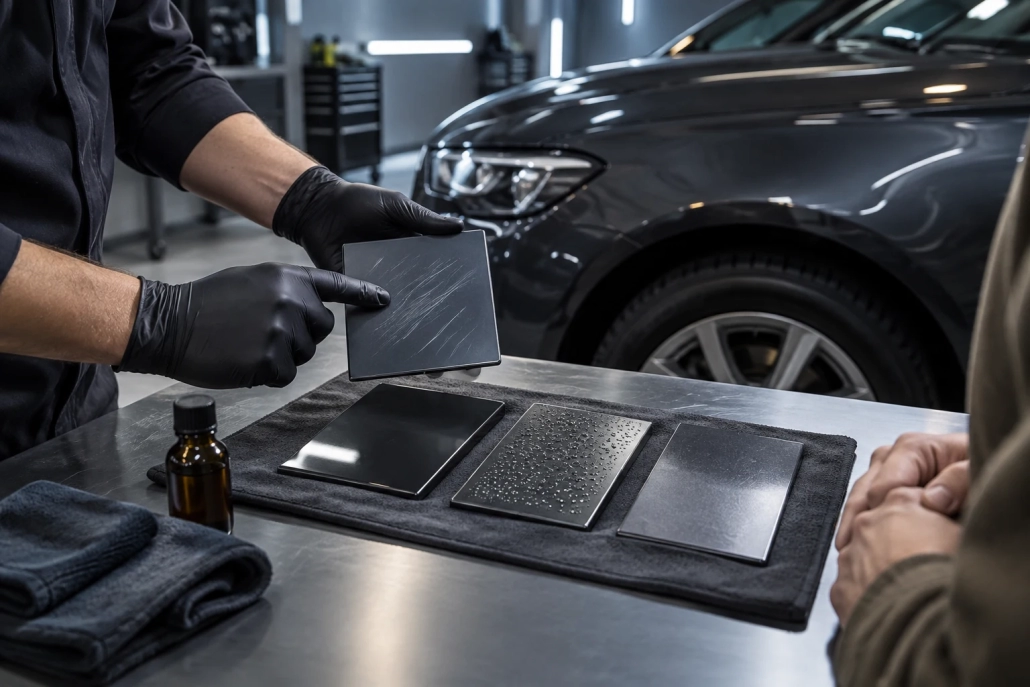
| Customer viewing | Can the finish be shown without touching? |
| Cleaning the bay | Could splash or dust reach the surface? |
Use a job card showing the relevant state and next permitted step. A sign reading do not touch is useful but incomplete if nobody knows when the restriction ends or who can release the vehicle.
If another product lands on the surface or someone contacts it, document the location and time. Follow the coating supplier’s supported assessment and correction method. Do not automatically wipe, polish or add a layer to make the mark disappear before understanding the state of the coating.
The protection plan should fit normal workshop operations. Clear routes, task scheduling and a visible release state reduce accidental interference without turning the whole facility into an impractical exclusion zone.
Ask NANOLAB about your surface and intended use. For application and care, use the current instructions for the exact product.
Use clear checkpoints before application, after levelling and at handover to make coating work consistent and traceable.
Interpret salt-spray reports for nano-coated metals by checking the complete specimen system, acceptance criteria and limits of outdoor-life predictions.
Investigate oily runoff from badges and recesses before coating nearby paint, using the surface history and a controlled preparation sequence.
 Badge Recesses and Oily Runoff: A Local Preparation Problem