






A full polishing range.
From cutting and one-step correction to final finishing.
Specialist chemistry. Expert application.
 QUARTZ99 / CERAMIC BASE COAT
The foundation of your coating system.
A layerable quartz base coat designed for mechanical protection. Pair it with a suitable top coat to create the final finish.
For application by NANOLAB certified installers only.
Four formulas. Extended working time. Find the coating for your finish.
Explore the BEAST family of ceramic coatings.
Find the coating for each exterior surface.
 PPF & VINYLGLOSSProtection for glossy films and wraps.Discover
 MATTE & SATINMATTEProtection that respects the finish.Discover
 GLASSWINDOWSExplore dedicated glass protection.Discover
 WHEEL PROTECTIONWHEELSA dedicated coating for your wheels.Discover
 TRIM PROTECTIONPLASTICProtection for plastic surfaces.Discover
Dedicated care for the surfaces inside.
 LEATHER SURFACESLEATHERDiscover NANOLAB leather protection.Discover PLASTIC SURFACESPLASTICProtection for interior plastic surfaces.Discover TEXTILE SURFACESFABRICExplore the latest fabric formulation.Discover
Spray protection, maintenance and upcoming wash products.
 MAINTENANCEBEAST 365Explore the BEAST maintenance range.Discover
Next in washing, cleaning & care.
Ceramic protection for boats and yachts.
An easy-to-apply ceramic coating with an established track record on boats and yachts around the world.
Results vary with surface preparation, exposure and maintenance.
Read 50 MARINE guides →Explore MARINEProtection for the surfaces you live with.
A look at what we’re developing.
From cutting and one-step correction to final finishing.
A wider range for professional vehicle care.
Taking shape alongside BEAST & MATRIX.
Practical guidance for your next coating project.
Explore all guides →
Recheck actual surface conditions after preparation wiping when evaporation or a changing environment may alter the coating application window.
Updated · NANOLAB Knowledge

A panel’s temperature can change during preparation and while a vehicle settles into a workshop. A temperature recorded at intake may no longer describe the surface when coating begins.
Use a suitable measurement method for the surface and follow the instrument’s limitations. Check representative areas after preparation and before application. Record air conditions separately from surface temperature.
Evaporation and environmental changes can affect the surface condition. The practical requirement is to verify the coating’s actual application conditions, not to calculate a universal cooling allowance from the amount of panel wipe used.
| Area | Reason for a separate check |
|---|---|
| Previously sun-exposed panel | May retain heat differently |
| Recently wiped section | Has a different immediate history |
| Panel near a doorway | May experience changing airflow |
DeFelsko’s environmental guidance explains why coating work considers surface temperature, humidity and dew point. Industrial-paint thresholds should not be copied automatically into every nano-coating instruction. Apply the requirements for the exact product and substrate.
If condensation or another unsuitable condition is suspected, stop and resolve it through the appropriate procedure. Do not cover uncertainty with another preparation wipe or a faster application.
Record the condition that was accepted and the time coating started. This creates a useful history if working behaviour changes later in the job and prevents the team from treating a room thermometer reading as proof that every panel is ready.
The sources below support the stated concepts or describe their own methods. The worked scenarios are editorial examples, not NANOLAB test results.
Ask NANOLAB about your surface and intended use. For application and care, use the current instructions for the exact product.
Use clear checkpoints before application, after levelling and at handover to make coating work consistent and traceable.
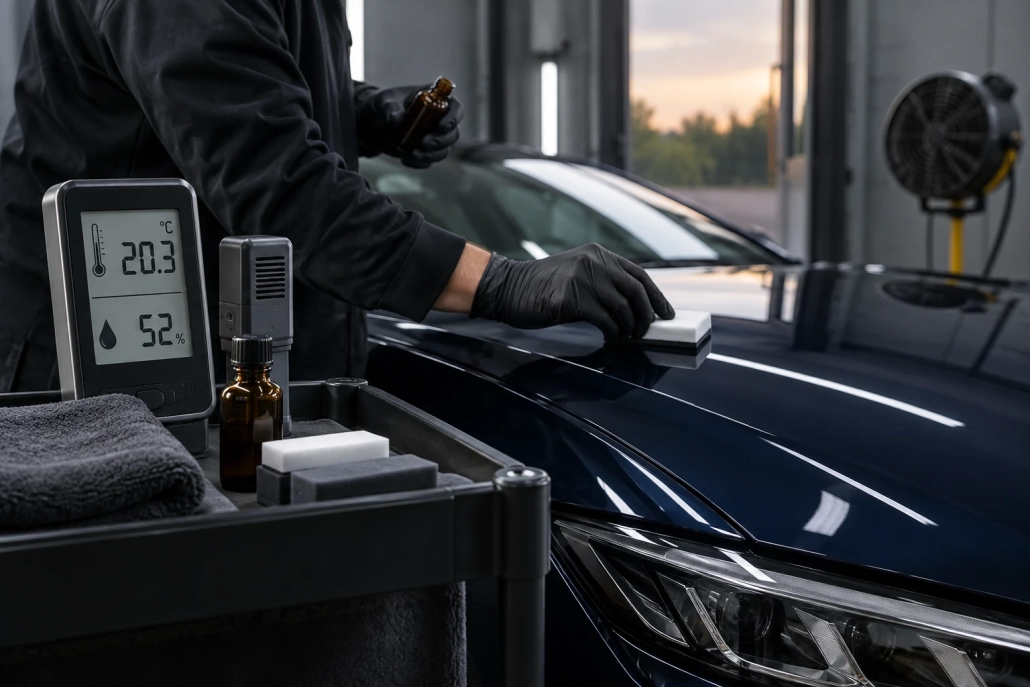
Plan coating work around the product's environmental requirements and check panel temperature, airflow and changing conditions.
Coordinate nearby spraying, traffic and handling so a freshly coated vehicle remains protected during the product’s required initial processing period.
 Protecting a Fresh Coating Job from Nearby Spray and Workshop Traffic