






A full polishing range.
From cutting and one-step correction to final finishing.
Specialist chemistry. Expert application.
 QUARTZ99 / CERAMIC BASE COAT
The foundation of your coating system.
A layerable quartz base coat designed for mechanical protection. Pair it with a suitable top coat to create the final finish.
For application by NANOLAB certified installers only.
Four formulas. Extended working time. Find the coating for your finish.
Explore the BEAST family of ceramic coatings.
Find the coating for each exterior surface.
 PPF & VINYLGLOSSProtection for glossy films and wraps.Discover
 MATTE & SATINMATTEProtection that respects the finish.Discover
 GLASSWINDOWSExplore dedicated glass protection.Discover
 WHEEL PROTECTIONWHEELSA dedicated coating for your wheels.Discover
 TRIM PROTECTIONPLASTICProtection for plastic surfaces.Discover
Dedicated care for the surfaces inside.
 LEATHER SURFACESLEATHERDiscover NANOLAB leather protection.Discover PLASTIC SURFACESPLASTICProtection for interior plastic surfaces.Discover TEXTILE SURFACESFABRICExplore the latest fabric formulation.Discover
Spray protection, maintenance and upcoming wash products.
 MAINTENANCEBEAST 365Explore the BEAST maintenance range.Discover
Next in washing, cleaning & care.
Ceramic protection for boats and yachts.
An easy-to-apply ceramic coating with an established track record on boats and yachts around the world.
Results vary with surface preparation, exposure and maintenance.
Read 50 MARINE guides →Explore MARINEProtection for the surfaces you live with.
A look at what we’re developing.
From cutting and one-step correction to final finishing.
A wider range for professional vehicle care.
Taking shape alongside BEAST & MATRIX.
Practical guidance for your next coating project.
Explore all guides →
Plan polishing test spots around repaired and original panels so one successful combination is not assumed suitable for every finish.
Updated · NANOLAB Knowledge
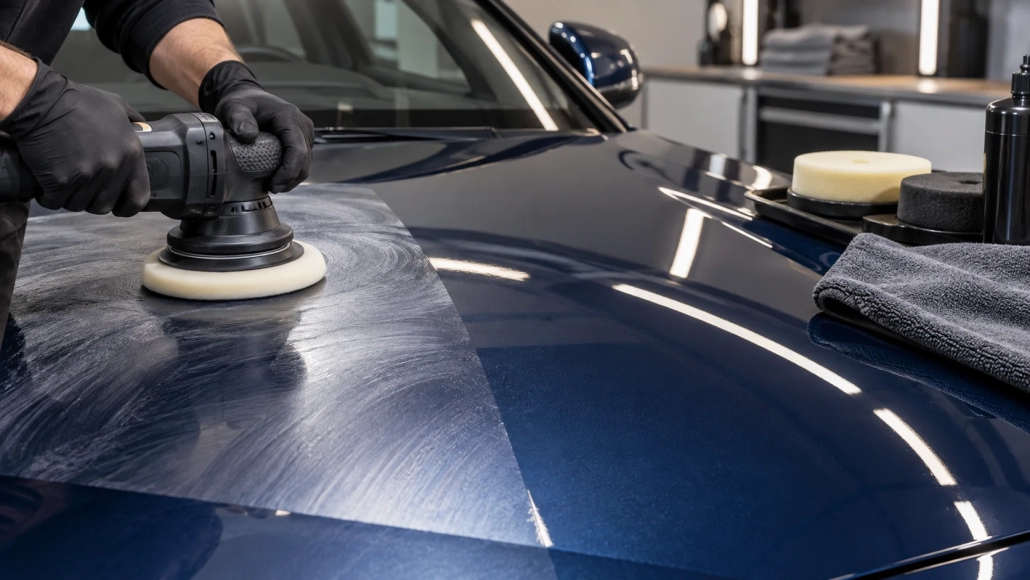
A vehicle with mixed paint repairs may not respond uniformly to polishing. A test spot on one original panel cannot establish the correct process for every repaired door, bumper or blended area.
Use owner information, repair records and appropriate inspection to identify likely differences. Record uncertainty rather than assigning a paint type from appearance alone. Different substrates and measurement limitations should remain visible in the assessment.
| Area group | Test objective |
|---|---|
| Original finish | Establish the main correction process |
| Known repaired panel | Confirm its response and restrictions |
| Uncertain transition | Assess cautiously before crossing the boundary |
| Vulnerable edge or feature | Define a separate limit or exclusion |
For each accepted test spot, note machine, pad, liquid, working approach, residue removal and inspection result. Include any required refinement. Keep product-specific settings with the actual combination rather than creating a universal speed prescription.
If a pad begins to drag or the finish develops unexpected haze on another panel, pause and reassess. Do not assume the operator needs more pressure because the previous panel behaved differently.
For illustration, the original bonnet may accept a one-stage enhancement while a repaired door needs a different finishing combination. The map should show both processes and preserve the accepted appearance goal across the vehicle.
Repaired finishes may have product-specific requirements before further treatment. Confirm readiness with the repairer or paint-system guidance where relevant. A successful polishing appearance alone does not establish that every coating process is suitable.
Retain the panel map and remaining-defect photographs. Later maintenance or repair can then start with the actual history instead of repeating uncertain test work. A mixed-repair vehicle benefits from a consistent inspection standard, even when achieving it requires more than one polishing route.
Ask NANOLAB about your surface and intended use. For application and care, use the current instructions for the exact product.
Choose a polishing process by testing defect removal, finishing quality and clear-coat preservation rather than counting steps alone.
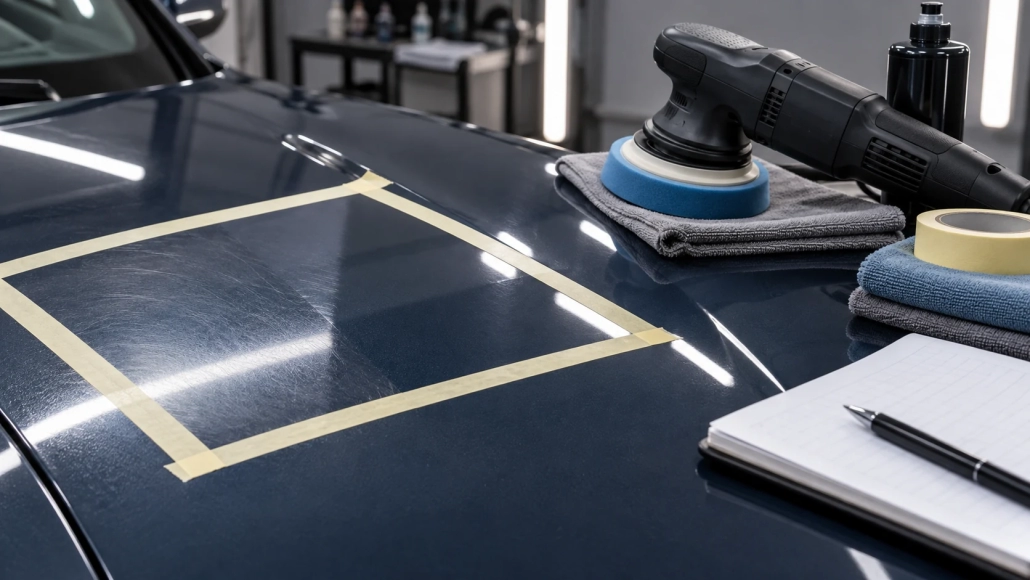
Compare pad and compound changes without confusing their effects. Use a four-cell test and judge correction, finish and total working time.
Reinspect the same mapped paint defects after final polish and suitable panel preparation to verify clarity before ceramic coating.
 A Final-Polish Check after Panel Prep: Inspect the Same Defect Locations