






A full polishing range.
From cutting and one-step correction to final finishing.
Specialist chemistry. Expert application.
 QUARTZ99 / CERAMIC BASE COAT
The foundation of your coating system.
A layerable quartz base coat designed for mechanical protection. Pair it with a suitable top coat to create the final finish.
For application by NANOLAB certified installers only.
Four formulas. Extended working time. Find the coating for your finish.
Explore the BEAST family of ceramic coatings.
Find the coating for each exterior surface.
 PPF & VINYLGLOSSProtection for glossy films and wraps.Discover
 MATTE & SATINMATTEProtection that respects the finish.Discover
 GLASSWINDOWSExplore dedicated glass protection.Discover
 WHEEL PROTECTIONWHEELSA dedicated coating for your wheels.Discover
 TRIM PROTECTIONPLASTICProtection for plastic surfaces.Discover
Dedicated care for the surfaces inside.
 LEATHER SURFACESLEATHERDiscover NANOLAB leather protection.Discover PLASTIC SURFACESPLASTICProtection for interior plastic surfaces.Discover TEXTILE SURFACESFABRICExplore the latest fabric formulation.Discover
Spray protection, maintenance and upcoming wash products.
 MAINTENANCEBEAST 365Explore the BEAST maintenance range.Discover
Next in washing, cleaning & care.
Ceramic protection for boats and yachts.
An easy-to-apply ceramic coating with an established track record on boats and yachts around the world.
Results vary with surface preparation, exposure and maintenance.
Read 50 MARINE guides →Explore MARINEProtection for the surfaces you live with.
A look at what we’re developing.
From cutting and one-step correction to final finishing.
A wider range for professional vehicle care.
Taking shape alongside BEAST & MATRIX.
Practical guidance for your next coating project.
Explore all guides →
Compare pad and compound changes without confusing their effects. Use a four-cell test and judge correction, finish and total working time.
Updated · NANOLAB Knowledge
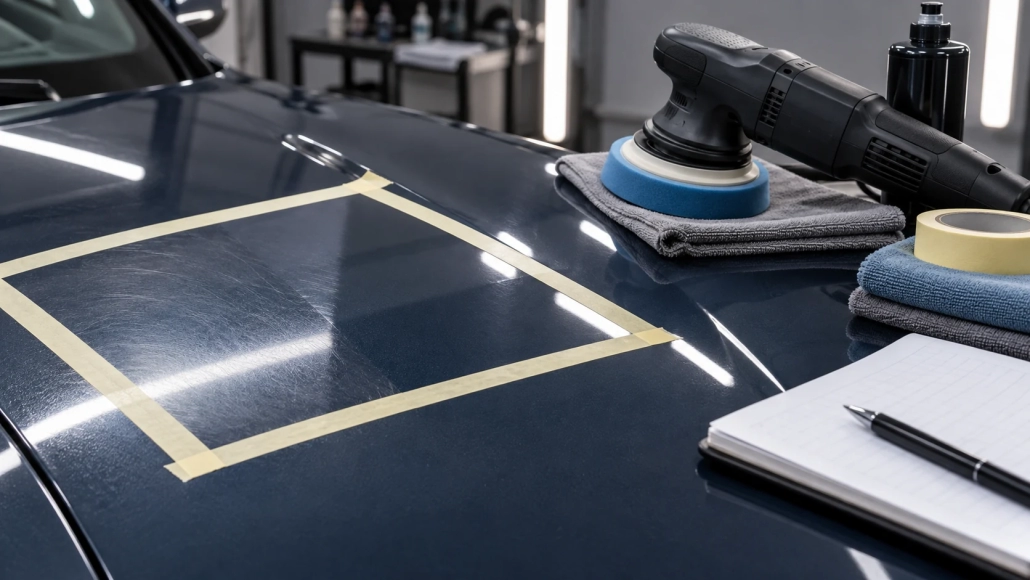
When a stronger compound and a different pad are introduced together, a better result does not reveal which change helped. A small, structured comparison can prevent an entire vehicle being corrected with an unnecessarily aggressive combination.
Choose comparable areas of suitable glossy paint. Keep the machine, preparation, lighting and inspection method constant. Label four cells: current liquid with current pad; candidate liquid with current pad; current liquid with candidate pad; candidate liquid with candidate pad. Use separate clean pads so residue from one liquid cannot enter another test.
For each cell, follow the approved working procedure for its combination. Record deviations explicitly: different liquids may need different working cycles, so imposing an identical cycle can itself make the comparison unfair. This is a workshop screening exercise, not a laboratory ranking.
| Observation | What it answers |
|---|---|
| Target defects remaining | Did the change improve useful correction? |
| Haze after compatible residue removal | Does the result need further refinement? |
| Working and cleanup time | Did the complete process become more efficient? |
If only the pad change improves the target result, buying a stronger compound is not yet justified. If the new liquid improves correction with both pads, it merits a wider trial. If only the combined change works, record that pairing rather than claiming that either component alone is superior.
Repeat the promising combination on another representative panel. A resprayed door and an original bonnet may respond differently. Keep an untouched reference and photograph it under the same light. Stop where paint condition or repair history makes further abrasion inappropriate.
Use the car polish and compound selection guide for the wider decision sequence. RUPES describes pads, liquids and tools as interacting system components in its official polishing-pad guidance; this comparison turns that principle into a traceable workshop decision.

 Paint Thickness Mapping: Locate the Same Point Again