






A full polishing range.
From cutting and one-step correction to final finishing.
Specialist chemistry. Expert application.
 QUARTZ99 / CERAMIC BASE COAT
The foundation of your coating system.
A layerable quartz base coat designed for mechanical protection. Pair it with a suitable top coat to create the final finish.
For application by NANOLAB certified installers only.
Four formulas. Extended working time. Find the coating for your finish.
Explore the BEAST family of ceramic coatings.
Find the coating for each exterior surface.
 PPF & VINYLGLOSSProtection for glossy films and wraps.Discover
 MATTE & SATINMATTEProtection that respects the finish.Discover
 GLASSWINDOWSExplore dedicated glass protection.Discover
 WHEEL PROTECTIONWHEELSA dedicated coating for your wheels.Discover
 TRIM PROTECTIONPLASTICProtection for plastic surfaces.Discover
Dedicated care for the surfaces inside.
 LEATHER SURFACESLEATHERDiscover NANOLAB leather protection.Discover PLASTIC SURFACESPLASTICProtection for interior plastic surfaces.Discover TEXTILE SURFACESFABRICExplore the latest fabric formulation.Discover
Spray protection, maintenance and upcoming wash products.
 MAINTENANCEBEAST 365Explore the BEAST maintenance range.Discover
Next in washing, cleaning & care.
Ceramic protection for boats and yachts.
An easy-to-apply ceramic coating with an established track record on boats and yachts around the world.
Results vary with surface preparation, exposure and maintenance.
Read 50 MARINE guides →Explore MARINEProtection for the surfaces you live with.
A look at what we’re developing.
From cutting and one-step correction to final finishing.
A wider range for professional vehicle care.
Taking shape alongside BEAST & MATRIX.
Practical guidance for your next coating project.
Explore all guides →
Measure polishing progress against an agreed defect target and paint-preservation limit so remaining deep scratches do not drive unnecessary correction.
Updated · NANOLAB Knowledge
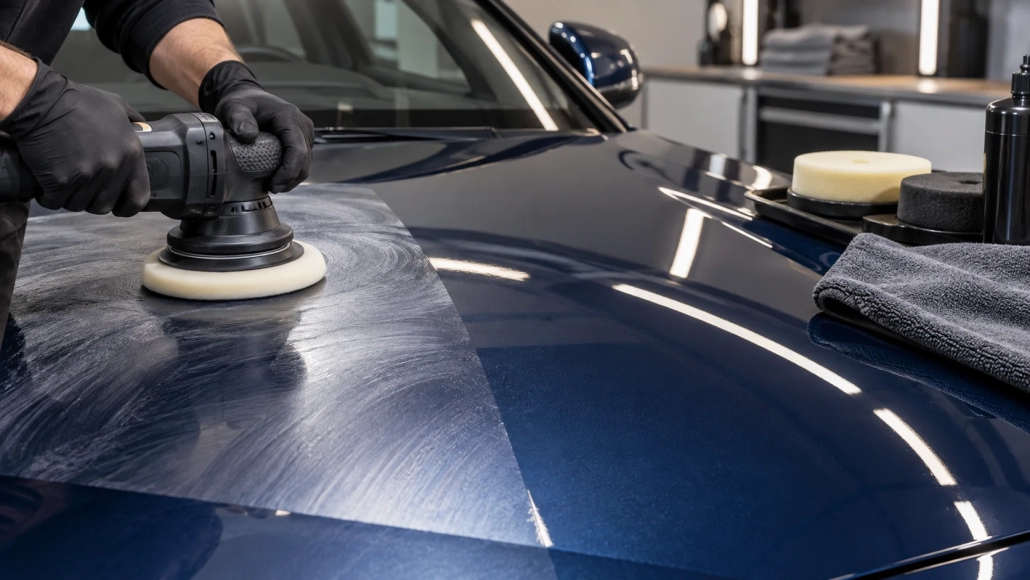
Polishing progress should be judged against the service goal and the paint’s condition, not the disappearance of every visible scratch. A defect map helps distinguish broad improvement from a few outliers that should remain.
Separate widespread wash marks, local scuffs, isolated deeper scratches and damage needing another repair approach. Record representative locations before work. Avoid treating the deepest visible mark as the target for the whole panel.
| Group | Decision |
|---|---|
| Widespread superficial marks | Evaluate a suitable correction process |
| Isolated deeper defects | Assess individually and set a stopping point |
| Edges or vulnerable paint | Apply separate limits |
| Cracking or failing finish | Refer for appropriate repair assessment |
Return to the same locations under comparable lighting after each planned stage. Keep the surface condition consistent and remove residue appropriately before judging. A defect hidden temporarily by polishing residue has not necessarily been corrected.
Imagine a panel with widespread light wash marks and three isolated deep scratches. The agreed enhancement process removes much of the general marking while the three scratches remain. That can be a successful result if the scope prioritised overall appearance and paint preservation.
Do not convert the visible improvement into an unsupported percentage unless a defined counting or measurement method was used. “The mapped general marks were substantially reduced; three documented defects remain” is more informative than an invented correction percentage.
Consider paint history, thickness assessment where applicable, heat, local geometry and the approved process. Another pass is justified only when its likely benefit and risk fit the job. A customer’s desire for perfection does not remove the physical limits of the finish.
Photograph remaining defects and explain them before coating. Protection should follow an accepted preparation result, not become a way to avoid discussing limitations. This produces a clearer handover and protects the workshop from repeatedly chasing the same irreducible defect.
Ask NANOLAB about your surface and intended use. For application and care, use the current instructions for the exact product.
Choose a polishing process by testing defect removal, finishing quality and clear-coat preservation rather than counting steps alone.

One coarse line remaining after compounding a sanded area may belong to an earlier sanding stage.
Plan polishing test spots around repaired and original panels so one successful combination is not assumed suitable for every finish.
 Polishing Test Spots on Mixed Repairs: Build a Panel-Specific Map