






A full polishing range.
From cutting and one-step correction to final finishing.
Specialist chemistry. Expert application.
 QUARTZ99 / CERAMIC BASE COAT
The foundation of your coating system.
A layerable quartz base coat designed for mechanical protection. Pair it with a suitable top coat to create the final finish.
For application by NANOLAB certified installers only.
Four formulas. Extended working time. Find the coating for your finish.
Explore the BEAST family of ceramic coatings.
Find the coating for each exterior surface.
 PPF & VINYLGLOSSProtection for glossy films and wraps.Discover
 MATTE & SATINMATTEProtection that respects the finish.Discover
 GLASSWINDOWSExplore dedicated glass protection.Discover
 WHEEL PROTECTIONWHEELSA dedicated coating for your wheels.Discover
 TRIM PROTECTIONPLASTICProtection for plastic surfaces.Discover
Dedicated care for the surfaces inside.
 LEATHER SURFACESLEATHERDiscover NANOLAB leather protection.Discover PLASTIC SURFACESPLASTICProtection for interior plastic surfaces.Discover TEXTILE SURFACESFABRICExplore the latest fabric formulation.Discover
Spray protection, maintenance and upcoming wash products.
 MAINTENANCEBEAST 365Explore the BEAST maintenance range.Discover
Next in washing, cleaning & care.
Ceramic protection for boats and yachts.
An easy-to-apply ceramic coating with an established track record on boats and yachts around the world.
Results vary with surface preparation, exposure and maintenance.
Read 50 MARINE guides →Explore MARINEProtection for the surfaces you live with.
A look at what we’re developing.
From cutting and one-step correction to final finishing.
A wider range for professional vehicle care.
Taking shape alongside BEAST & MATRIX.
Practical guidance for your next coating project.
Explore all guides →
Use a fixed vehicle inspection route with explicit lower-panel checks to catch missed coating residue and coverage concerns before handover.
Updated · NANOLAB Knowledge

Upper panels attract attention because they are easy to see under workshop lights. Lower doors, sills and complex bumper areas are easier to miss. A fixed inspection route makes coverage of the inspection itself visible.
Do not assume that an area was accepted because it appears on the application map. Inspect the completed work with a separate checklist. Record exclusions so an intentionally untreated surface is not confused with an omission.
| Pass | Focus |
|---|---|
| Overall walkaround | Uniform appearance and obvious concerns |
| Upper and middle panels | Reflections, boundaries and local residue |
| Lower panels | Sills, lower doors and bumper contours |
| Interfaces | Trim, badges, film edges and agreed exclusions |
Arrange suitable lighting and safe access. Do not adopt unstable positions or use vehicle lifting equipment without the appropriate competence and procedures. The inspection plan must fit safe workshop practice.
Use a vehicle diagram or photographs rather than touching the fresh surface. A note such as “left rear lower door, forward edge” is more useful than “some haze on the side.” Assign each concern a status: accepted, corrected and rechecked, or held for review.
A local correction can transfer residue into an adjacent area. Review the corrected zone and its boundaries under the relevant lighting. Do not close the checklist merely because a towel was passed over the marked spot.
In an illustrative handover, a lower sill shows residue only under an oblique light. The route catches it before delivery even though the main door reflection looked excellent. That is the practical value of checking difficult areas deliberately.
Record the inspector, time, unresolved limitations and release conditions. Where two people perform the work, the final reviewer should use the record rather than relying solely on verbal reassurance.
A consistent route does not guarantee perfection, but it makes missed areas less dependent on memory and gives the workshop a repeatable standard for every job.
Ask NANOLAB about your surface and intended use. For application and care, use the current instructions for the exact product.
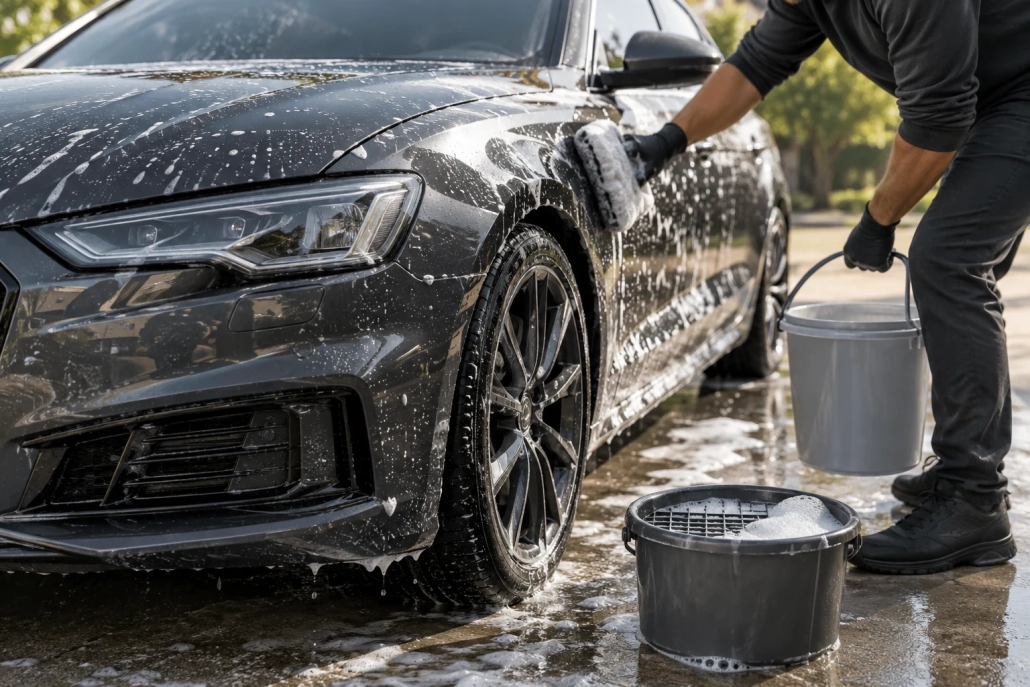
Build a gentle wash routine that removes loose grit before contact, keeps wheel tools separate and ends with careful rinsing and drying.

Plan ceramic coating on lower sills by identifying the finish, removing road film and arranging safe access for application and inspection.
Review a customer's report of new scratches using baseline photos, panel history and consistent inspection without assuming the cause.
 A Customer Reports New Scratches: Build a Fair Coating Service Review