






A full polishing range.
From cutting and one-step correction to final finishing.
Specialist chemistry. Expert application.
 QUARTZ99 / CERAMIC BASE COAT
The foundation of your coating system.
A layerable quartz base coat designed for mechanical protection. Pair it with a suitable top coat to create the final finish.
For application by NANOLAB certified installers only.
Four formulas. Extended working time. Find the coating for your finish.
Explore the BEAST family of ceramic coatings.
Find the coating for each exterior surface.
 PPF & VINYLGLOSSProtection for glossy films and wraps.Discover
 MATTE & SATINMATTEProtection that respects the finish.Discover
 GLASSWINDOWSExplore dedicated glass protection.Discover
 WHEEL PROTECTIONWHEELSA dedicated coating for your wheels.Discover
 TRIM PROTECTIONPLASTICProtection for plastic surfaces.Discover
Dedicated care for the surfaces inside.
 LEATHER SURFACESLEATHERDiscover NANOLAB leather protection.Discover PLASTIC SURFACESPLASTICProtection for interior plastic surfaces.Discover TEXTILE SURFACESFABRICExplore the latest fabric formulation.Discover
Spray protection, maintenance and upcoming wash products.
 MAINTENANCEBEAST 365Explore the BEAST maintenance range.Discover
Next in washing, cleaning & care.
Ceramic protection for boats and yachts.
An easy-to-apply ceramic coating with an established track record on boats and yachts around the world.
Results vary with surface preparation, exposure and maintenance.
Read 50 MARINE guides →Explore MARINEProtection for the surfaces you live with.
A look at what we’re developing.
From cutting and one-step correction to final finishing.
A wider range for professional vehicle care.
Taking shape alongside BEAST & MATRIX.
Practical guidance for your next coating project.
Explore all guides →
Prepare coating records and panel photographs for a bodyshop estimate so repair scope and later protection renewal are clear.
Updated · NANOLAB Knowledge

A bodyshop estimate should distinguish vehicle repair from later restoration of surface protection. Providing a concise coating record helps the repairer understand what is present and helps the owner avoid assuming that untouched panels and repaired panels will share the same protection history.
Do not invent a product identity when the history is unknown. State which records are available and ask the original installer for missing details where practical.
Identify panels to be repaired, refinished, blended or otherwise worked on. Nearby panels may be affected by preparation and finishing even when they do not receive the main repair. Keep the protection renewal decision tied to the actual work performed.
Ask the bodyshop when the repaired finish may receive the intended preparation and coating process. Use the paint-system and coating requirements together. A generic waiting period from an unrelated vehicle is not a reliable release rule.
A damaged door is refinished and the adjacent panel receives finishing work. The coating record should identify both areas for post-repair assessment. It should not automatically require recoating the entire car, nor assume the adjacent area remained unaffected.
Clarify who inspects the repair finish, who determines coating readiness and who performs any protection renewal. Keep commercial coverage and payment questions separate from technical suitability; this guide does not determine what an insurer or warranty will reimburse.
At collection, record the accepted repair appearance and any remaining concerns before adding new protection. Update each affected panel’s application date and aftercare requirements. The purpose is continuity: a future detailer should be able to understand what changed without reconstructing the repair from water behaviour alone.
Ask NANOLAB about your surface and intended use. For application and care, use the current instructions for the exact product.
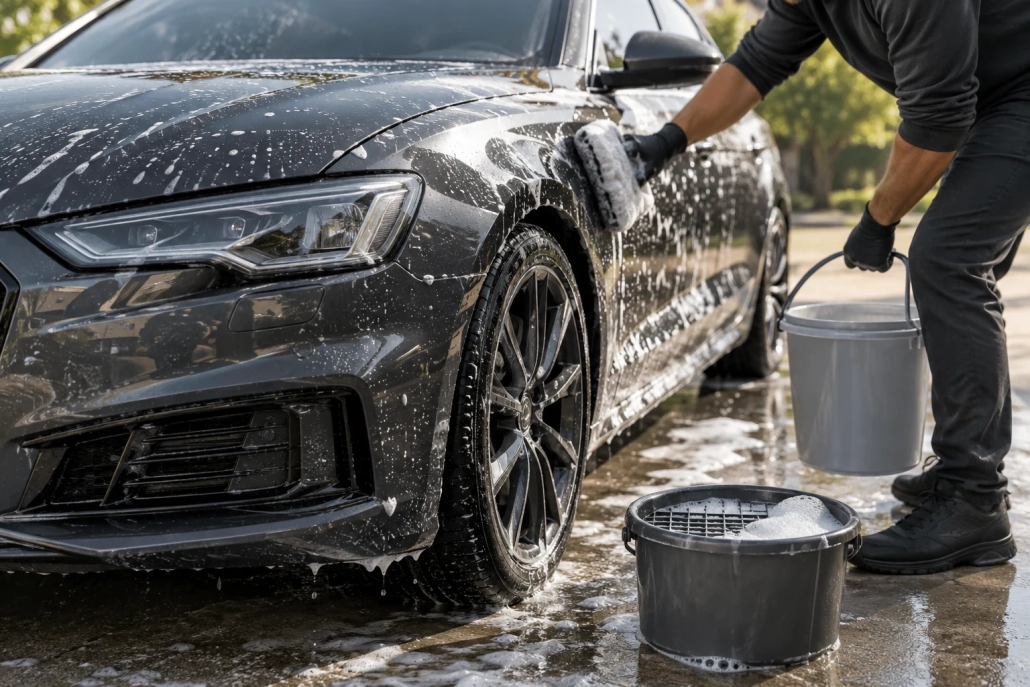
Build a gentle wash routine that removes loose grit before contact, keeps wheel tools separate and ends with careful rinsing and drying.

Record measured area and actual use while separating trial waste from repeatable application needs.
Use a fixed vehicle inspection route with explicit lower-panel checks to catch missed coating residue and coverage concerns before handover.
 Inspection after Ceramic Coating: A Route That Avoids Missed Lower Panels