






A full polishing range.
From cutting and one-step correction to final finishing.
Specialist chemistry. Expert application.
 QUARTZ99 / CERAMIC BASE COAT
The foundation of your coating system.
A layerable quartz base coat designed for mechanical protection. Pair it with a suitable top coat to create the final finish.
For application by NANOLAB certified installers only.
Four formulas. Extended working time. Find the coating for your finish.
Explore the BEAST family of ceramic coatings.
Find the coating for each exterior surface.
 PPF & VINYLGLOSSProtection for glossy films and wraps.Discover
 MATTE & SATINMATTEProtection that respects the finish.Discover
 GLASSWINDOWSExplore dedicated glass protection.Discover
 WHEEL PROTECTIONWHEELSA dedicated coating for your wheels.Discover
 TRIM PROTECTIONPLASTICProtection for plastic surfaces.Discover
Dedicated care for the surfaces inside.
 LEATHER SURFACESLEATHERDiscover NANOLAB leather protection.Discover PLASTIC SURFACESPLASTICProtection for interior plastic surfaces.Discover TEXTILE SURFACESFABRICExplore the latest fabric formulation.Discover
Spray protection, maintenance and upcoming wash products.
 MAINTENANCEBEAST 365Explore the BEAST maintenance range.Discover
Next in washing, cleaning & care.
Ceramic protection for boats and yachts.
An easy-to-apply ceramic coating with an established track record on boats and yachts around the world.
Results vary with surface preparation, exposure and maintenance.
Read 50 MARINE guides →Explore MARINEProtection for the surfaces you live with.
A look at what we’re developing.
From cutting and one-step correction to final finishing.
A wider range for professional vehicle care.
Taking shape alongside BEAST & MATRIX.
Practical guidance for your next coating project.
Explore all guides →
The background used behind a transparent or translucent specimen can influence an appearance comparison. Specify it before testing and keep it consistent so that a change in backing is not mistaken for a change in the coating.
Updated · NANOLAB Knowledge
The assessment should identify the complete optical arrangement: specimen, substrate, background and viewing or measurement conditions. A transparent coating on glass may be evaluated differently from the same material on an opaque panel. The report needs to explain which arrangement represents the intended question.
Illustrative example: a clear coated pane is photographed against a white wall before treatment and a dark workshop afterward. The images can emphasize different features without proving that the coating changed colour. A useful comparison repeats the original arrangement and labels any additional diagnostic views.
Do not infer installed appearance under every lighting condition from one backed sample. A reference arrangement improves repeatability but does not reproduce all real environments. Claims should describe the tested system and avoid implying that a transparent coating is optically invisible solely because one photograph looks clear.
Ask NANOLAB about the exact product and intended use. Use the current product documentation for formulation-specific instructions.

Keep each coating sample paired with its own baseline and report both the size and consistency of before-and-after changes.
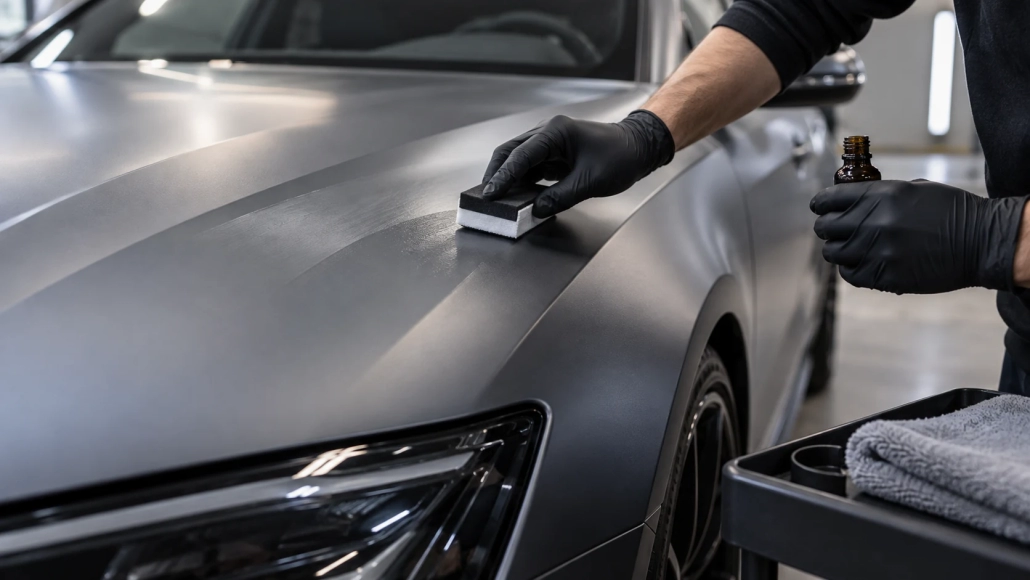
Plan a colour-change assessment for nano coatings with matched samples, consistent lighting and a clear distinction between visual observation and instrument data.
Equal applied force does not mean equal contact pressure when the contact areas differ. A coating test comparison should retain the tool geometry and contact arrangement alongside the load.