






A full polishing range.
From cutting and one-step correction to final finishing.
Specialist chemistry. Expert application.
 QUARTZ99 / CERAMIC BASE COAT
The foundation of your coating system.
A layerable quartz base coat designed for mechanical protection. Pair it with a suitable top coat to create the final finish.
For application by NANOLAB certified installers only.
Four formulas. Extended working time. Find the coating for your finish.
Explore the BEAST family of ceramic coatings.
Find the coating for each exterior surface.
 PPF & VINYLGLOSSProtection for glossy films and wraps.Discover
 MATTE & SATINMATTEProtection that respects the finish.Discover
 GLASSWINDOWSExplore dedicated glass protection.Discover
 WHEEL PROTECTIONWHEELSA dedicated coating for your wheels.Discover
 TRIM PROTECTIONPLASTICProtection for plastic surfaces.Discover
Dedicated care for the surfaces inside.
 LEATHER SURFACESLEATHERDiscover NANOLAB leather protection.Discover PLASTIC SURFACESPLASTICProtection for interior plastic surfaces.Discover TEXTILE SURFACESFABRICExplore the latest fabric formulation.Discover
Spray protection, maintenance and upcoming wash products.
 MAINTENANCEBEAST 365Explore the BEAST maintenance range.Discover
Next in washing, cleaning & care.
Ceramic protection for boats and yachts.
An easy-to-apply ceramic coating with an established track record on boats and yachts around the world.
Results vary with surface preparation, exposure and maintenance.
Read 50 MARINE guides →Explore MARINEProtection for the surfaces you live with.
A look at what we’re developing.
From cutting and one-step correction to final finishing.
A wider range for professional vehicle care.
Taking shape alongside BEAST & MATRIX.
Practical guidance for your next coating project.
Explore all guides →
Cost comparisons become misleading when one product is measured only through application while another includes rinsing, drying and residue correction. Define the completed job before comparing material use or working time.
Updated · NANOLAB Knowledge
Include the steps needed to deliver the same agreed surface condition. A product that applies quickly may need additional removal work; another may use more liquid but reduce a later step within its approved process. The relevant comparison depends on the service being sold, not on a single attractive metric from a demonstration.
Illustrative example: one wheel-cleaning trial ends when the product is sprayed, while the other ends after the wheel is rinsed and dried. The recorded times cannot support a purchasing decision. Repeating the comparison with a common completion point makes the result interpretable.
Do not force two products into identical steps if their instructions differ. Compare complete approved methods and disclose the difference. A small trial provides an estimate for those conditions, not a guaranteed saving across every vehicle, soil type or operator.
Ask NANOLAB about the exact product and intended use. Use the current product documentation for formulation-specific instructions.
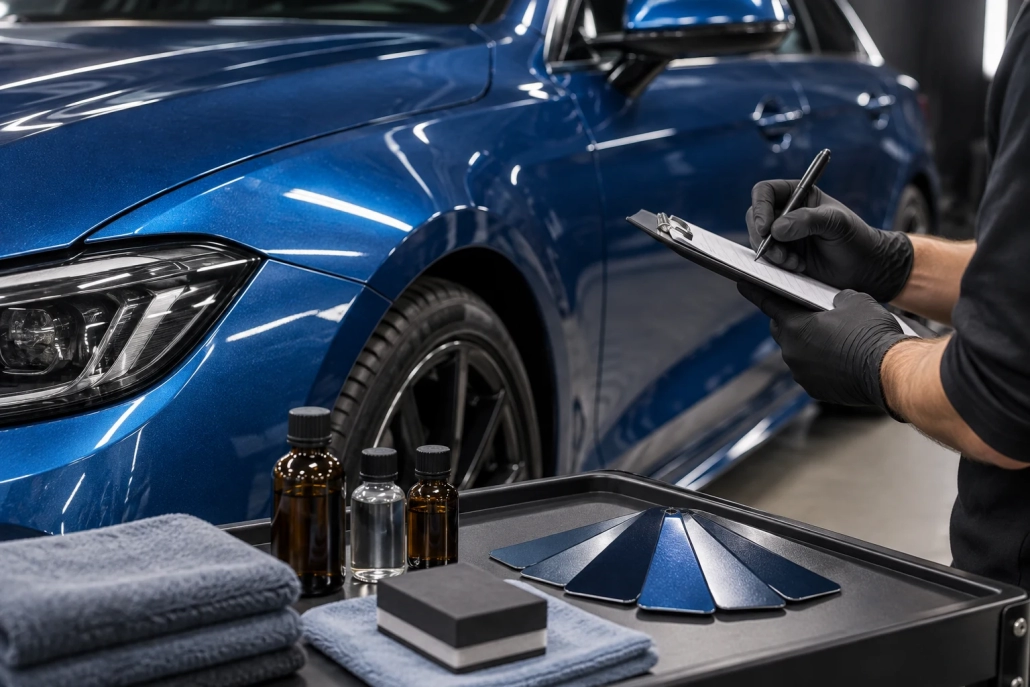
Estimate labour, materials and workshop occupancy from the actual scope, then compare planned and completed work to improve future quotes.

Comparing coatings on different film samples can mix treatment effects with film variation. Comparable substrates improve interpretation.
A result and an acceptance limit must use compatible units and the same quantity basis before comparison. A correct-looking number can produce the wrong decision when a unit prefix or concentration basis is overlooked.