






A full polishing range.
From cutting and one-step correction to final finishing.
Specialist chemistry. Expert application.
 QUARTZ99 / CERAMIC BASE COAT
The foundation of your coating system.
A layerable quartz base coat designed for mechanical protection. Pair it with a suitable top coat to create the final finish.
For application by NANOLAB certified installers only.
Four formulas. Extended working time. Find the coating for your finish.
Explore the BEAST family of ceramic coatings.
Find the coating for each exterior surface.
 PPF & VINYLGLOSSProtection for glossy films and wraps.Discover
 MATTE & SATINMATTEProtection that respects the finish.Discover
 GLASSWINDOWSExplore dedicated glass protection.Discover
 WHEEL PROTECTIONWHEELSA dedicated coating for your wheels.Discover
 TRIM PROTECTIONPLASTICProtection for plastic surfaces.Discover
Dedicated care for the surfaces inside.
 LEATHER SURFACESLEATHERDiscover NANOLAB leather protection.Discover PLASTIC SURFACESPLASTICProtection for interior plastic surfaces.Discover TEXTILE SURFACESFABRICExplore the latest fabric formulation.Discover
Spray protection, maintenance and upcoming wash products.
 MAINTENANCEBEAST 365Explore the BEAST maintenance range.Discover
Next in washing, cleaning & care.
Ceramic protection for boats and yachts.
An easy-to-apply ceramic coating with an established track record on boats and yachts around the world.
Results vary with surface preparation, exposure and maintenance.
Read 50 MARINE guides →Explore MARINEProtection for the surfaces you live with.
A look at what we’re developing.
From cutting and one-step correction to final finishing.
A wider range for professional vehicle care.
Taking shape alongside BEAST & MATRIX.
Practical guidance for your next coating project.
Explore all guides →
Investigate unexpected DA polisher vibration after a pad change. Check compatibility, centring, damage and loading before continuing paint correction.
Updated · NANOLAB Knowledge
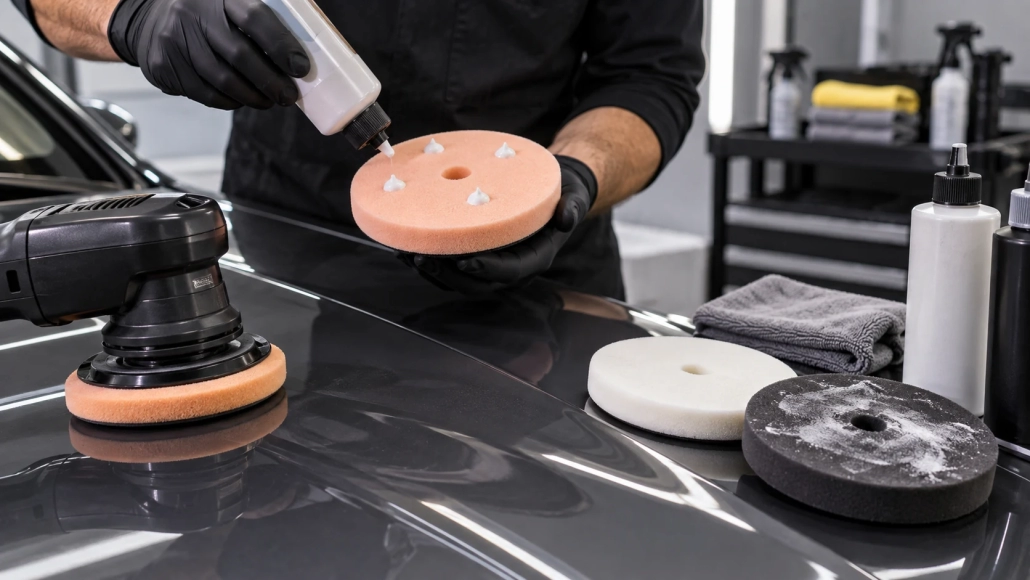
A dual-action polisher has its normal operating feel. A sudden change after fitting a pad is a reason to stop and inspect the setup, not a signal to grip harder and finish the panel.
Switch off and disconnect the machine as its instructions require before inspection. Confirm that the backing plate and pad are approved for the model, movement and size. A pad that physically attaches is not automatically a balanced or compatible choice.
Inspect the attachment face for residue and damage. Check the backing plate, pad backing and working face. Centre the pad using the manufacturer’s method; uneven overhang can reveal poor positioning. Do not compensate for a damaged component by moving it off centre.
A pad can start correctly fitted and later develop uneven loading. Record whether the vibration appeared immediately, after reloading compound or after several working sections. Look for local saturation, distorted foam, damaged fibres or separated backing.
Use the approved cleaning or replacement procedure. Do not run a suspect pad at high speed in free air to prove that it is acceptable. Follow the machine manual’s prescribed checks and restart procedure. If an undamaged, correctly fitted approved pad leaves unexplained vibration, arrange equipment inspection.
This record distinguishes a recurring machine issue from one pad or loading event. It also avoids condemning a compound when the mechanical setup changed at the same time.
RUPES discusses system balance and vibration in its official pad guidance. Use that principle with the actual machine manual. For abrasive selection after the equipment is ready, return to the car polish and compound guide.

 Polish Inspection Wipes: A Controlled Two-Towel Test