






A full polishing range.
From cutting and one-step correction to final finishing.
Specialist chemistry. Expert application.
 QUARTZ99 / CERAMIC BASE COAT
The foundation of your coating system.
A layerable quartz base coat designed for mechanical protection. Pair it with a suitable top coat to create the final finish.
For application by NANOLAB certified installers only.
Four formulas. Extended working time. Find the coating for your finish.
Explore the BEAST family of ceramic coatings.
Find the coating for each exterior surface.
 PPF & VINYLGLOSSProtection for glossy films and wraps.Discover
 MATTE & SATINMATTEProtection that respects the finish.Discover
 GLASSWINDOWSExplore dedicated glass protection.Discover
 WHEEL PROTECTIONWHEELSA dedicated coating for your wheels.Discover
 TRIM PROTECTIONPLASTICProtection for plastic surfaces.Discover
Dedicated care for the surfaces inside.
 LEATHER SURFACESLEATHERDiscover NANOLAB leather protection.Discover PLASTIC SURFACESPLASTICProtection for interior plastic surfaces.Discover TEXTILE SURFACESFABRICExplore the latest fabric formulation.Discover
Spray protection, maintenance and upcoming wash products.
 MAINTENANCEBEAST 365Explore the BEAST maintenance range.Discover
Next in washing, cleaning & care.
Ceramic protection for boats and yachts.
An easy-to-apply ceramic coating with an established track record on boats and yachts around the world.
Results vary with surface preparation, exposure and maintenance.
Read 50 MARINE guides →Explore MARINEProtection for the surfaces you live with.
A look at what we’re developing.
From cutting and one-step correction to final finishing.
A wider range for professional vehicle care.
Taking shape alongside BEAST & MATRIX.
Practical guidance for your next coating project.
Explore all guides →
Judge a car polish by clean reflections, remaining defects and consistent lighting, rather than relying only on shine, slickness or one photograph.
Updated · NANOLAB Knowledge
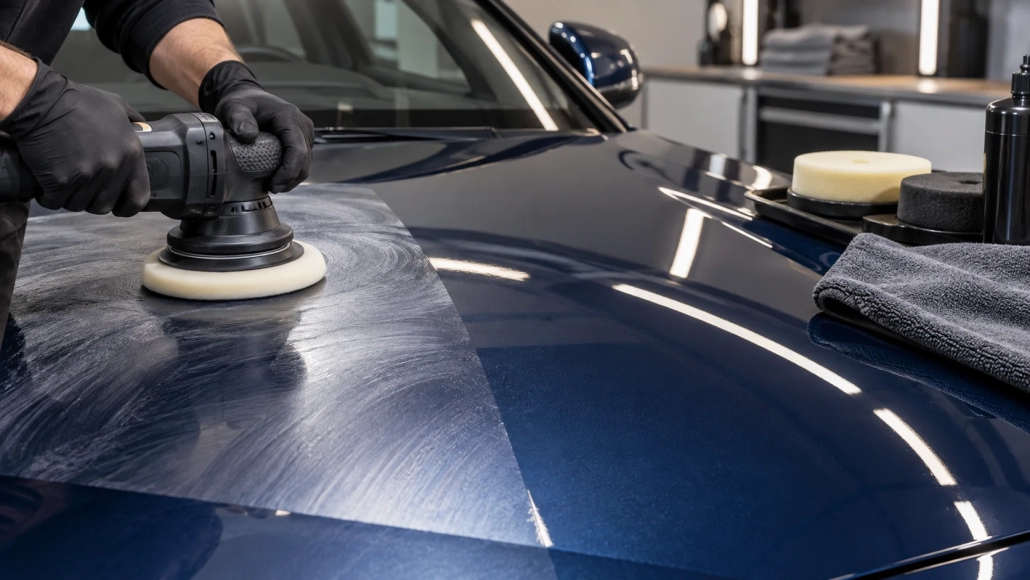
A panel can look shiny while still carrying swirls or polishing haze. Gloss, reflection clarity and visible defects are related observations, but they are not interchangeable. A useful finish assessment considers all three after appropriate residue removal.
Broad reflections help reveal overall visual consistency. A directional inspection light can expose defects that disappear under diffuse workshop lighting. Move the light or your viewing position so you can see how the surface behaves from more than one angle.
Do not confuse the reflected shape of a ceiling panel with proof of defect-free paint. Existing paint texture also affects reflected images, and conventional correction should not automatically become an attempt to flatten the factory texture.
Before-and-after images are only useful when the lighting, exposure, angle and surface condition are comparable. A wet after-picture beside a dry before-picture is not a fair demonstration of a polish’s mechanical result.
Use the same inspection cleaner and allow the area to reach the appropriate dry condition. Photograph the same defect field. Record any marks deliberately left because further removal would be unsuitable.
A slippery feel may come from polishing residue or a protective ingredient. It does not establish how well the abrasive stage corrected the paint. Similarly, a strong visual darkening effect does not by itself demonstrate permanent scratch removal.
Evaluate correction before choosing the final protection system. That makes it easier to identify whether a later appearance change comes from the polish, the preparation step or the coating.
For a daily vehicle, an even improvement with sound paint preservation may be the correct objective. A presentation vehicle can have a more demanding visual brief, but that does not create unlimited clear coat to remove.
Agree where and how the finish will be inspected. The same standard should be used for the initial test area, intermediate checks and final handover. This turns a vague promise of maximum shine into a result both the technician and owner can actually assess.
Understand heavy cut compound, fine cut and finishing polish, then choose a paint correction process that fits your paint, machine and intended result.
Choose a polishing process by testing defect removal, finishing quality and clear-coat preservation rather than counting steps alone.

 Heavy Cut Compound: When Stronger Correction Is Justified