






A full polishing range.
From cutting and one-step correction to final finishing.
Specialist chemistry. Expert application.
 QUARTZ99 / CERAMIC BASE COAT
The foundation of your coating system.
A layerable quartz base coat designed for mechanical protection. Pair it with a suitable top coat to create the final finish.
For application by NANOLAB certified installers only.
Four formulas. Extended working time. Find the coating for your finish.
Explore the BEAST family of ceramic coatings.
Find the coating for each exterior surface.
 PPF & VINYLGLOSSProtection for glossy films and wraps.Discover
 MATTE & SATINMATTEProtection that respects the finish.Discover
 GLASSWINDOWSExplore dedicated glass protection.Discover
 WHEEL PROTECTIONWHEELSA dedicated coating for your wheels.Discover
 TRIM PROTECTIONPLASTICProtection for plastic surfaces.Discover
Dedicated care for the surfaces inside.
 LEATHER SURFACESLEATHERDiscover NANOLAB leather protection.Discover PLASTIC SURFACESPLASTICProtection for interior plastic surfaces.Discover TEXTILE SURFACESFABRICExplore the latest fabric formulation.Discover
Spray protection, maintenance and upcoming wash products.
 MAINTENANCEBEAST 365Explore the BEAST maintenance range.Discover
Next in washing, cleaning & care.
Ceramic protection for boats and yachts.
An easy-to-apply ceramic coating with an established track record on boats and yachts around the world.
Results vary with surface preparation, exposure and maintenance.
Read 50 MARINE guides →Explore MARINEProtection for the surfaces you live with.
A look at what we’re developing.
From cutting and one-step correction to final finishing.
A wider range for professional vehicle care.
Taking shape alongside BEAST & MATRIX.
Practical guidance for your next coating project.
Explore all guides →
A xenon-arc weathering report should identify the optical filter used. Filters influence the light reaching the sample, so the lamp name alone does not define the exposure or establish relevance to an outdoor coating application.
Updated · NANOLAB Knowledge
Q-Lab describes different filter families for different exposure purposes, including direct outdoor sunlight and sunlight passing through glass. The buyer should connect that choice to the proposed service environment. A harsher-looking spectrum is not automatically a more useful simulation of the conditions the finished coating will actually face.
Illustrative example: an interior-surface trial is compared with an exterior-bodywork trial because both used xenon equipment. Without the filter information, the comparison may ignore a major difference in exposure. A useful review starts with the intended environment and the full test configuration.
Do not infer universal outdoor suitability from a lamp designation. A weathering result remains specific to the tested system and conditions. Ask the laboratory to justify its filter selection rather than choosing the option that simply produces the fastest visible deterioration.
Technical references: Q-Lab: Xenon filter selection. These sources describe their stated methods or products; they do not certify NANOLAB products or establish compatibility with an unlisted surface.
Ask NANOLAB about the exact product and intended use. Use the current product documentation for formulation-specific instructions.

Total test hours do not fully describe an accelerated-weathering exposure. Light, moisture and temperature stages belong to the method.
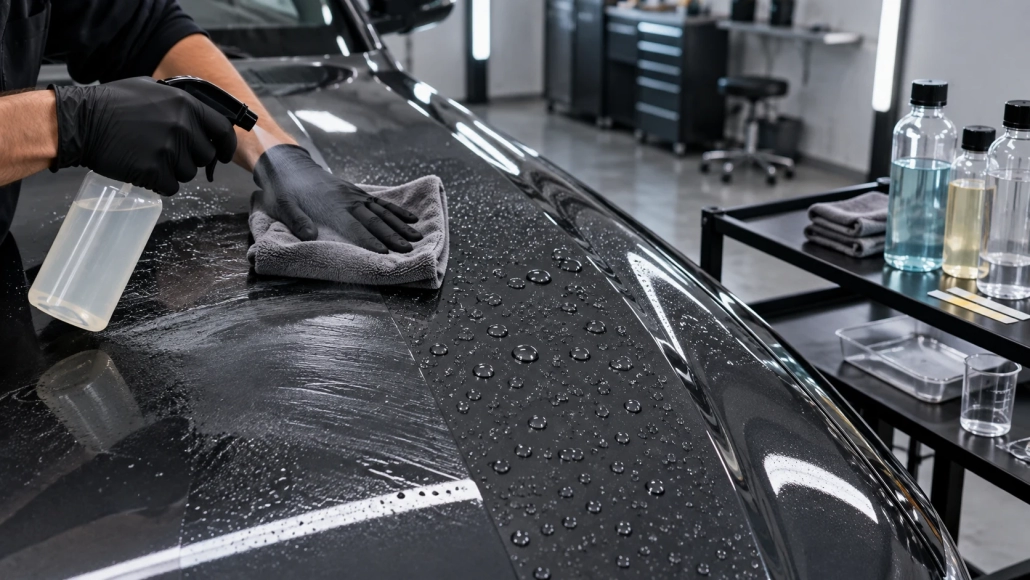
Distinguish spot, wipe and immersion tests when reading ceramic coating chemical-resistance claims, with attention to concentration, time and failure criteria.
Two weathering exposures can have similar reported intensity while differing in the wavelengths reaching the sample. A coating comparison should retain the spectral information relevant to the method instead of treating one intensity number as the complete exposure description.