






A full polishing range.
From cutting and one-step correction to final finishing.
Specialist chemistry. Expert application.
 QUARTZ99 / CERAMIC BASE COAT
The foundation of your coating system.
A layerable quartz base coat designed for mechanical protection. Pair it with a suitable top coat to create the final finish.
For application by NANOLAB certified installers only.
Four formulas. Extended working time. Find the coating for your finish.
Explore the BEAST family of ceramic coatings.
Find the coating for each exterior surface.
 PPF & VINYLGLOSSProtection for glossy films and wraps.Discover
 MATTE & SATINMATTEProtection that respects the finish.Discover
 GLASSWINDOWSExplore dedicated glass protection.Discover
 WHEEL PROTECTIONWHEELSA dedicated coating for your wheels.Discover
 TRIM PROTECTIONPLASTICProtection for plastic surfaces.Discover
Dedicated care for the surfaces inside.
 LEATHER SURFACESLEATHERDiscover NANOLAB leather protection.Discover PLASTIC SURFACESPLASTICProtection for interior plastic surfaces.Discover TEXTILE SURFACESFABRICExplore the latest fabric formulation.Discover
Spray protection, maintenance and upcoming wash products.
 MAINTENANCEBEAST 365Explore the BEAST maintenance range.Discover
Next in washing, cleaning & care.
Ceramic protection for boats and yachts.
An easy-to-apply ceramic coating with an established track record on boats and yachts around the world.
Results vary with surface preparation, exposure and maintenance.
Read 50 MARINE guides →Explore MARINEProtection for the surfaces you live with.
A look at what we’re developing.
From cutting and one-step correction to final finishing.
A wider range for professional vehicle care.
Taking shape alongside BEAST & MATRIX.
Practical guidance for your next coating project.
Explore all guides →
Evaluate water-saving car wash methods using litres per accepted job, rework and dry-finish quality rather than water use alone.
Updated · NANOLAB Knowledge

A wash method that uses less water but leaves more residue is not automatically more efficient. Compare water consumption against a completed, accepted cleaning result and include any repeat work needed to get there.
Decide whether the trial includes pre-rinsing, bucket filling, contact washing, final rinsing and equipment cleaning. Use the same boundary for both methods. Record water used to correct an incomplete result instead of treating it as unrelated work.
| Measure | Why it belongs |
|---|---|
| Litres per accepted vehicle | Connects consumption to useful output |
| First-pass acceptance | Reveals incomplete cleaning |
| Labour time | Shows whether water savings shift work elsewhere |
| Surface result | Preserves the quality requirement |
In an illustrative trial, method A uses eighty litres and passes inspection. Method B initially uses fifty litres but requires a twenty-litre corrective rinse. Its accepted consumption is seventy litres, a 12.5% reduction relative to A, not the 37.5% reduction suggested by the initial fifty-litre figure.
These numbers are examples, not targets. A safe and suitable process depends on contamination, surface type, equipment and the products used.
Compare similar size and contamination or record those differences explicitly. A lightly dusty small car should not represent the same cleaning challenge as a heavily soiled van. Rotate operators or use a consistent trained method to reduce technique effects.
Do not reduce rinsing or lubrication below what the process requires merely to improve the consumption number. Follow the instructions for the coating, film and cleaning products. A damaged finish would defeat the purpose of the trial.
Include product use, tool cleaning and rework alongside water. Report the observed range and trial conditions. The strongest water-saving claim is a reproducible reduction per accepted job under a clearly described method, not a low reading from the easiest vehicle.
Ask NANOLAB about your surface and intended use. For application and care, use the current instructions for the exact product.
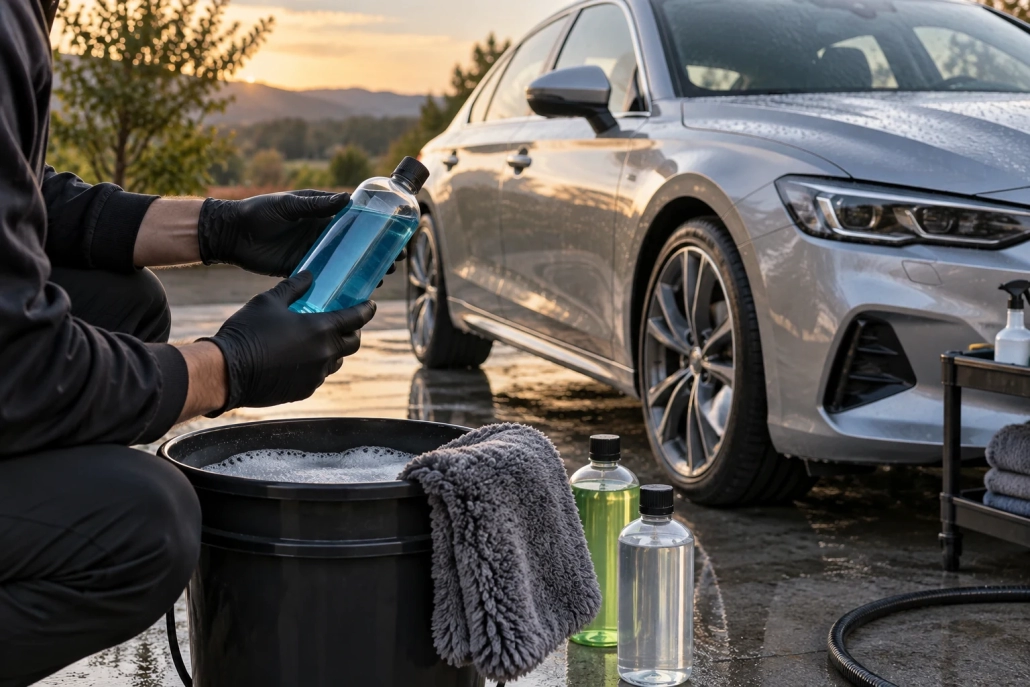
Choose a compatible wash product, use its dilution correctly and avoid judging cleaning suitability from a ceramic label or foam thickness alone.

Different washing frequencies change the exposure history of trial vehicles. Record them instead of comparing only installation dates.
Calculate shampoo cost after repeat cleaning so a low concentrate cost does not hide extra labour, water and consumables.
 Shampoo Rewash Costs: When a Cheaper Dose Becomes a More Expensive Job