






A full polishing range.
From cutting and one-step correction to final finishing.
Specialist chemistry. Expert application.
 QUARTZ99 / CERAMIC BASE COAT
The foundation of your coating system.
A layerable quartz base coat designed for mechanical protection. Pair it with a suitable top coat to create the final finish.
For application by NANOLAB certified installers only.
Four formulas. Extended working time. Find the coating for your finish.
Explore the BEAST family of ceramic coatings.
Find the coating for each exterior surface.
 PPF & VINYLGLOSSProtection for glossy films and wraps.Discover
 MATTE & SATINMATTEProtection that respects the finish.Discover
 GLASSWINDOWSExplore dedicated glass protection.Discover
 WHEEL PROTECTIONWHEELSA dedicated coating for your wheels.Discover
 TRIM PROTECTIONPLASTICProtection for plastic surfaces.Discover
Dedicated care for the surfaces inside.
 LEATHER SURFACESLEATHERDiscover NANOLAB leather protection.Discover PLASTIC SURFACESPLASTICProtection for interior plastic surfaces.Discover TEXTILE SURFACESFABRICExplore the latest fabric formulation.Discover
Spray protection, maintenance and upcoming wash products.
 MAINTENANCEBEAST 365Explore the BEAST maintenance range.Discover
Next in washing, cleaning & care.
Ceramic protection for boats and yachts.
An easy-to-apply ceramic coating with an established track record on boats and yachts around the world.
Results vary with surface preparation, exposure and maintenance.
Read 50 MARINE guides →Explore MARINEProtection for the surfaces you live with.
A look at what we’re developing.
From cutting and one-step correction to final finishing.
A wider range for professional vehicle care.
Taking shape alongside BEAST & MATRIX.
Practical guidance for your next coating project.
Explore all guides →
Sample labels should preserve identity without changing the area being evaluated. Ink, adhesive or physical marking placed on the test surface can introduce a new variable that later looks like a treatment effect.
Updated · NANOLAB Knowledge
Choose an identification method suited to the sample construction and the planned observations. Record orientation and boundaries using a separate map or an approved edge label where appropriate. If the trial involves cleaning, consider whether the identifier will remain legible and whether its contact materials could affect the sample. Keep a duplicate record outside the test area.
Illustrative example: a fabric sample is marked with a pen directly beside a spill-test area. During cleaning, colour from the mark moves into the observed region. The result now contains a labelling effect that should not be attributed to the protective treatment.
Do not conceal an identification failure by guessing which sample is which. Quarantine ambiguous results from the comparison until identity is resolved. A well-labelled sample is still only as representative as its material, preparation and test conditions.
Ask NANOLAB about the exact product and intended use. Use the current product documentation for formulation-specific instructions.

Some viscosity methods depend on the sample container and immersion arrangement. Changing the vessel can change the measurement conditions.
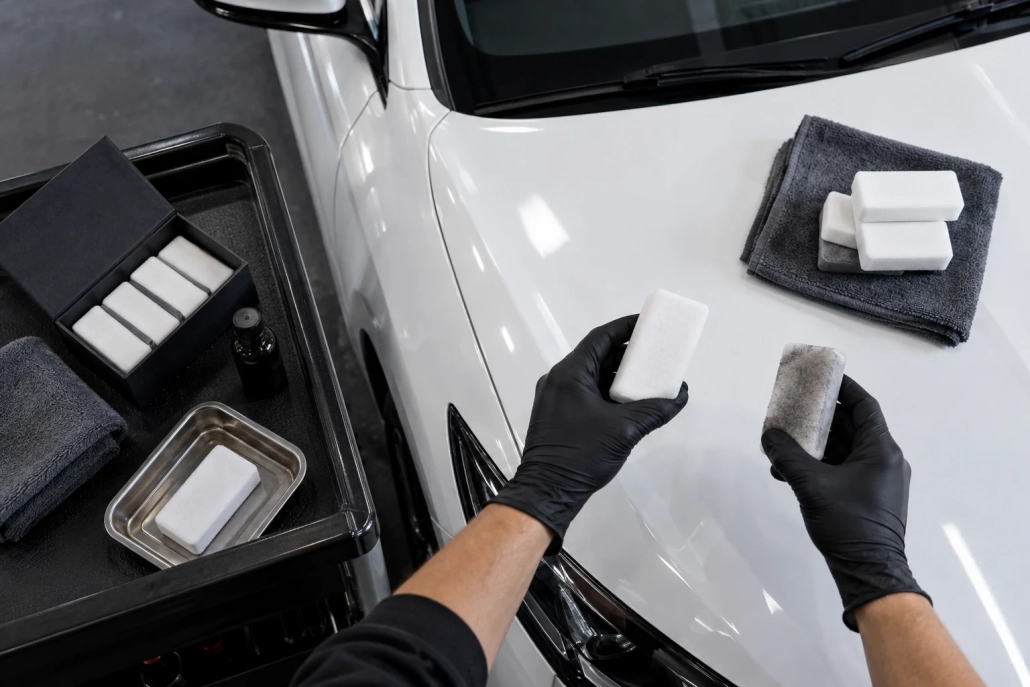
Match a coating applicator to the accessible surface so product can be spread and levelled around contours without flooding adjacent materials.
The cloth used for upholstery care should not introduce a new mark or obscure what is being removed. Material-specific instructions may therefore specify a white, unprinted cloth rather than any convenient coloured towel or paper.