






A full polishing range.
From cutting and one-step correction to final finishing.
Specialist chemistry. Expert application.
 QUARTZ99 / CERAMIC BASE COAT
The foundation of your coating system.
A layerable quartz base coat designed for mechanical protection. Pair it with a suitable top coat to create the final finish.
For application by NANOLAB certified installers only.
Four formulas. Extended working time. Find the coating for your finish.
Explore the BEAST family of ceramic coatings.
Find the coating for each exterior surface.
 PPF & VINYLGLOSSProtection for glossy films and wraps.Discover
 MATTE & SATINMATTEProtection that respects the finish.Discover
 GLASSWINDOWSExplore dedicated glass protection.Discover
 WHEEL PROTECTIONWHEELSA dedicated coating for your wheels.Discover
 TRIM PROTECTIONPLASTICProtection for plastic surfaces.Discover
Dedicated care for the surfaces inside.
 LEATHER SURFACESLEATHERDiscover NANOLAB leather protection.Discover PLASTIC SURFACESPLASTICProtection for interior plastic surfaces.Discover TEXTILE SURFACESFABRICExplore the latest fabric formulation.Discover
Spray protection, maintenance and upcoming wash products.
 MAINTENANCEBEAST 365Explore the BEAST maintenance range.Discover
Next in washing, cleaning & care.
Ceramic protection for boats and yachts.
An easy-to-apply ceramic coating with an established track record on boats and yachts around the world.
Results vary with surface preparation, exposure and maintenance.
Read 50 MARINE guides →Explore MARINEProtection for the surfaces you live with.
A look at what we’re developing.
From cutting and one-step correction to final finishing.
A wider range for professional vehicle care.
Taking shape alongside BEAST & MATRIX.
Practical guidance for your next coating project.
Explore all guides →
Define coating boundaries around fasteners, threads and contact surfaces so a decorative metal treatment does not interfere with assembly requirements.
Updated · NANOLAB Knowledge

A visible screw head may be part of a decorative surface, but the fastener also has a mechanical job. Before including fasteners in a nano coating project, distinguish the exposed cosmetic face from threads, seating surfaces and interfaces whose condition is specified by the assembly manufacturer.
Record whether the fastener is structural, adjustable, electrically conductive or simply decorative. Note any required lubricant, thread treatment or installation process. Do not assume that an added coating is too thin to matter to a specified interface.
For wheels, machinery, safety equipment or other critical assemblies, follow the responsible manufacturer’s instructions and qualified maintenance procedures. A surface-care project is not authority to change those requirements.
If coating the visible head is approved, define how adjacent threads, joints and moving parts will be protected. Consider whether product could run into the connection during application or cleaning. If the area cannot be controlled and inspected, exclude it until an appropriate method is established.
Do not remove a fastener solely to improve access unless removal and reinstallation are within the competent person’s authorised work. Reassembly should use the original technical requirements, not a coating supplier’s generic application advice.
Rust staining or finish failure around a fastener may indicate a problem that extends beyond the visible head. Photograph the condition and obtain a repair assessment where necessary. An extra transparent layer does not establish that the connection remains fit for service.
For replaceable decorative fittings, a matching sample can help assess appearance and cleaning without altering the installed assembly.
List included and excluded areas, preparation products and the coating used. If a technician later replaces or retightens the fastener, that record helps prevent confusion about surface treatments. The useful outcome is a cleanable decorative finish with the mechanical and electrical requirements preserved, rather than treating every visible metallic part as automatically eligible for the same coating.
For your exact finish and service conditions, ask NANOLAB about coating suitability and consult the current product documentation.
Understand why a nano coating demonstration does not establish galvanic isolation, and what to review before treating mixed-metal assemblies.
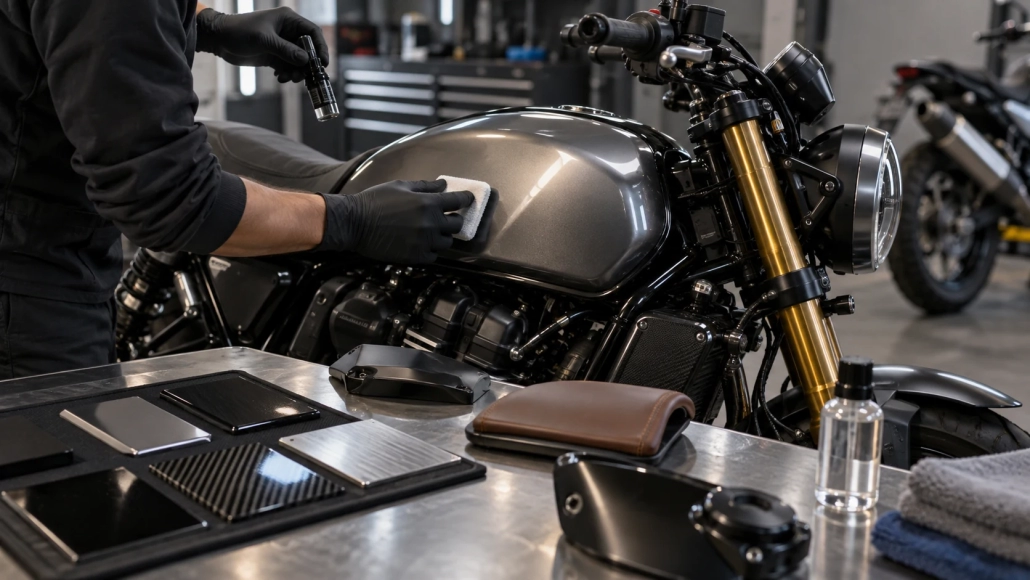
Map motorcycle chrome covers and decorative brightwork before coating, with clear boundaries for heat, controls, fasteners and maintenance.
Assess polished aluminium before ceramic coating, distinguishing bare metal from clear-coated parts and setting a realistic appearance and care trial.
 Nano Coating Perforated Metal Panels: Coverage Without Residue