






A full polishing range.
From cutting and one-step correction to final finishing.
Specialist chemistry. Expert application.
 QUARTZ99 / CERAMIC BASE COAT
The foundation of your coating system.
A layerable quartz base coat designed for mechanical protection. Pair it with a suitable top coat to create the final finish.
For application by NANOLAB certified installers only.
Four formulas. Extended working time. Find the coating for your finish.
Explore the BEAST family of ceramic coatings.
Find the coating for each exterior surface.
 PPF & VINYLGLOSSProtection for glossy films and wraps.Discover
 MATTE & SATINMATTEProtection that respects the finish.Discover
 GLASSWINDOWSExplore dedicated glass protection.Discover
 WHEEL PROTECTIONWHEELSA dedicated coating for your wheels.Discover
 TRIM PROTECTIONPLASTICProtection for plastic surfaces.Discover
Dedicated care for the surfaces inside.
 LEATHER SURFACESLEATHERDiscover NANOLAB leather protection.Discover PLASTIC SURFACESPLASTICProtection for interior plastic surfaces.Discover TEXTILE SURFACESFABRICExplore the latest fabric formulation.Discover
Spray protection, maintenance and upcoming wash products.
 MAINTENANCEBEAST 365Explore the BEAST maintenance range.Discover
Next in washing, cleaning & care.
Ceramic protection for boats and yachts.
An easy-to-apply ceramic coating with an established track record on boats and yachts around the world.
Results vary with surface preparation, exposure and maintenance.
Read 50 MARINE guides →Explore MARINEProtection for the surfaces you live with.
A look at what we’re developing.
From cutting and one-step correction to final finishing.
A wider range for professional vehicle care.
Taking shape alongside BEAST & MATRIX.
Practical guidance for your next coating project.
Explore all guides →
Evaluate a graphene-labelled coating through both additive documentation and finished-product testing without transferring one material property to the whole formula.
Updated · NANOLAB Knowledge

A graphene-related ingredient record and a coating performance result answer different questions. One concerns what material is present; the other concerns how the finished system behaves on a specified surface. A credible evaluation needs the connection between them.
| Track | Questions |
|---|---|
| Material identity | What additive is specified and how is its identity controlled? |
| Finished product | What does the actual coating achieve under a relevant test? |
| Link between them | Which product version and batches were evaluated? |
Do not infer additive identity from bottle colour, a dark residue or a marketing name. Equally, identifying an additive does not establish the amount dispersed, its condition in the cured film or the finished coating’s service performance.
Choose appearance, application, cleanability or another relevant endpoint. Use suitable comparison products and representative substrates. Follow each product’s approved process rather than forcing unrelated formulas into one arbitrary application window.
If a graphene-labelled coating outperforms another commercial coating, the result compares two complete formulations. It does not isolate the additive’s contribution. A controlled formulation study would be needed to address that narrower causal question.
For illustration, two products may differ in several ingredients and application instructions. Better wipe-off from one cannot be assigned solely to the named additive without additional evidence.
Review compatibility, working process, support and maintenance alongside measured performance. A technically interesting ingredient does not replace those requirements. Obtain current product documentation for any specific NANOLAB formula being considered.
State that the tested finished product met the defined requirement under the recorded conditions. Avoid importing impressive properties from research on a different material form into an automotive coating claim.
This approach allows a graphene-enhanced product to be judged on its actual merits while keeping material identity, formulation design and field performance distinct.
Ask NANOLAB about your surface and intended use. For application and care, use the current instructions for the exact product.
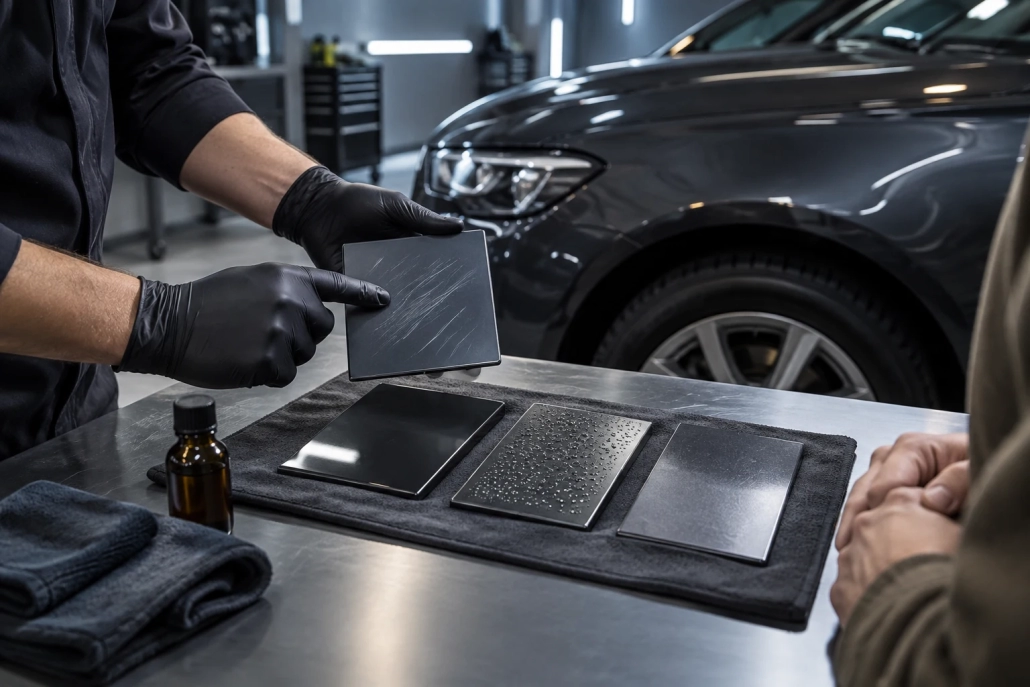
Keep coating performance statements connected to their product version, test method and limitations before using them in sales material.
A graphene coating trial is easier to interpret when the sample can be traced to the supplied product.
Assess a borophene coating proposal by checking material identity, formulation relevance and finished-product evidence before accepting performance claims.

 Borophene Coating Enquiries: Build a Documentation-First Assessment