






A full polishing range.
From cutting and one-step correction to final finishing.
Specialist chemistry. Expert application.
 QUARTZ99 / CERAMIC BASE COAT
The foundation of your coating system.
A layerable quartz base coat designed for mechanical protection. Pair it with a suitable top coat to create the final finish.
For application by NANOLAB certified installers only.
Four formulas. Extended working time. Find the coating for your finish.
Explore the BEAST family of ceramic coatings.
Find the coating for each exterior surface.
 PPF & VINYLGLOSSProtection for glossy films and wraps.Discover
 MATTE & SATINMATTEProtection that respects the finish.Discover
 GLASSWINDOWSExplore dedicated glass protection.Discover
 WHEEL PROTECTIONWHEELSA dedicated coating for your wheels.Discover
 TRIM PROTECTIONPLASTICProtection for plastic surfaces.Discover
Dedicated care for the surfaces inside.
 LEATHER SURFACESLEATHERDiscover NANOLAB leather protection.Discover PLASTIC SURFACESPLASTICProtection for interior plastic surfaces.Discover TEXTILE SURFACESFABRICExplore the latest fabric formulation.Discover
Spray protection, maintenance and upcoming wash products.
 MAINTENANCEBEAST 365Explore the BEAST maintenance range.Discover
Next in washing, cleaning & care.
Ceramic protection for boats and yachts.
An easy-to-apply ceramic coating with an established track record on boats and yachts around the world.
Results vary with surface preparation, exposure and maintenance.
Read 50 MARINE guides →Explore MARINEProtection for the surfaces you live with.
A look at what we’re developing.
From cutting and one-step correction to final finishing.
A wider range for professional vehicle care.
Taking shape alongside BEAST & MATRIX.
Practical guidance for your next coating project.
Explore all guides →
Check whether pad warming, panel conditions or test order changed a finishing-polish comparison before deciding which process performs better.
Updated · NANOLAB Knowledge
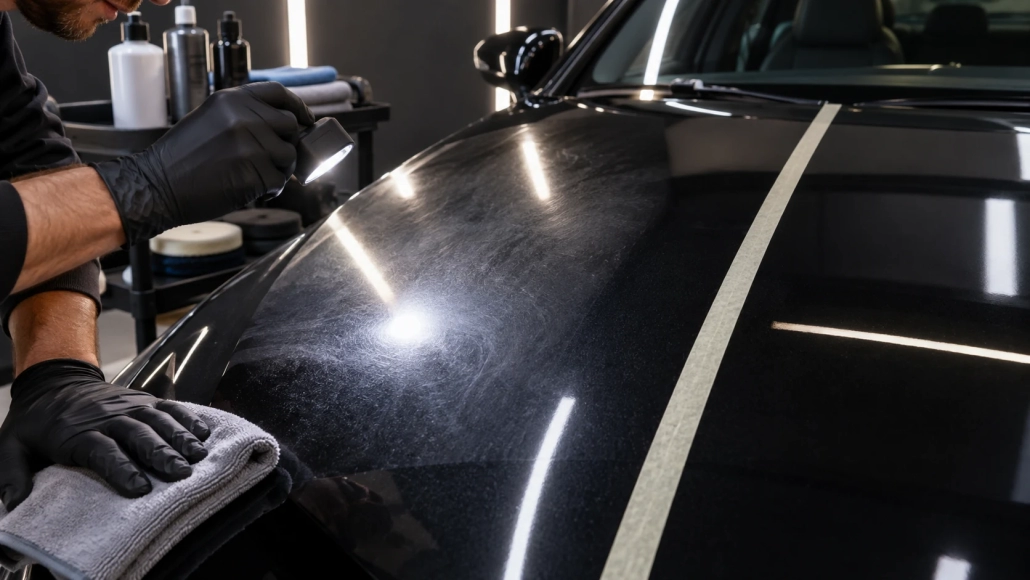
Two finishing polishes can appear different because one was tested first on a cool panel and the other later with a loaded pad. Reversing the order on another comparable area helps expose that problem.
Prepare two representative areas of suitable glossy paint with similar defects. On the first area, test candidate A and then candidate B in separate cells. On the second, reverse that sequence. Allocate clean, equivalent pads to each candidate and follow each product’s approved procedure.
Keep notes on panel temperature, elapsed time, lighting and pad condition. Do not use the same contaminated pad for both products. Allow the surface to reach appropriate working conditions between tests rather than treating a hotter panel as an unavoidable detail.
Identify a target, such as the fine haze left by a preceding correction stage. Evaluate that haze after compatible residue removal. A bright reflection alone may hide remaining marks, especially when the inspection light, angle or camera exposure changes.
If A appears better in both testing orders, its advantage is more credible on those conditions. If the second-tested candidate always appears better, sequence or inspection drift may be influencing the result. If the result changes from panel to panel, separate the paint responses instead of declaring one universal winner.
Record clarity, wipe-off effort, unwanted marring and the time to the accepted finish. A candidate that wins only while its oils remain on the surface has not demonstrated the same result as one that stays clear after the planned preparation step.
This simple design cannot remove every source of uncertainty. It is a way to identify an obvious confound before a larger workshop evaluation. Repeat the promising process on additional representative panels and include an untouched reference.
For context, compare polishing roles and system selection. The Menzerna finishing-polish instructions illustrate why the actual liquid’s procedure matters when planning a comparison.

 Compounding a Repair: Match the Surrounding Texture