






A full polishing range.
From cutting and one-step correction to final finishing.
Specialist chemistry. Expert application.
 QUARTZ99 / CERAMIC BASE COAT
The foundation of your coating system.
A layerable quartz base coat designed for mechanical protection. Pair it with a suitable top coat to create the final finish.
For application by NANOLAB certified installers only.
Four formulas. Extended working time. Find the coating for your finish.
Explore the BEAST family of ceramic coatings.
Find the coating for each exterior surface.
 PPF & VINYLGLOSSProtection for glossy films and wraps.Discover
 MATTE & SATINMATTEProtection that respects the finish.Discover
 GLASSWINDOWSExplore dedicated glass protection.Discover
 WHEEL PROTECTIONWHEELSA dedicated coating for your wheels.Discover
 TRIM PROTECTIONPLASTICProtection for plastic surfaces.Discover
Dedicated care for the surfaces inside.
 LEATHER SURFACESLEATHERDiscover NANOLAB leather protection.Discover PLASTIC SURFACESPLASTICProtection for interior plastic surfaces.Discover TEXTILE SURFACESFABRICExplore the latest fabric formulation.Discover
Spray protection, maintenance and upcoming wash products.
 MAINTENANCEBEAST 365Explore the BEAST maintenance range.Discover
Next in washing, cleaning & care.
Ceramic protection for boats and yachts.
An easy-to-apply ceramic coating with an established track record on boats and yachts around the world.
Results vary with surface preparation, exposure and maintenance.
Read 50 MARINE guides →Explore MARINEProtection for the surfaces you live with.
A look at what we’re developing.
From cutting and one-step correction to final finishing.
A wider range for professional vehicle care.
Taking shape alongside BEAST & MATRIX.
Practical guidance for your next coating project.
Explore all guides →
A flat fabric swatch is useful for an initial appearance check, but it does not reproduce every feature of an upholstered seat or cushion. Evaluate the finished construction before extending a sample result to the complete item.
Updated · NANOLAB Knowledge
Seams, tension, backing, padding and access can change how the approved process is carried out. The swatch should represent the correct fabric and finish, and the assembled trial should preserve the component's care restrictions. Keep the two stages linked so the business knows which questions each one has answered.
Illustrative example: a protection product is easy to apply evenly to a loose sample on a table. The installed seat has deep contours and mixed inserts. The loose-sample result supports further evaluation but does not prove that the same application can be achieved across the finished seat.
Do not dismantle safety-related vehicle components or alter upholstery construction to make a trial easier. Get approval for the actual surface and application method. A swatch is evidence for its own conditions, not a universal certificate of suitability.
Ask NANOLAB about the exact product and intended use. Use the current product documentation for formulation-specific instructions.
Repaired fabric has a different local history. Confirm the repair material and readiness before applying the original upholstery routine.
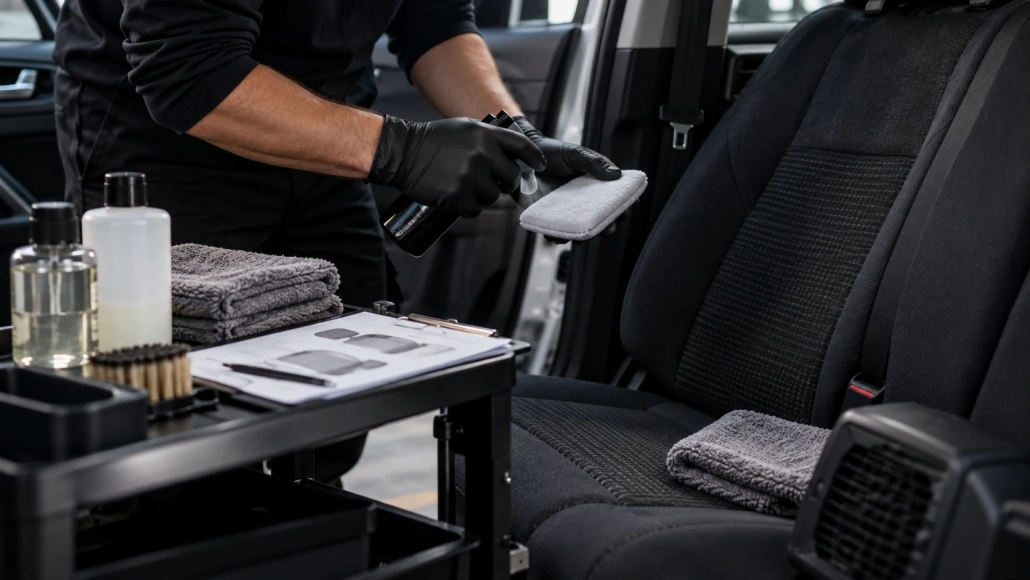
Plan fabric cleaning, drying and product distribution, and understand why water repellency does not make upholstery waterproof.
Knowing when upholstery was cleaned is less useful than knowing how it was cleaned and whether the required finishing steps were completed. Obtain that information before deciding whether the surface is ready for a protective treatment.