






A full polishing range.
From cutting and one-step correction to final finishing.
Specialist chemistry. Expert application.
 QUARTZ99 / CERAMIC BASE COAT
The foundation of your coating system.
A layerable quartz base coat designed for mechanical protection. Pair it with a suitable top coat to create the final finish.
For application by NANOLAB certified installers only.
Four formulas. Extended working time. Find the coating for your finish.
Explore the BEAST family of ceramic coatings.
Find the coating for each exterior surface.
 PPF & VINYLGLOSSProtection for glossy films and wraps.Discover
 MATTE & SATINMATTEProtection that respects the finish.Discover
 GLASSWINDOWSExplore dedicated glass protection.Discover
 WHEEL PROTECTIONWHEELSA dedicated coating for your wheels.Discover
 TRIM PROTECTIONPLASTICProtection for plastic surfaces.Discover
Dedicated care for the surfaces inside.
 LEATHER SURFACESLEATHERDiscover NANOLAB leather protection.Discover PLASTIC SURFACESPLASTICProtection for interior plastic surfaces.Discover TEXTILE SURFACESFABRICExplore the latest fabric formulation.Discover
Spray protection, maintenance and upcoming wash products.
 MAINTENANCEBEAST 365Explore the BEAST maintenance range.Discover
Next in washing, cleaning & care.
Ceramic protection for boats and yachts.
An easy-to-apply ceramic coating with an established track record on boats and yachts around the world.
Results vary with surface preparation, exposure and maintenance.
Read 50 MARINE guides →Explore MARINEProtection for the surfaces you live with.
A look at what we’re developing.
From cutting and one-step correction to final finishing.
A wider range for professional vehicle care.
Taking shape alongside BEAST & MATRIX.
Practical guidance for your next coating project.
Explore all guides →
Assess coating slickness as an application or handling property while testing durability and cleaning performance separately.
Updated · NANOLAB Knowledge

A very slick surface can create a strong first impression. It does not, by itself, establish long-term durability, scratch resistance or ease of cleaning after months of exposure. Keep the immediate tactile observation separate from the performance claim you want to make.
A fingertip impression, towel glide and instrumented friction measurement are different methods. For workshop screening, specify the contact material, condition, load as consistently as practical, and the cure stage. Avoid dragging objects across customer paint to create an informal scratch test.
| Observation | Appropriate conclusion |
|---|---|
| Towel moves with less perceived resistance | Lower perceived drag under that procedure |
| Water beads prominently | Observed water behaviour under that test |
| Cleaning requires less accepted work | Maintenance benefit under the recorded conditions |
| Performance remains after exposure | Evidence of retention for that measured property |
Record all preparation and maintenance products. A drying aid or topper can affect the feel of the surface. If the objective is to evaluate the base coating, do not silently add another product before judging it.
Assess initial slickness after the specified cure stage, then repeat the same method at planned intervals after representative cleaning. Track appearance and cleanability alongside it. A decrease in slickness may be operationally relevant, but it does not prove that every protective function has disappeared.
In an illustrative result, A feels slicker initially while B retains more consistent cleaning performance during the trial. That is a trade-off to report, not a contradiction to hide. The preferred choice depends on the customer’s objective and the strength of the evidence.
Use language such as “lower perceived towel drag in this workshop comparison” when that is what was tested. Reserve quantitative friction claims for a suitable instrumented method, and durability claims for a defined exposure programme.
A coating selection becomes stronger when the enjoyable first impression is supported by separate evidence for the properties that matter over time.
Ask NANOLAB about your surface and intended use. For application and care, use the current instructions for the exact product.
Use clear checkpoints before application, after levelling and at handover to make coating work consistent and traceable.
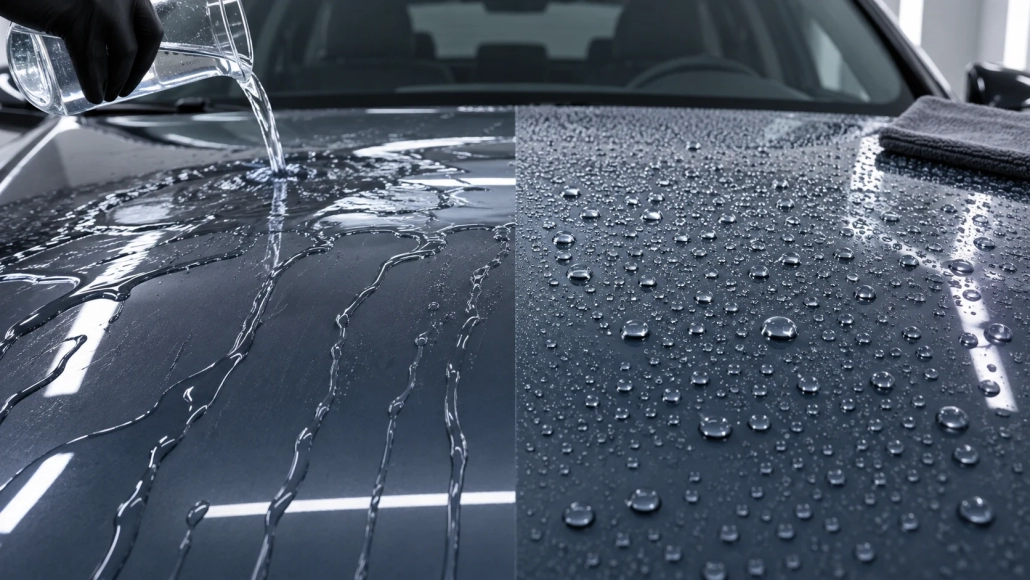
Compare water behaviour on coated surfaces under consistent cleaning, flow and viewing conditions while recognising the test's limits.
Align coating inspectors using representative accepted, borderline and rejected samples instead of relying on vague appearance ratings.
 Coating Inspection Disagreements: Align Two Reviewers with Anchor Samples