






A full polishing range.
From cutting and one-step correction to final finishing.
Specialist chemistry. Expert application.
 QUARTZ99 / CERAMIC BASE COAT
The foundation of your coating system.
A layerable quartz base coat designed for mechanical protection. Pair it with a suitable top coat to create the final finish.
For application by NANOLAB certified installers only.
Four formulas. Extended working time. Find the coating for your finish.
Explore the BEAST family of ceramic coatings.
Find the coating for each exterior surface.
 PPF & VINYLGLOSSProtection for glossy films and wraps.Discover
 MATTE & SATINMATTEProtection that respects the finish.Discover
 GLASSWINDOWSExplore dedicated glass protection.Discover
 WHEEL PROTECTIONWHEELSA dedicated coating for your wheels.Discover
 TRIM PROTECTIONPLASTICProtection for plastic surfaces.Discover
Dedicated care for the surfaces inside.
 LEATHER SURFACESLEATHERDiscover NANOLAB leather protection.Discover PLASTIC SURFACESPLASTICProtection for interior plastic surfaces.Discover TEXTILE SURFACESFABRICExplore the latest fabric formulation.Discover
Spray protection, maintenance and upcoming wash products.
 MAINTENANCEBEAST 365Explore the BEAST maintenance range.Discover
Next in washing, cleaning & care.
Ceramic protection for boats and yachts.
An easy-to-apply ceramic coating with an established track record on boats and yachts around the world.
Results vary with surface preparation, exposure and maintenance.
Read 50 MARINE guides →Explore MARINEProtection for the surfaces you live with.
A look at what we’re developing.
From cutting and one-step correction to final finishing.
A wider range for professional vehicle care.
Taking shape alongside BEAST & MATRIX.
Practical guidance for your next coating project.
Explore all guides →
Track the same water-spot locations before and after each cleaning stage so photographs show changes rather than changing conditions.
Updated · NANOLAB Knowledge

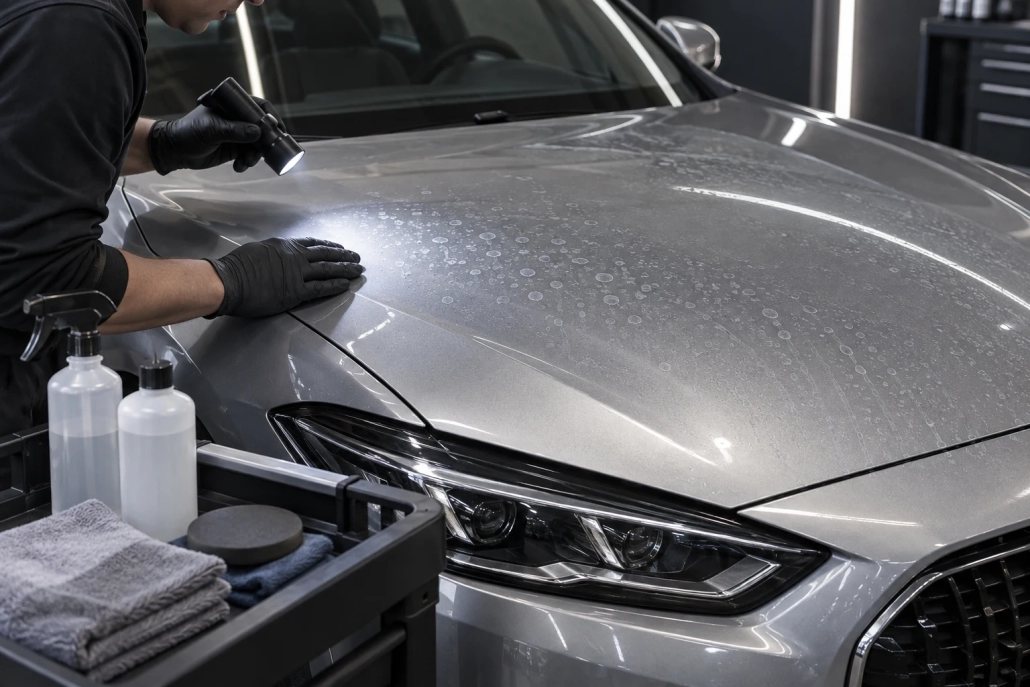
Water-spot photographs are easy to misread when the light, camera angle or surface wetness changes. A simple staged photo protocol helps show whether a treatment removed residue, changed the appearance temporarily or left a persistent mark.
Select several representative spots and one nearby reference area. Identify them on a panel map using edges or stable features. Record the surface, coating history and recent exposure. Keep the camera position, lighting and framing consistent enough to revisit each location.
| Stage | Record |
|---|---|
| Initial dry inspection | Location and visible extent |
| After routine compatible washing | Which marks remain when dry |
| After an approved targeted test | Local change and any new appearance issue |
| Final dry review | Accepted result or unresolved defect |
Label wet photographs explicitly. Water can alter reflections and make some marks less visible, so a wet “after” image should not be compared with a dry “before” image as proof of removal.
If routine washing removes most spots, the remaining locations deserve focused inspection rather than another whole-vehicle treatment. If a targeted cleaner changes residue but leaves a visible outline, do not assume the next step is a stronger concentration. The remaining feature may need a different diagnosis.
For example, three mapped spots may respond differently because their exposure histories differ. Keep each result separate. Selecting the easiest spot for the final photograph would conceal the unresolved work.
Retain originals. If cropping or exposure adjustment is necessary for communication, apply comparable treatment and disclose it. Do not use selective contrast changes to exaggerate the initial defect or hide the final one.
Finish with a short action record: process used, compatibility basis, remaining marks and next review. The photographs support that record; they do not independently establish coating failure, mineral composition or permanent damage.
Ask NANOLAB about your surface and intended use. For application and care, use the current instructions for the exact product.
Use clear checkpoints before application, after levelling and at handover to make coating work consistent and traceable.
Distinguish mineral deposits from etched damage and choose a compatible response before considering polishing or coating renewal.
Assess coating slickness as an application or handling property while testing durability and cleaning performance separately.

 Comparing Ceramic Coating Slickness Without Confusing It with Durability