






A full polishing range.
From cutting and one-step correction to final finishing.
Specialist chemistry. Expert application.
 QUARTZ99 / CERAMIC BASE COAT
The foundation of your coating system.
A layerable quartz base coat designed for mechanical protection. Pair it with a suitable top coat to create the final finish.
For application by NANOLAB certified installers only.
Four formulas. Extended working time. Find the coating for your finish.
Explore the BEAST family of ceramic coatings.
Find the coating for each exterior surface.
 PPF & VINYLGLOSSProtection for glossy films and wraps.Discover
 MATTE & SATINMATTEProtection that respects the finish.Discover
 GLASSWINDOWSExplore dedicated glass protection.Discover
 WHEEL PROTECTIONWHEELSA dedicated coating for your wheels.Discover
 TRIM PROTECTIONPLASTICProtection for plastic surfaces.Discover
Dedicated care for the surfaces inside.
 LEATHER SURFACESLEATHERDiscover NANOLAB leather protection.Discover PLASTIC SURFACESPLASTICProtection for interior plastic surfaces.Discover TEXTILE SURFACESFABRICExplore the latest fabric formulation.Discover
Spray protection, maintenance and upcoming wash products.
 MAINTENANCEBEAST 365Explore the BEAST maintenance range.Discover
Next in washing, cleaning & care.
Ceramic protection for boats and yachts.
An easy-to-apply ceramic coating with an established track record on boats and yachts around the world.
Results vary with surface preparation, exposure and maintenance.
Read 50 MARINE guides →Explore MARINEProtection for the surfaces you live with.
A look at what we’re developing.
From cutting and one-step correction to final finishing.
A wider range for professional vehicle care.
Taking shape alongside BEAST & MATRIX.
Practical guidance for your next coating project.
Explore all guides →
Plan the measurement queue so coating samples are compared at similar ages after preparation rather than at different stages of development.
Updated · NANOLAB Knowledge

A large coating comparison can take hours to measure. If all samples are prepared together but tested in a fixed product order, the last product may be substantially older at measurement than the first. The queue can become an unintended experimental factor.
Define the interval from a clear preparation event to measurement, consistent with the product-specific method. Record actual preparation and measurement times for every specimen. Do not substitute the day on the calendar for elapsed time when early behaviour is being compared.
Stagger preparation or divide specimens into smaller blocks so each product is measured within the intended age window. Balance the order within blocks where appropriate. Keep operators and instruments available before preparing more samples than the queue can handle.
If a measurement takes ten minutes and thirty panels are prepared at once, the series occupies roughly five hours before additional handling time. That is a meaningful age difference in an early-stage study. Three smaller balanced blocks may produce a more interpretable comparison.
| Time field | Use |
|---|---|
| Preparation completed | Starts the defined age clock |
| Conditioning completed | Confirms required treatment |
| Measurement started | Calculates actual age |
If equipment stops, record which samples fall outside the agreed window. Apply a pre-established rule for retesting or reporting them separately. Do not quietly extend the allowable window only for the preferred product.
A balanced queue reduces a preventable confounder. It also makes staffing and specimen preparation more realistic, because the laboratory’s measurement capacity becomes part of the plan instead of an afterthought.
Ask NANOLAB about your surface and intended use. For application and care, use the current instructions for the exact product.
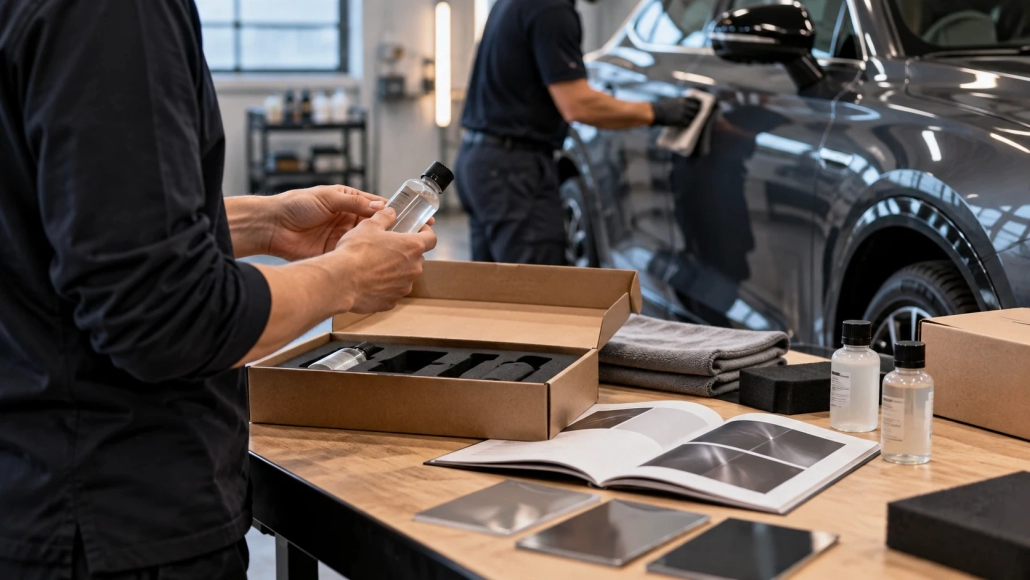
Design a coating field trial with recorded vehicles, use patterns, care routines and inspection points that produce interpretable feedback.

Different washing frequencies change the exposure history of trial vehicles. Record them instead of comparing only installation dates.
Distinguish first-contact water behaviour from repeated wetting when assessing a coating, and keep drying and cleaning between cycles documented.

 Separating a Coating’s First Wetting from Its Repeated-Wetting Behavi...