






A full polishing range.
From cutting and one-step correction to final finishing.
Specialist chemistry. Expert application.
 QUARTZ99 / CERAMIC BASE COAT
The foundation of your coating system.
A layerable quartz base coat designed for mechanical protection. Pair it with a suitable top coat to create the final finish.
For application by NANOLAB certified installers only.
Four formulas. Extended working time. Find the coating for your finish.
Explore the BEAST family of ceramic coatings.
Find the coating for each exterior surface.
 PPF & VINYLGLOSSProtection for glossy films and wraps.Discover
 MATTE & SATINMATTEProtection that respects the finish.Discover
 GLASSWINDOWSExplore dedicated glass protection.Discover
 WHEEL PROTECTIONWHEELSA dedicated coating for your wheels.Discover
 TRIM PROTECTIONPLASTICProtection for plastic surfaces.Discover
Dedicated care for the surfaces inside.
 LEATHER SURFACESLEATHERDiscover NANOLAB leather protection.Discover PLASTIC SURFACESPLASTICProtection for interior plastic surfaces.Discover TEXTILE SURFACESFABRICExplore the latest fabric formulation.Discover
Spray protection, maintenance and upcoming wash products.
 MAINTENANCEBEAST 365Explore the BEAST maintenance range.Discover
Next in washing, cleaning & care.
Ceramic protection for boats and yachts.
An easy-to-apply ceramic coating with an established track record on boats and yachts around the world.
Results vary with surface preparation, exposure and maintenance.
Read 50 MARINE guides →Explore MARINEProtection for the surfaces you live with.
A look at what we’re developing.
From cutting and one-step correction to final finishing.
A wider range for professional vehicle care.
Taking shape alongside BEAST & MATRIX.
Practical guidance for your next coating project.
Explore all guides →
Converting a temperature and converting a temperature change require different formulas. Keep the distinction clear when comparing product instructions or laboratory exposure records.
Updated · NANOLAB Knowledge
For an absolute value, Fahrenheit equals Celsius multiplied by 1.8, plus 32. For a temperature difference, multiply the Celsius difference by 1.8 without adding 32.
Arithmetic example: 20 degrees Celsius equals 68 degrees Fahrenheit. A rise of ten degrees Celsius equals a rise of eighteen degrees Fahrenheit, not fifty degrees Fahrenheit.
These calculations do not establish an application or storage range. Follow the exact product's current limits, and ask the supplier to resolve inconsistent instructions instead of choosing the more convenient interpretation.
Ask NANOLAB about the exact product and intended use. Use the current product documentation for formulation-specific instructions.
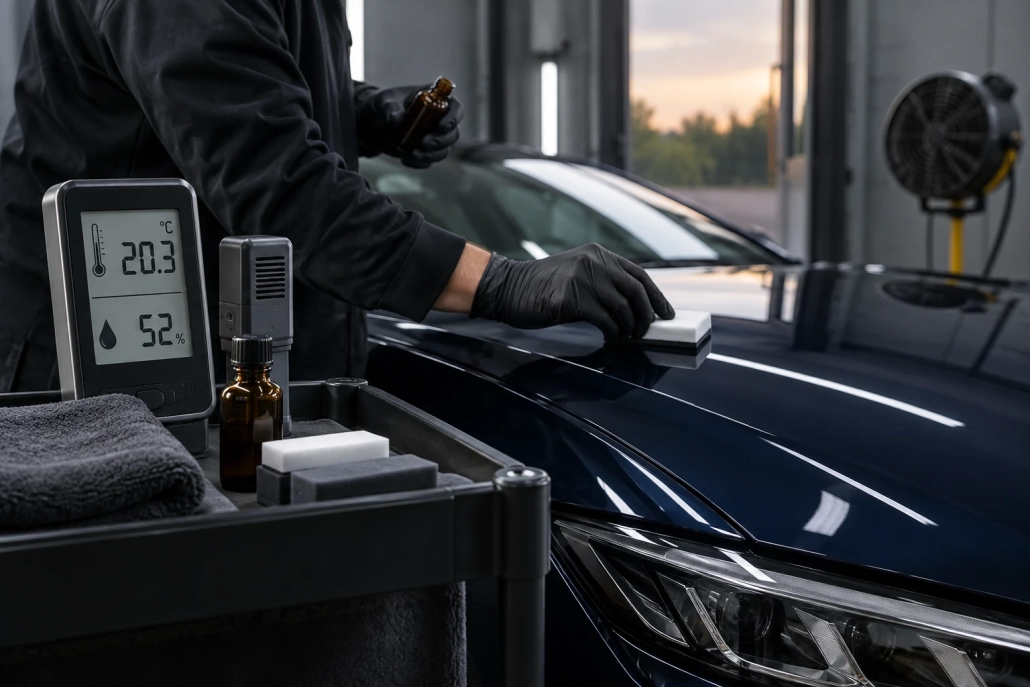
Understand where and how to check vehicle panel temperature before coating, including limitations of infrared readings on shiny finishes.
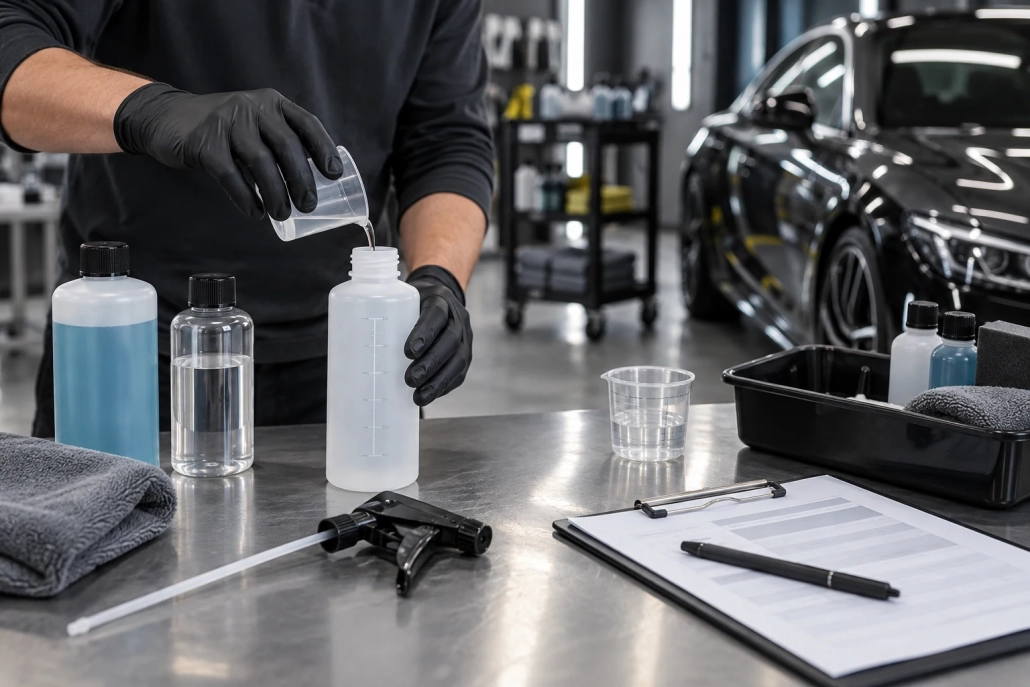
Read dilution ratios precisely, measure a repeatable working solution and avoid confusing product-to-water ratios with final-volume instructions.

A pressure value must retain its unit and measurement context. One bar is approximately 14.504 psi, but a correct conversion does not make two different test arrangements equivalent.