






A full polishing range.
From cutting and one-step correction to final finishing.
Specialist chemistry. Expert application.
 QUARTZ99 / CERAMIC BASE COAT
The foundation of your coating system.
A layerable quartz base coat designed for mechanical protection. Pair it with a suitable top coat to create the final finish.
For application by NANOLAB certified installers only.
Four formulas. Extended working time. Find the coating for your finish.
Explore the BEAST family of ceramic coatings.
Find the coating for each exterior surface.
 PPF & VINYLGLOSSProtection for glossy films and wraps.Discover
 MATTE & SATINMATTEProtection that respects the finish.Discover
 GLASSWINDOWSExplore dedicated glass protection.Discover
 WHEEL PROTECTIONWHEELSA dedicated coating for your wheels.Discover
 TRIM PROTECTIONPLASTICProtection for plastic surfaces.Discover
Dedicated care for the surfaces inside.
 LEATHER SURFACESLEATHERDiscover NANOLAB leather protection.Discover PLASTIC SURFACESPLASTICProtection for interior plastic surfaces.Discover TEXTILE SURFACESFABRICExplore the latest fabric formulation.Discover
Spray protection, maintenance and upcoming wash products.
 MAINTENANCEBEAST 365Explore the BEAST maintenance range.Discover
Next in washing, cleaning & care.
Ceramic protection for boats and yachts.
An easy-to-apply ceramic coating with an established track record on boats and yachts around the world.
Results vary with surface preparation, exposure and maintenance.
Read 50 MARINE guides →Explore MARINEProtection for the surfaces you live with.
A look at what we’re developing.
From cutting and one-step correction to final finishing.
A wider range for professional vehicle care.
Taking shape alongside BEAST & MATRIX.
Practical guidance for your next coating project.
Explore all guides →
A before-and-after cleaning comparison needs a location plan that accounts for any effect of the first measurement. Measuring nearby but unrecorded spots can confuse local variation with the cleaning response.
Updated · NANOLAB Knowledge
Ask the laboratory how to pair observations without compromising the specimen. The plan may use matched regions or another justified arrangement. Preserve the map and cleaning sequence so the result can be interpreted correctly.
Illustrative example: the before result comes from a panel edge while the after result comes from its centre. A difference may reflect location rather than cleaning. A mapped design makes that limitation visible.
Do not assume every measurement is nondisturbing. Follow the method's specimen requirements and avoid claiming a cleaning effect that the sampling arrangement cannot distinguish.
Ask NANOLAB about the exact product and intended use. Use the current product documentation for formulation-specific instructions.
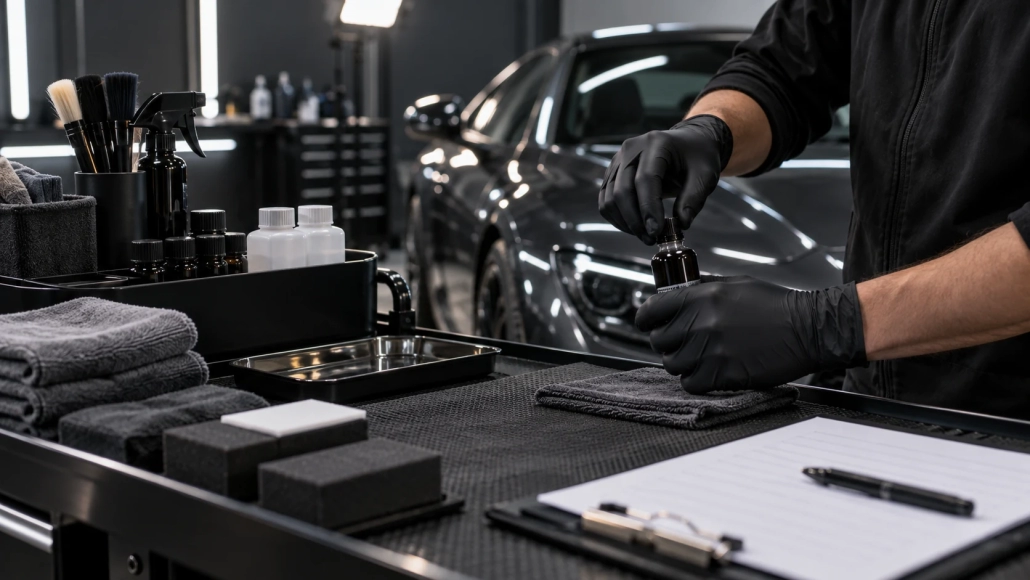
Check shelter, surface conditions, cleanliness, lighting and protected curing before accepting a mobile coating location.

Compare cleaning effort with a defined cleanliness endpoint, consistent tools and separate timing for each maintenance stage.

Cleaning a weathered specimen before measurement can change what the evaluation reveals. Define whether the assessment concerns the exposed surface as received, the surface after an approved cleaning step, or both.