






A full polishing range.
From cutting and one-step correction to final finishing.
Specialist chemistry. Expert application.
 QUARTZ99 / CERAMIC BASE COAT
The foundation of your coating system.
A layerable quartz base coat designed for mechanical protection. Pair it with a suitable top coat to create the final finish.
For application by NANOLAB certified installers only.
Four formulas. Extended working time. Find the coating for your finish.
Explore the BEAST family of ceramic coatings.
Find the coating for each exterior surface.
 PPF & VINYLGLOSSProtection for glossy films and wraps.Discover
 MATTE & SATINMATTEProtection that respects the finish.Discover
 GLASSWINDOWSExplore dedicated glass protection.Discover
 WHEEL PROTECTIONWHEELSA dedicated coating for your wheels.Discover
 TRIM PROTECTIONPLASTICProtection for plastic surfaces.Discover
Dedicated care for the surfaces inside.
 LEATHER SURFACESLEATHERDiscover NANOLAB leather protection.Discover PLASTIC SURFACESPLASTICProtection for interior plastic surfaces.Discover TEXTILE SURFACESFABRICExplore the latest fabric formulation.Discover
Spray protection, maintenance and upcoming wash products.
 MAINTENANCEBEAST 365Explore the BEAST maintenance range.Discover
Next in washing, cleaning & care.
Ceramic protection for boats and yachts.
An easy-to-apply ceramic coating with an established track record on boats and yachts around the world.
Results vary with surface preparation, exposure and maintenance.
Read 50 MARINE guides →Explore MARINEProtection for the surfaces you live with.
A look at what we’re developing.
From cutting and one-step correction to final finishing.
A wider range for professional vehicle care.
Taking shape alongside BEAST & MATRIX.
Practical guidance for your next coating project.
Explore all guides →
A demonstration video should show enough of the sequence for viewers to understand what happened. Editing out preparation, waiting or maintenance steps can make a genuine observation support a claim that the demonstration did not establish.
Updated · NANOLAB Knowledge
Plan the result and its context before filming. The audience needs to know the surface, product system and relevant interventions, even when the final video is short. A continuous reference recording can support technical review while an edited version explains the observation clearly without hiding steps that affect interpretation.
Illustrative example: a surface is cleaned between two filmed water demonstrations, but the published clip removes that step. Viewers may interpret restored behaviour as uninterrupted durability. Showing or explicitly describing the cleaning step preserves the useful observation without overstating what the sequence proves.
A video is not a substitute for a suitable test method. Do not turn one successful demonstration into a universal claim about every substrate, chemical or service life. Keep the caption and narration within the scope of the actual recorded conditions.
Discuss bulk supply and private-label requirements with NANOLAB. Use the current product documentation for formulation-specific instructions.

Plan a ceramic coating demonstration that answers buyer questions about product selection, application and support, with a useful follow-up record.
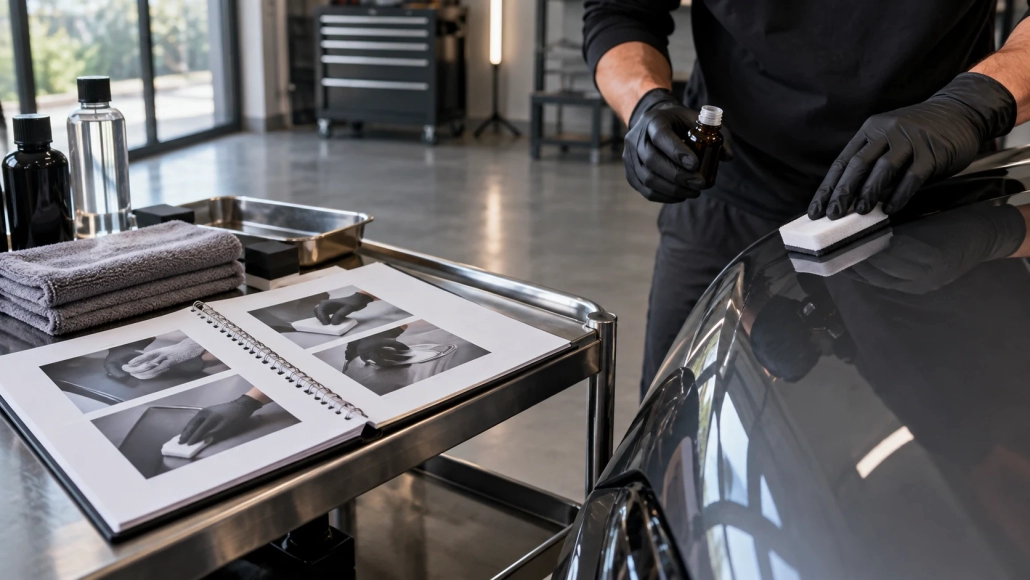
Plan short private label coating training videos around specific user decisions, approved instructions and version control instead of one long promotional demonstration.
A product or batch code is an identifier, not necessarily a number for calculation. Preserve leading zeros and exact characters when importing coating records into a spreadsheet.