






A full polishing range.
From cutting and one-step correction to final finishing.
Specialist chemistry. Expert application.
 QUARTZ99 / CERAMIC BASE COAT
The foundation of your coating system.
A layerable quartz base coat designed for mechanical protection. Pair it with a suitable top coat to create the final finish.
For application by NANOLAB certified installers only.
Four formulas. Extended working time. Find the coating for your finish.
Explore the BEAST family of ceramic coatings.
Find the coating for each exterior surface.
 PPF & VINYLGLOSSProtection for glossy films and wraps.Discover
 MATTE & SATINMATTEProtection that respects the finish.Discover
 GLASSWINDOWSExplore dedicated glass protection.Discover
 WHEEL PROTECTIONWHEELSA dedicated coating for your wheels.Discover
 TRIM PROTECTIONPLASTICProtection for plastic surfaces.Discover
Dedicated care for the surfaces inside.
 LEATHER SURFACESLEATHERDiscover NANOLAB leather protection.Discover PLASTIC SURFACESPLASTICProtection for interior plastic surfaces.Discover TEXTILE SURFACESFABRICExplore the latest fabric formulation.Discover
Spray protection, maintenance and upcoming wash products.
 MAINTENANCEBEAST 365Explore the BEAST maintenance range.Discover
Next in washing, cleaning & care.
Ceramic protection for boats and yachts.
An easy-to-apply ceramic coating with an established track record on boats and yachts around the world.
Results vary with surface preparation, exposure and maintenance.
Read 50 MARINE guides →Explore MARINEProtection for the surfaces you live with.
A look at what we’re developing.
From cutting and one-step correction to final finishing.
A wider range for professional vehicle care.
Taking shape alongside BEAST & MATRIX.
Practical guidance for your next coating project.
Explore all guides →
A consumption comparison should include material used in unsuccessful or repeated attempts, not only the final successful pass. Define the accepted cleaning result before calculating how efficiently a product or process achieved it.
Updated · NANOLAB Knowledge
A low volume per application can look attractive while hiding extra passes, rework or incomplete cleaning. Record the full sequence needed to meet the agreed endpoint. Keep product consumption separate from labour and water use so that each quantity remains understandable and the final comparison does not conceal a trade-off.
Arithmetic example: one process uses 20 millilitres once, while another uses 12 millilitres twice to reach the same accepted endpoint. Comparing 20 with 12 would omit the second application's consumption. The useful material comparison is 20 with 24, with the other process differences shown separately.
This calculation does not establish surface compatibility or permission to repeat a cleaner. Use only approved methods and preserve failed outcomes in the record. A purchasing decision should consider the complete result rather than selecting the smallest isolated application quantity.
Ask NANOLAB about the exact product and intended use. Use the current product documentation for formulation-specific instructions.

Time savings and chemical savings are separate outcomes. A quicker clean may still use more product.
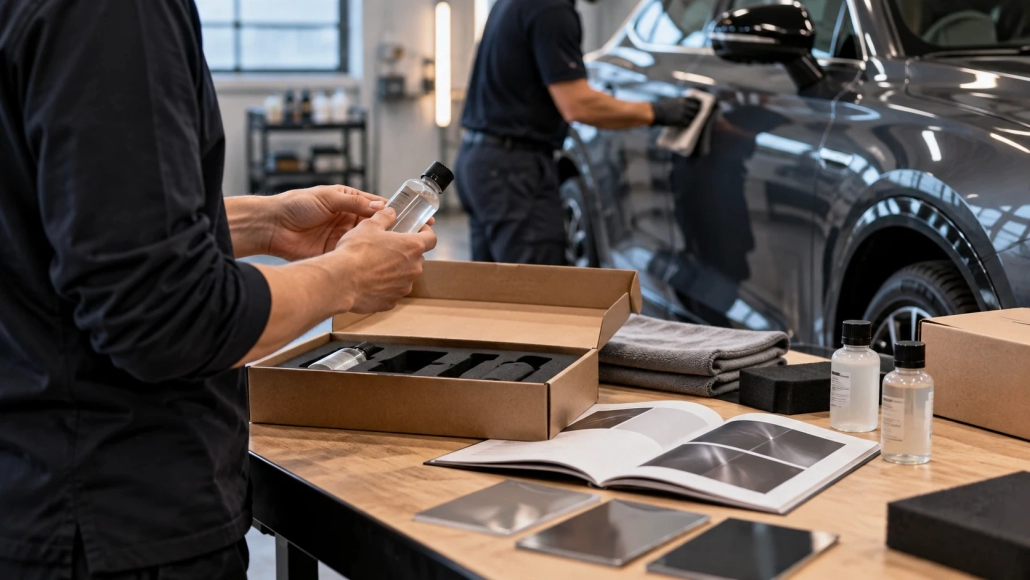
Track towels, applicators and preparation products by job so a detailing team can plan stock without sacrificing clean working practices.
Combining groups with different difficulty can reverse an apparent coating comparison. Review relevant group composition before treating an overall acceptance rate as a product effect.