






A full polishing range.
From cutting and one-step correction to final finishing.
Specialist chemistry. Expert application.
 QUARTZ99 / CERAMIC BASE COAT
The foundation of your coating system.
A layerable quartz base coat designed for mechanical protection. Pair it with a suitable top coat to create the final finish.
For application by NANOLAB certified installers only.
Four formulas. Extended working time. Find the coating for your finish.
Explore the BEAST family of ceramic coatings.
Find the coating for each exterior surface.
 PPF & VINYLGLOSSProtection for glossy films and wraps.Discover
 MATTE & SATINMATTEProtection that respects the finish.Discover
 GLASSWINDOWSExplore dedicated glass protection.Discover
 WHEEL PROTECTIONWHEELSA dedicated coating for your wheels.Discover
 TRIM PROTECTIONPLASTICProtection for plastic surfaces.Discover
Dedicated care for the surfaces inside.
 LEATHER SURFACESLEATHERDiscover NANOLAB leather protection.Discover PLASTIC SURFACESPLASTICProtection for interior plastic surfaces.Discover TEXTILE SURFACESFABRICExplore the latest fabric formulation.Discover
Spray protection, maintenance and upcoming wash products.
 MAINTENANCEBEAST 365Explore the BEAST maintenance range.Discover
Next in washing, cleaning & care.
Ceramic protection for boats and yachts.
An easy-to-apply ceramic coating with an established track record on boats and yachts around the world.
Results vary with surface preparation, exposure and maintenance.
Read 50 MARINE guides →Explore MARINEProtection for the surfaces you live with.
A look at what we’re developing.
From cutting and one-step correction to final finishing.
A wider range for professional vehicle care.
Taking shape alongside BEAST & MATRIX.
Practical guidance for your next coating project.
Explore all guides →
Verify temperatures, volumes and timing when translating ceramic coating instructions for another market.
Updated · NANOLAB Knowledge

Translated coating instructions need a technical check as well as fluent language. A unit conversion, decimal separator or timing phrase can change how the product is used. The review should preserve the original requirements without inventing convenient local alternatives.
List temperatures, volumes, dimensions, dilution expressions and waiting periods. Record the source value and its meaning before conversion. A working window, release time and full-curing period should remain separate instructions even when they all involve hours or minutes.
Check whether the destination market expects different units, then use a verified conversion process. Avoid rounding a boundary in a direction that broadens the permitted application range. Where a rounded value is necessary, have it approved by the technical owner.
Numbers are not the only risk. ‘At least’, ‘within’, ‘before’ and ‘after’ determine how a quantity is applied. A correct converted number in a reversed instruction still produces the wrong process.
Have a technically informed reviewer compare the complete translated sequence with the approved source. Use a practical read-through with an installer to identify ambiguity, while keeping that exercise distinct from authorising new product conditions.
Store the original, translation, reviewer and approval date together. Update labels, downloadable sheets and training material when a value changes. Retain old versions for support enquiries about earlier packaging.
Coordinate product-specific wording through NANOLAB Private Label and OEM. A disciplined unit review gives the international user the same technical instruction in a usable local format, rather than a subtly different product process.
Keep translated coating instructions aligned with the approved product, sequence and safety information before distributing them to a new market.
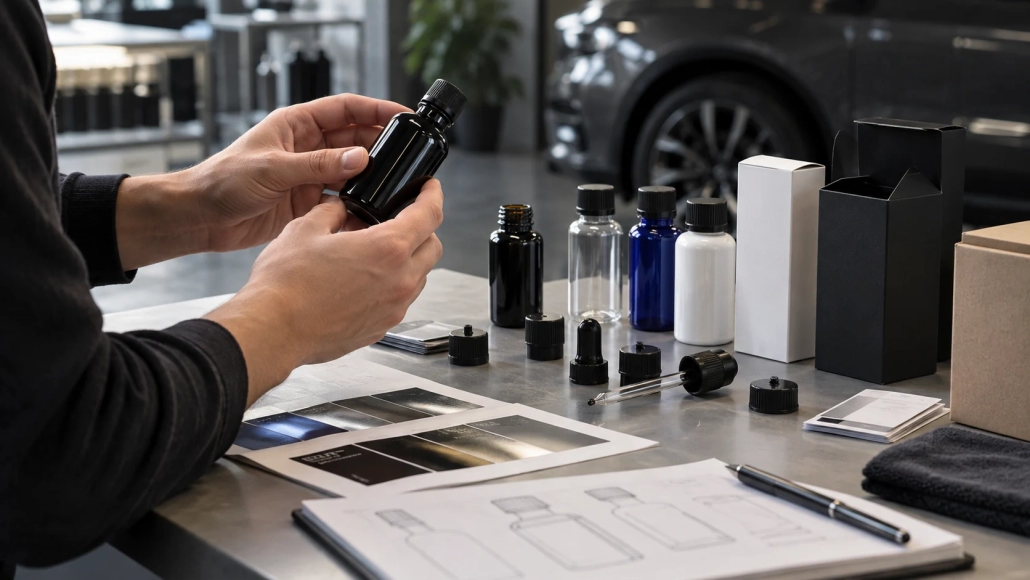
Review dispensing, labelling and handling when a private label coating moves to a new bottle or closure.

Review genuine product use, available stock and unusual adjustments before placing the next coating supply order.

 Ceramic Coating Packaging Changes: Recheck the User Experience