






A full polishing range.
From cutting and one-step correction to final finishing.
Specialist chemistry. Expert application.
 QUARTZ99 / CERAMIC BASE COAT
The foundation of your coating system.
A layerable quartz base coat designed for mechanical protection. Pair it with a suitable top coat to create the final finish.
For application by NANOLAB certified installers only.
Four formulas. Extended working time. Find the coating for your finish.
Explore the BEAST family of ceramic coatings.
Find the coating for each exterior surface.
 PPF & VINYLGLOSSProtection for glossy films and wraps.Discover
 MATTE & SATINMATTEProtection that respects the finish.Discover
 GLASSWINDOWSExplore dedicated glass protection.Discover
 WHEEL PROTECTIONWHEELSA dedicated coating for your wheels.Discover
 TRIM PROTECTIONPLASTICProtection for plastic surfaces.Discover
Dedicated care for the surfaces inside.
 LEATHER SURFACESLEATHERDiscover NANOLAB leather protection.Discover PLASTIC SURFACESPLASTICProtection for interior plastic surfaces.Discover TEXTILE SURFACESFABRICExplore the latest fabric formulation.Discover
Spray protection, maintenance and upcoming wash products.
 MAINTENANCEBEAST 365Explore the BEAST maintenance range.Discover
Next in washing, cleaning & care.
Ceramic protection for boats and yachts.
An easy-to-apply ceramic coating with an established track record on boats and yachts around the world.
Results vary with surface preparation, exposure and maintenance.
Read 50 MARINE guides →Explore MARINEProtection for the surfaces you live with.
A look at what we’re developing.
From cutting and one-step correction to final finishing.
A wider range for professional vehicle care.
Taking shape alongside BEAST & MATRIX.
Practical guidance for your next coating project.
Explore all guides →
Separate above-waterline appearance and cleaning goals from submerged fouling control when specifying a marine coating system.
Updated · NANOLAB Knowledge
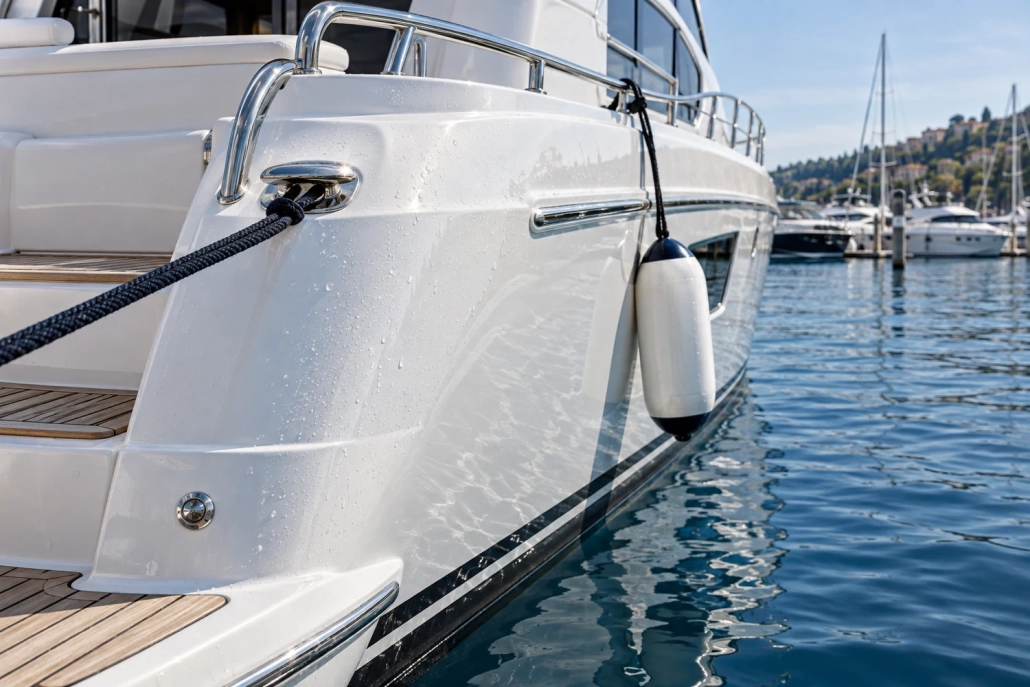
An easy-clean treatment on above-waterline gelcoat and an antifouling system on an immersed hull serve different purposes. Similar words such as “marine protection” do not establish that one product can replace the other.
Specify substrate, position relative to the waterline and expected immersion. Include whether the boat is briefly launched, continuously moored or used in another pattern. These details belong in the enquiry before a product is selected.
| Question | Evidence needed |
|---|---|
| Will routine deposits be easier to remove? | Relevant cleanability trial |
| Will the appearance remain acceptable? | Defined appearance assessment and exposure |
| Will submerged fouling be controlled? | Evidence and approval for that specific antifouling use |
A water-beading demonstration does not answer the third question.
Marine paint manufacturers distinguish product families and application zones in their guidance. Confirm compatibility with the existing substrate and paint, required preparation and any immersion limitations in the exact product documentation. Do not extend a general exterior coating claim to a below-waterline application.
A proposal might cover above-waterline gelcoat cleaning and coating while excluding underwater hull treatment. Name that boundary on the vessel diagram and quotation. If the owner also needs fouling control, obtain a separate, suitable specification. Clear scope prevents a successful cosmetic or cleaning trial from being presented as proof of an unrelated underwater function, and it gives the owner a realistic maintenance plan for each part of the boat.
The sources below support the stated concepts or describe their own methods. The worked scenarios are editorial examples, not NANOLAB test results.
Ask NANOLAB about your surface and intended use. For application and care, use the current instructions for the exact product.
A pre-coating inspection prevents attractive results in one area from hiding unresolved problems elsewhere.
The term “boat protection” covers several different systems.
Record cover contact, trapped moisture and movement when investigating local changes on coated boats kept under covers.
 Boat Covers and Trapped Moisture: Evaluate Contact Conditions before Blaming...